

Egypt Daily News – U.S. President Donald Trump’s arrival in the Netherlands on Tuesday for a two-day NATO summit in The Hague was accompanied by renewed uncertainty over Washington’s commitment to the alliance’s cornerstone principle of collective defense. As NATO allies gathered to affirm increased defense spending, one of Trump’s long-standing demands, the president once again raised doubts about the U.S. obligation to defend fellow member states under Article 5 of the NATO treaty.
Speaking to reporters en route to the summit, Trump suggested that Article 5, which commits members to mutual defense in the event of an attack, was open to “multiple interpretations.” His comments unsettled European allies seeking to present a unified front to Russian President Vladimir Putin, amid heightened tensions and a drive to deter any potential aggression from Moscow.
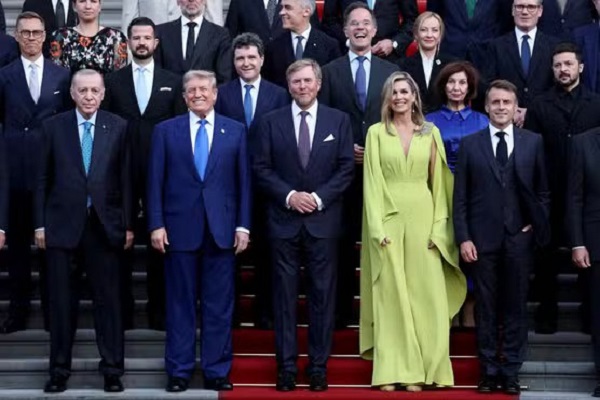
Upon landing at Amsterdam’s Schiphol Airport aboard Air Force One, Trump proceeded to The Hague, where the summit’s agenda centered on strengthening deterrence and unity. That evening, he attended a formal dinner at the royal palace hosted by King Willem-Alexander. On Wednesday, Trump was scheduled to participate in the summit’s only working session, which was notably shortened to under three hours.
Despite Trump’s mixed messaging, the 32 NATO member states reached a significant agreement to boost defense and security spending. In the final communiqué, members pledged to dedicate at least 5% of their GDP to security by 2035, 3.5% of which will go toward military expenditure, and 1.5% toward general security, including cybersecurity and the protection of critical infrastructure.
European diplomats noted that the 5% figure symbolically links two critical objectives: meeting Trump’s demands for increased burden-sharing and securing a renewed U.S. commitment to Article 5. “Five is the magic number,” said one European official in Brussels, highlighting the balance between financial contribution and mutual defense assurances.
Trump had previously threatened not to defend NATO members he labeled as “delinquent” in their defense spending. His pressure has visibly influenced the summit’s outcomes. European leaders now hope that meeting the U.S. demand for greater spending will result in a firmer American security guarantee.
NATO Secretary General Mark Rutte attempted to ease concerns over Trump’s wavering stance. “The President of the United States and senior American officials are fully committed to NATO,” Rutte said on Tuesday, urging allies to focus less on rhetoric and more on real investments. “Enough worrying,” he added. “The real issue is that we, as Europeans and Canadians, simply don’t spend enough.”
European Commission President Ursula von der Leyen echoed that sentiment, declaring that “Europe’s defense sector has finally woken up,” and praised the “historic new spending goals.”
While the 3.5% military spending target may appear modest, it represents hundreds of billions of euros—an ambitious leap for many countries that still struggle to meet NATO’s earlier benchmark of 2% GDP defense spending, agreed upon at the 2014 summit.
As the summit wrapped up, NATO sought to send a clear message of deterrence to Russia and internal cohesion to its members. Yet Trump’s equivocal rhetoric has ensured that questions around American reliability remain part of the transatlantic security conversation.
