

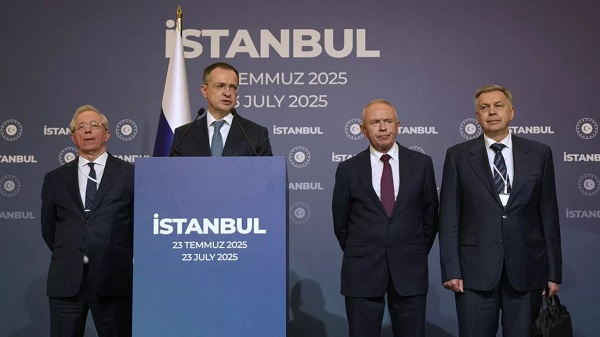
Egypt Daily News – Russia and Ukraine have agreed on a new prisoner exchange deal, including both military personnel and civilians, following the third round of direct negotiations held in Istanbul. Despite ongoing hostilities on the battlefield, the talks signaled cautious steps toward de-escalation, with both sides floating proposals for temporary ceasefires and a possible presidential summit.
The latest round of negotiations, which took place on Wednesday, July 23, was confirmed by Russian state news agency TASS, citing diplomatic sources. The centerpiece of the session was an agreement to exchange 1,200 prisoners from each side, a significant expansion from previous swaps that focused solely on military captives. This time, civilians are included as well.
Russian negotiator Vladimir Medinsky stated during a press conference that Moscow had also offered to return the remains of approximately 3,000 Ukrainian soldiers. He added that Russia proposed localized ceasefires lasting between 24 and 48 hours along the front lines, specifically to allow both sides to evacuate wounded soldiers and recover the dead.
“We have once again proposed to the Ukrainian side the idea of short-term ceasefires, 24 to 48 hours along the front to enable medical teams to operate and retrieve the bodies of fallen soldiers,” Medinsky explained.
On the Ukrainian side, chief negotiator Rustem Umerov revealed that his delegation proposed a meeting between Ukrainian President Volodymyr Zelensky and Russian President Vladimir Putin before the end of August. The possibility of such a high-level encounter would mark a significant development in the protracted war, which has seen limited diplomatic engagement between the two leaders.
Difficult Talks Amid Deep Divisions
The negotiations in Istanbul were described by both parties as challenging. The Kremlin had warned in advance that this third round would be “very difficult,” and dismissed the possibility of a swift diplomatic breakthrough.
The talks opened with a bilateral meeting between Medinsky and Umerov, followed by a formal session reportedly attended by Turkish Foreign Minister Hakan Fidan. While a Russian source claimed the meeting was purely bilateral, Ukrainian officials said it was trilateral, with Turkey playing a mediating role.
Fidan, in his opening remarks, called for an urgent end to what he termed a “bloody war” and emphasized that the ultimate goal must be a comprehensive ceasefire that could pave the way for lasting peace. He also expressed gratitude to Presidents Putin and Zelensky for showing willingness to engage in the dialogue, and acknowledged the role of U.S. President Donald Trump and other international supporters.
Fidan pointed to earlier negotiations as having produced “important results,” especially in terms of prisoner releases. He also reiterated Turkey’s readiness to provide infrastructure for a future monitoring mechanism, should a ceasefire be achieved.
Continued Fighting on the Ground
Despite the diplomatic overtures, the situation on the battlefield remained volatile. On the same day as the talks, Russia’s Ministry of Defense announced the capture of the village of Varatsyne in Ukraine’s northeastern Sumy region. Ukrainian President Volodymyr Zelensky reported that overnight Russian missile and drone attacks had knocked out power to more than 220,000 people.
Kyiv and its Western allies accused Moscow of undermining the talks by clinging to maximalist demands while continuing military offensives across multiple fronts. Ukrainian officials argued that such behavior casts doubt on Russia’s commitment to a negotiated resolution.
U.S. Pressure and the Clock Ticking
The latest talks came in the wake of renewed pressure from Washington. U.S. President Donald Trump, who has re-engaged with the conflict diplomatically, reportedly gave Moscow a 50-day deadline to reach an agreement with Kyiv or face harsher economic sanctions. The ultimatum has added urgency to the negotiations, as both sides weigh the political and strategic costs of prolonged warfare.
While the road to peace remains uncertain, the developments in Istanbul reflect a rare moment of tangible progress in an otherwise entrenched and bloody conflict. Whether this momentum can lead to broader agreements or even a direct presidential meeting will depend on the political will of both nations and the influence of international actors invested in ending the war.
