

Ahmed Kamel – Egypt Daily News
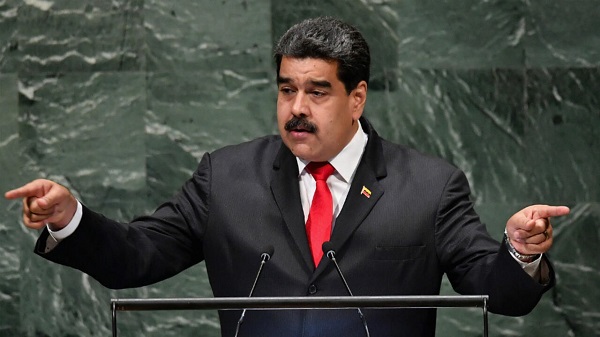
In a dramatic escalation of its pressure campaign against Nicolás Maduro, the United States has doubled the reward for information leading to the Venezuelan president’s arrest, raising it to an unprecedented $50 million. The announcement, made Thursday by U.S. Special Prosecutor Pam Bondi, accuses Maduro of deep involvement in drug trafficking and cooperation with notorious criminal organizations claims swiftly rejected by Caracas as baseless and politically motivated.
Speaking in a video published on X, Bondi alleged that Maduro is one of the world’s most prolific drug traffickers and a national security threat to the United States. She directly linked him to the Tren de Aragua gang, a Venezuelan criminal syndicate, and Mexico’s infamous Sinaloa cartel. According to Bondi, U.S. authorities have already seized over $700 million in assets allegedly connected to Maduro, including two private jets, and tied the Venezuelan leader to the trafficking of seven million tons of cocaine.
“This man is not just a corrupt politician,” Bondi said. “He is a kingpin who has used state power to protect and expand a vast narco-empire.”
Caracas Responds: “Absurd Political Stunt”
Venezuela’s Foreign Minister Yván Gil responded with scathing criticism, describing the announcement as “one of the most absurd fabrications ever made.”
“While we expose terrorist conspiracies that originate in the U.S., this woman stages a media circus to appease Venezuela’s defeated far-right,” Gil said in a Telegram post. “The dignity of our nation is not for sale. We categorically reject this brazen political propaganda campaign.”
The $50 million bounty marks a sharp increase from the initial $15 million reward offered by Washington in 2020, when the U.S. Justice Department formally indicted Maduro on drug trafficking charges. That figure was raised to $25 million earlier in 2025, shortly after Maduro was sworn in for a controversial third term an event widely condemned by Western nations and much of Latin America as fraudulent.
Criminal Ties Alleged by U.S.
The U.S. government claims Maduro is closely tied to several violent criminal organizations. Tren de Aragua formed in the early 2000s in a prison in Aragua state has evolved into a powerful transnational syndicate involved in extortion, kidnapping, and trafficking. Its leader, known as Niño Guerrero, has famously operated the gang from inside prison walls, reportedly transforming his facility into a bizarre criminal fiefdom, complete with luxury amenities including a zoo and a nightclub.
The Sinaloa cartel, another group cited in the allegations, is one of the world’s largest and most dangerous drug trafficking organizations, operating from the northern Mexican state of Sinaloa. The group has been a long-time target of U.S. anti-narcotics efforts.
In February, the U.S. State Department formally designated Tren de Aragua as a Foreign Terrorist Organization, alongside groups like MS-13 and several Mexican cartels. Just last month, the administration also labeled the “Cartel of the Suns” a Venezuela-based trafficking network allegedly led by senior military officers—as a global terrorist organization.
In a statement released Thursday night, U.S. Secretary of State Marco Rubio claimed that Maduro has led the Cartel of the Suns for over a decade, overseeing shipments of narcotics into the U.S. and collaborating with other foreign criminal entities.
A President Under Siege — But Still in Power
Despite mounting pressure and international isolation, Maduro remains entrenched in power. His controversial reelection in 2024 was denounced as illegitimate by the U.S., the EU, and several Latin American governments, many of which recognized opposition leader Juan Guaidó or others as Venezuela’s rightful head of state.
Maduro has managed to defy numerous attempts to undermine his rule, including economic sanctions, diplomatic isolation, and domestic unrest. A recent prisoner exchange between the U.S. and Venezuela resulted in the release of ten American detainees held in Caracas in exchange for the return of several deported migrants from El Salvador a move that drew criticism but highlighted ongoing backchannel negotiations between the two countries.
Shortly after the swap, the Biden administration adjusted its policy, permitting U.S. oil giant Chevron to resume operations in Venezuela. The decision signaled a partial thaw in economic relations after years of sanctions that had crippled the South American country’s oil-dependent economy.
A Battle Far from Over
The latest reward announcement underscores Washington’s ongoing efforts to hold Maduro accountable on criminal charges, even as geopolitical and economic realities complicate its strategy.
Whether the $50 million offer will yield any actionable intelligence remains to be seen. But what is certain is that tensions between Caracas and Washington have entered a new, more confrontational phase—one marked not only by legal maneuvering and asset seizures, but by a growing war of narratives.
As Venezuela braces for further economic and political volatility, the path ahead appears increasingly unpredictable, with both sides digging in deeper and the country’s long-standing crisis showing few signs of resolution.
