

Ahmed Kamel – Egypt Daily News
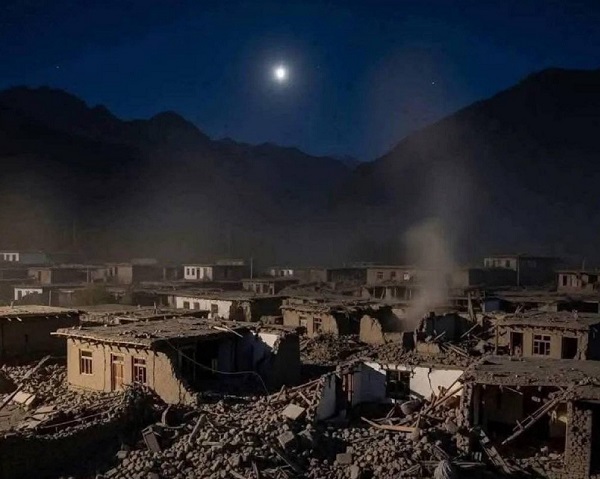
A powerful earthquake measuring 6.0 on the Richter scale struck eastern Afghanistan just after midnight on Monday, leaving a trail of destruction across several provinces and killing at least 800 people, according to preliminary figures released by the Taliban-led government. More than 2,800 others were reported injured, and the death toll is expected to rise as rescue efforts continue in remote areas.
The United States Geological Survey (USGS) reported that the quake’s epicenter was located approximately 27 kilometers northeast of Jalalabad, near the Afghan-Pakistani border. The tremor struck at a shallow depth of about 8 kilometers, amplifying its destructive impact in the densely populated mountainous region.
The Afghan Interior Ministry confirmed the casualty figures, adding that rescue operations were ongoing, with many rural communities still inaccessible due to damaged roads and communication infrastructure. Health authorities in Kabul said they were still working to confirm the final number of victims, particularly in isolated areas where information has been slow to emerge.
According to the state-run Bakhtar News Agency, the earthquake impacted several eastern provinces, including Kunar, Nangarhar, and Laghman. In Kunar province alone, at least 250 people lost their lives and over 500 were injured. Three villages in the province were reportedly flattened, and many others sustained severe structural damage.
In neighboring Pakistan, authorities in Khyber Pakhtunkhwa province reported damage along the shared border, particularly in areas where traditional mud-brick homes were unable to withstand the shock. Search and rescue teams were deployed in border regions in both countries, with emergency crews working around the clock to uncover survivors from beneath the rubble.
“This is a humanitarian catastrophe,” said an official with Afghanistan’s disaster management authority, speaking on condition of anonymity. “We are in desperate need of support, especially medical supplies, heavy machinery for debris removal, and shelter for the thousands who have lost their homes.”
Despite the scale of the disaster, the Taliban government confirmed that, as of Monday evening, no foreign governments had reached out to offer aid or assistance. A spokesperson for the Afghan Ministry of Foreign Affairs stated, “So far, we have not received any formal offers of help from international partners. We are relying on local resources, but the situation is dire.”
The lack of international engagement comes amid ongoing political isolation of the Taliban regime, which has struggled to gain global recognition since reclaiming power in 2021. Aid organizations operating in the country have also expressed concerns about access and coordination under the current administration.
Meanwhile, local communities have begun organizing grassroots relief efforts, with volunteers distributing food, water, and blankets to displaced families. Makeshift clinics have been set up in mosques and schools, where the injured are being treated in overcrowded and under-equipped conditions.
The latest earthquake is a grim reminder of Afghanistan’s vulnerability to natural disasters. The country’s mountainous terrain, coupled with poorly constructed housing and limited emergency response infrastructure, often results in high casualties during seismic events.
Experts warn that aftershocks could follow in the coming days, potentially compounding the devastation. Authorities have urged residents to remain vigilant and to avoid returning to damaged buildings.
As the nation reels from one of the deadliest earthquakes in recent years, the need for urgent humanitarian intervention has never been more critical. Without swift support, both local and international, the tragedy could deepen into a prolonged crisis for thousands of Afghan families.
