

Ahmed Kamel – Egypt Daily News
In a significant hardening of its immigration policy, the Greek Parliament has passed a new migration law that introduces forced deportations, criminalizes illegal residency, and imposes steep fines and prison sentences on undocumented migrants. The legislation, approved on Wednesday, September 3, 2025, has drawn strong criticism from human rights organizations and the UN refugee agency, as it tightens already strict policies under the conservative government of Prime Minister Kyriakos Mitsotakis.
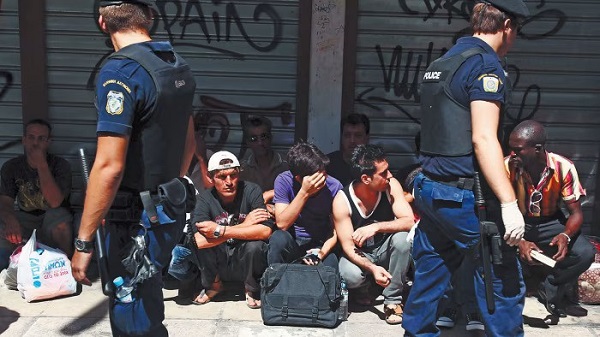
The new law mandates the compulsory return of asylum seekers whose applications have been rejected, and sets out harsh penalties for migrants entering Greece irregularly. Under the legislation, migrants from so-called “safe third countries” as designated by the European Union who are not officially registered and have no legal right to asylum, will either be deported or face detention for a minimum of 24 months. Offenders may also be subjected to fines of up to 10,000 euros.
Despite warnings from the UNHCR and rights groups about the law’s implications for international protection norms, the bill was passed with the support of the ruling New Democracy party, the far-right nationalist NIKI party, and several independent MPs from the far-right spectrum. A heated debate in Parliament preceded the vote, reflecting deep divisions over Greece’s approach to migration.
Criminalizing Illegal Residency
Greek Minister of Migration Thanos Plevris, a vocal hardliner and former member of a far-right party, defended the law as a necessary step to safeguard national interests. “The rights of Greek citizens who want to protect their homeland outweigh those of individuals whose asylum claims have been rejected but who continue to remain in the country illegally,” he told lawmakers during the parliamentary session.
Plevris further emphasized that Greece was leading the European Union in enforcing “deterrent” measures, applauding the law’s classification of illegal stay as a criminal offense. “From now on, any undocumented migrant must understand that they will be subject to administrative detention and surveillance, and that their presence constitutes a punishable crime that may result in prison,” he declared.
The minister also highlighted Greece’s recent efforts to expedite deportations, noting that hundreds of undocumented migrants had already been removed following the government’s temporary suspension of asylum applications in July. He announced that more deportation flights are scheduled this month to countries such as Pakistan, Bangladesh, and Egypt.
A Harsh Shift from Greece’s 2015 Role
The legislation marks a stark departure from Greece’s past position as a primary entry point and humanitarian responder during the refugee crisis of 2015–2016. At that time, more than one million people fleeing war, persecution, and poverty in the Middle East and Africa crossed into Europe through Greece.
While migrant arrivals have declined in recent years, 2025 has seen a renewed uptick in crossings, particularly from Libya to the southern Greek islands of Crete and Gavdos. In response, the Greek government has imposed a temporary ban on processing asylum applications from migrants arriving from North Africa another move that has drawn criticism from international observers.
Human rights organizations argue that the new law not only erodes refugee protections but also risks punishing vulnerable individuals who may be entitled to asylum. The UNHCR warned that the legislation could penalize people in need of international protection, urging the Greek government to adopt streamlined asylum procedures that distinguish genuine refugees from others more effectively.
Accusations of Illegal Pushbacks and Rights Violations
Greece’s aggressive border policies have come under increasing scrutiny in recent years. Athens has faced repeated accusations of engaging in illegal pushbacks the practice of forcibly returning asylum seekers without due process at both its land and sea borders. The European Union’s border agency, Frontex, has confirmed that it is currently investigating 12 potential cases of human rights violations involving Greek authorities.
Despite this, the Mitsotakis administration has continued to frame its policies as necessary for national security and border integrity. It has expanded a controversial border wall along the northern frontier, enhanced coastal patrols, and increased surveillance to block irregular arrivals.
Critics say these measures reflect a broader trend of shrinking humanitarian space in Europe, with Greece now standing at the forefront of the EU’s increasingly tough stance on migration. While the government insists it is protecting Greek sovereignty, rights advocates warn that it may be undermining the very principles of international refugee law.
As Athens moves to implement the new law, its impact on vulnerable migrants and on Greece’s reputation as a democratic state upholding human rights remains to be seen.
