

Ahmed Kamel – Egypt Daily News
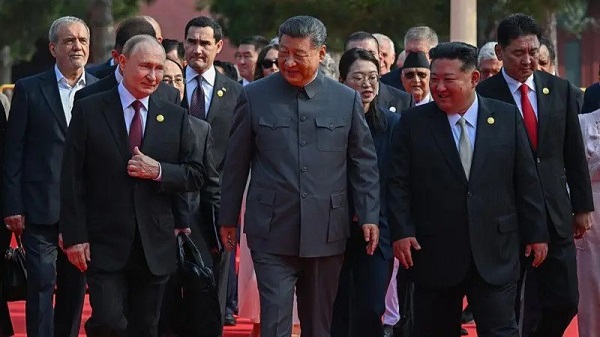
U.S. President Donald Trump has reignited criticism of the Biden administration’s foreign policy following a high-profile military parade in Beijing, hosted by Chinese President Xi Jinping and attended by Russian President Vladimir Putin and North Korean leader Kim Jong Un. Trump, in his characteristic style, took to his Truth Social platform to voice alarm over what he portrayed as a growing anti-U.S. authoritarian axis.
Sharing a photo of the three leaders walking together, Trump wrote: “It looks like we’ve lost India and Russia to deepest, darkest China. May they have a long and prosperous future together!”
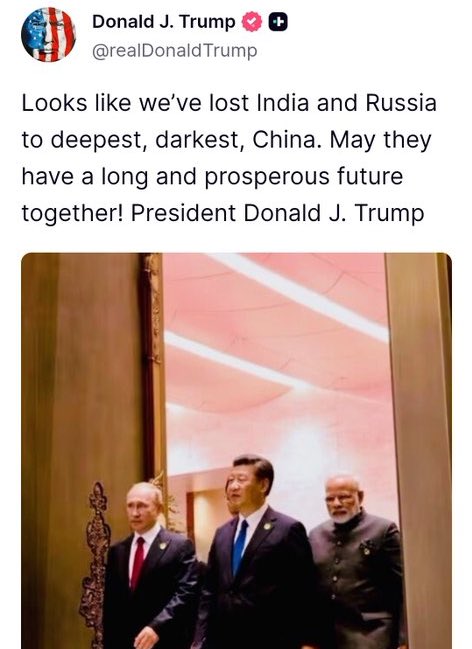
The image and comments come amid increasing global concerns about deepening ties between China, Russia, and North Korea three countries that have all come under international scrutiny for their human rights records, authoritarian governance, and geopolitical provocations. Trump’s remarks reflect mounting unease within parts of the American political establishment that Washington is losing ground to Beijing in the battle for global influence.
Although India remains a strategic partner for the United States especially within frameworks like the Quad alliance (U.S., India, Japan, Australia) New Delhi’s stance on key global issues, such as the war in Ukraine, has complicated the optics of that partnership. Prime Minister Narendra Modi participated in several events during the summit in China but notably departed before the military parade, which featured a show of military strength and political unity between Xi, Putin, and Kim.
India’s continued purchase of discounted Russian oil and its neutral stance on the Ukraine conflict have raised concerns in Washington, where officials view economic engagement with Moscow as undermining Western sanctions. However, the Biden administration has treaded carefully, reluctant to alienate India amid its broader strategy to contain Chinese influence in Asia.
According to a White House official, Trump’s comments followed a closed-door discussion among world leaders where he urged European nations to halt Russian energy imports and ramp up economic pressure on Beijing. Trump has long accused U.S. allies of not doing enough to share the burden of global security.
In a separate late-night post earlier this week, Trump reacted angrily to television footage showing Xi Jinping welcoming Putin and Kim Jong Un during the Beijing parade. The event, which displayed military hardware and nationalist fanfare, was widely viewed as a symbolic demonstration of a solidifying alliance among America’s most prominent adversaries.
Trump, known for his blunt and provocative messaging, directed a sarcastic message to Xi, writing: “Please send my warmest regards to Vladimir Putin and Kim Jong Un as you conspire against the United States of America.”
His rhetoric underscores a growing political narrative in the U.S. particularly among Republicans that the current administration is failing to contain the rise of an anti-Western bloc. Critics argue that the Biden White House has been too slow to respond to shifting global dynamics, particularly the increasingly visible alignment between Beijing and Moscow.
Analysts point out that while the symbolic optics of the Beijing summit are concerning, the depth of the alliance remains largely tactical and opportunistic. Nonetheless, the coordination among authoritarian states especially amid rising tensions over Taiwan, Ukraine, and North Korea’s missile program presents new challenges to the U.S.-led international order.
For Trump, the convergence of these global powers under the shadow of China is yet another opportunity to contrast his foreign policy legacy with that of his successor, as he mounts a return bid for the White House. Whether his dire warnings reflect geopolitical reality or political theater, they are likely to resonate in an election season where foreign policy is once again moving to the center of the debate.
