

Ahmed Kamel – Egypt Daily News
A series of powerful explosions rocked the Yemeni capital of Sana’a on Wednesday as Israeli fighter jets launched fresh airstrikes on positions controlled by the Iran-backed Houthi movement. The strikes come in direct response to the group’s recent attacks on Israeli territory, marking a dangerous escalation in the widening regional conflict.
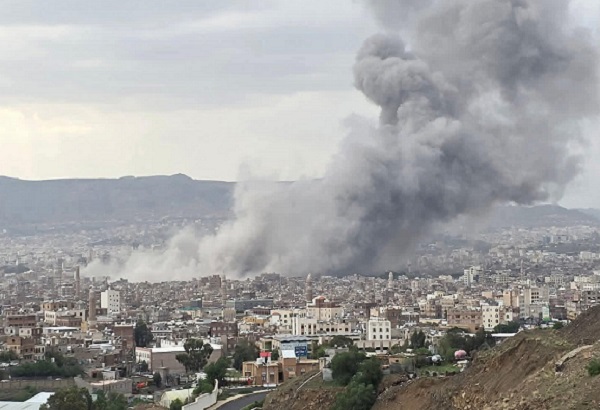
Local residents reported hearing multiple blasts across the city, with airstrikes targeting key sites including the Ministry of Defense in central Sana’a and areas to the southwest. Plumes of smoke were seen rising from various neighborhoods, including the Sixty Street area, where a medical facility reportedly sustained damage.
A Houthi military spokesperson confirmed the attacks, stating that Israeli forces launched “aerial aggression” on Yemeni territory. According to the Houthis’ Ministry of Health and affiliated media channels, the airstrikes struck multiple high-value targets, including the Defense Ministry, a government complex in Al-Hazm district in Al-Jawf province northeast of the capital, and other infrastructure believed to be linked to the group’s military operations.
In a televised statement, the Houthi military spokesperson claimed that their air defense systems responded to the assault, intercepting several incoming jets and forcing some formations to retreat before completing their missions. “Our air defenses confronted the Zionist enemy’s warplanes and prevented most of the aggression from reaching its goals,” the statement read.
Israel has not officially commented on the strikes; however, Channel 12 News in Israel reported that the operation targeted Houthi military camps, fuel storage depots, and media offices. Notably, the report said the Israeli Air Force struck two missile launch platforms, a Houthi spokesperson’s headquarters, and a training camp, marking the first time such strategic assets have been hit in Yemen by Israeli forces.
The strikes appear to be in retaliation for a recent wave of Houthi attacks on Israel. Over the past three days, the group has launched drones and missiles at strategic targets inside Israel, including Ben Gurion International Airport near Tel Aviv and Ramon Airport in the southern Negev desert. Most of the projectiles were reportedly intercepted by Israel’s Iron Dome defense system.
The latest escalation follows the assassination of the head of the Houthi government and several of his ministers in Sana’a earlier this month, an event that has led the Houthis to intensify their military campaign against Israel, according to statements from the group’s leadership.
Though the Houthis are primarily engaged in Yemen’s internal conflict, their involvement in the broader Israel-Gaza war has grown significantly over the past year. The group has positioned itself as a key member of the so-called “Axis of Resistance” aligned with Iran, alongside Hezbollah in Lebanon and various Shiite militias in Iraq and Syria.
International observers have expressed concern over the expanding geographic scope of the conflict, warning that direct military engagement between Israel and the Houthis could further destabilize the Red Sea region and disrupt global shipping routes.
As the situation develops, both Israeli and Houthi sources indicate that the confrontation is far from over, raising fears of a prolonged and potentially wider regional war involving multiple state and non-state actors.
