

Ahmed Kamel – Egypt Daily News
In an unprecedented move, the United Nations Security Council (UNSC) has issued a unanimous statement condemning an Israeli airstrike on a residential compound in Doha, the capital of Qatar. The strike, which targeted senior Hamas officials, has drawn swift backlash across the region and from unexpected corners of the international community, including the United States.
Though the statement did not explicitly name Israel, it was clearly directed at the strike carried out earlier this week, which reportedly killed five Hamas members and a Qatari security officer. The compound, located in a quiet diplomatic district of Doha, was believed to be housing members of Hamas’ political bureau, which has been based in Qatar since 2012.
The text of the statement, drafted by the United Kingdom and France, called for immediate de-escalation and expressed “solidarity with Qatar.” All 15 Security Council members, including the U.S. a historic and steadfast ally of Israel endorsed the statement, marking a significant diplomatic departure.
A Strained Alliance and a Regional Shock
The Israeli airstrike, launched without coordination with Doha or Washington, stunned officials across the Middle East and raised questions about the erosion of long-standing diplomatic norms.
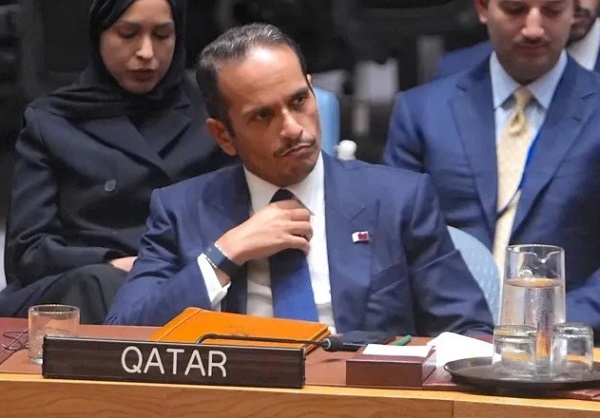
Qatar, a key intermediary in Israel-Hamas negotiations, immediately condemned the strike as a violation of its sovereignty and international law. The nation requested an emergency Security Council session alongside Algeria, Pakistan, and Somalia. Qatar’s Prime Minister, Sheikh Mohammed bin Abdulrahman Al Thani, personally traveled to New York to address the Council.
“This attack puts the international community before a test,” he told delegates. “Israel, led by blusterous extremists, has gone beyond any borders, any limitations when it comes to behavior. We are unable to predict what Israel will do. How can we host Israeli representatives when they have committed this attack?”
His remarks were echoed by Pakistan’s ambassador, Asim Iftikhar Ahmad, who accused Israel of seeking to “undermine and blow up every possibility of peace.” Algeria’s UN ambassador Amar Bendjama criticized the Council’s inability to even name the aggressor, calling it a constraint that undermines international accountability.
Israel Stands Firm
In response, Israel’s UN envoy Danny Danon doubled down on the military operation, declaring: “This strike sends a message that should echo across this chamber. There is no sanctuary for terrorists not in Gaza, not in Tehran, not in Doha.”
Danon said the targeted compound was being used to coordinate attacks against Israeli civilians and insisted Israel would “act decisively wherever threats emerge.”
A Rare Break from the U.S.
The United States’ support for the Security Council statement is especially notable. Washington has historically used its veto power to block resolutions critical of Israel. While the text avoided naming Israel directly, its implications were clear.
U.S. President Donald Trump, who has long championed Israel’s security, offered a carefully calibrated response. In a statement, he criticized the strike, saying that “unilaterally striking inside Qatar does not advance Israel or America’s goals,” but added, “this unfortunate incident could serve as an opportunity for PEACE.” He reaffirmed that the elimination of Hamas remained a “worthy goal.”
Trump’s comments reflect the delicate balance his administration has tried to maintain in a region increasingly fractured by overlapping alliances. Qatar hosts the largest U.S. military base in the Middle East and remains a close strategic and economic partner.
Just months ago, Trump celebrated what he called a “historic” $1.2 trillion economic partnership with Doha. The Gulf nation also recently gifted the U.S. president a $400 million aircraft intended to serve as the new Air Force One as an “unconditional gesture of goodwill.”
Strain Spreads Across the Gulf
The Israeli strike has reverberated beyond Qatar. On Friday, the United Arab Emirates summoned Israel’s deputy ambassador to protest what it described as “hostile and unacceptable” remarks by Israeli Prime Minister Benjamin Netanyahu, as well as the attack itself.
The UAE normalized diplomatic ties with Israel under the U.S.-brokered Abraham Accords in 2020, alongside Bahrain, Morocco, and Sudan. The agreements, widely seen as a landmark foreign policy achievement of Trump’s first term, opened the door to cooperation in trade, security, and tourism. However, the strike on Qatar another U.S. ally has complicated that landscape.
Hamas Confirms Casualties
Hamas confirmed that five of its members were killed in the strike, including the son of chief negotiator Khalil al-Hayya. Despite the losses, the group said its senior negotiating team had survived. The strike occurred as indirect negotiations mediated by Qatar were reportedly underway to secure a ceasefire in Gaza, where fighting has escalated in recent weeks.
Qatar’s role as both mediator and host of Hamas’ political wing has long been a source of quiet tension with Israel. However, the decision to strike inside Qatari territory represents a significant escalation.
Diplomatic Fallout and What Comes Next
While the Security Council statement may be symbolic it carries no binding legal force it represents growing international unease with Israel’s conduct in Gaza and its expanding reach into regional capitals. It also signals a potential shift in Washington’s posture, at least in tone, if not yet in policy.
For many across the region, the attack on Doha shattered assumptions that close ties with Washington could shield them from direct military action. It has injected new urgency into diplomatic efforts to de-escalate the Israel-Gaza conflict and to reaffirm basic norms of sovereignty.
Whether this moment becomes a turning point for regional diplomacy or simply another chapter in a long-running crisis remains to be seen. But with Israel’s actions drawing rare rebukes even from its closest allies the diplomatic calculus appears to be shifting.
