

Ahmed Kamel – Egypt Daily News
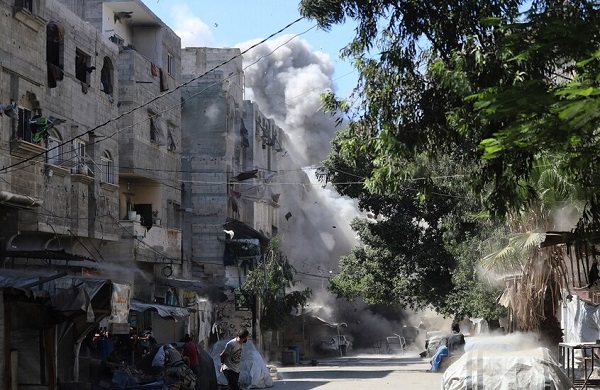
More than one million Palestinians in Gaza and the northern regions of the Strip are defying Israeli military evacuation orders, refusing to abandon their homes despite ongoing bombardment and the escalating humanitarian catastrophe. The Gaza Government Media Office released a statement on Friday condemning what it called a campaign of “forced displacement” that aims to permanently expel Palestinians from the northern areas of Gaza.
According to the statement, over 1.3 million residents live in Gaza City and the northern governorates—around 398,000 in northern Gaza and 914,000 in Gaza City. While roughly 300,000 people have been forced to flee from the eastern neighborhoods to central and western areas of Gaza, officials noted a striking countertrend: “reverse displacement.” Despite the danger, more than 20,000 displaced people have returned north, citing unlivable conditions in the south.
“We Will Not Leave”: Defying a Final Expulsion
“The people of Gaza are staying rooted in their land,” the statement declared. “More than a million Palestinians, including over 350,000 children, are refusing the forced displacement imposed by the Israeli occupation, even in the face of brutal bombardment and an ongoing genocide.”
Israel has issued repeated evacuation warnings to residents of Gaza City and northern areas, urging them to move south—orders that many see as part of a broader campaign to permanently depopulate northern Gaza. Israeli officials have indicated that this evacuation may be permanent, reinforcing fears that Palestinians would be denied the right to return, in what local and international observers have described as a violation of international law.
Palestinian officials assert that this constitutes a war crime and a grave breach of the Fourth Geneva Convention, which prohibits forcible transfers of protected populations during wartime.
Southern Gaza: No Safety, No Infrastructure
Many of those who fled south found no refuge. Government sources highlighted that the so-called “safe zone” of al-Mawasi, located in Khan Younis and Rafah, has become a humanitarian nightmare. Initially designated by Israeli authorities as a “humanitarian zone,” the area has been bombed over 109 times, resulting in the deaths of more than 2,000 Palestinians, according to local reports.
Currently, approximately 800,000 people are crammed into al-Mawasi—an area with no functioning hospitals, no sewage system, no electricity, and no consistent access to food or drinking water. In a particularly dire development, Israeli authorities have cut the main water pipeline (“Mekorot”) to Khan Younis, rendering basic survival nearly impossible.
“Life in the southern regions is no longer sustainable,” the statement read. “The displaced are trapped in what amounts to open-air prisons, while their homes in the north are bombed into rubble.”
A Deliberate Policy of Displacement?
Officials in Gaza accused Israel of engaging in a systematic campaign to depopulate Gaza City and the northern Strip, using both military force and resource denial to drive residents into a concentrated southern enclave.
They note that the Israeli-designated “shelter zones” now account for less than 12% of the territory of Gaza, where over 1.7 million people are being forced to concentrate. This, they argue, represents not only a humanitarian collapse but a deliberate and premeditated war strategy aimed at changing the demographic map of Gaza permanently.
“This is not just war, it is a crime against humanity,” the media office stated, calling the operation a planned and executed act of ethnic cleansing.
International Condemnation and Legal Demands
The statement condemned both Israel and its strategic ally, the United States, for complicity in the ongoing war and called on the international community to intervene.
“We hold the Israeli occupation and its partners in this aggression particularly the U.S. administration fully responsible for the massacres and the forced displacement campaign,” the Gaza Government Media Office said.
It urged the United Nations, international courts, and human rights organizations to act immediately, calling for:
- An end to forced displacement
- The establishment of international protection mechanisms for civilians
- Accountability for what the statement describes as “genocide” and “crimes against humanity”
A Humanitarian and Moral Crisis
The refusal of Palestinians to flee en masse, despite extreme risk, underscores what many in Gaza say is a collective decision: to remain on their ancestral land, even in the face of death, rather than allow a second Nakba to unfold. The term Nakba, meaning “catastrophe,” refers to the 1948 mass displacement of Palestinians during the creation of the State of Israel.
In Gaza today, amid famine, disease, bombardment, and international paralysis, that collective memory looms large.
“We have nowhere else to go,” said one resident interviewed by local journalists. “If we leave now, we may never return. Better to die in our homes than live as refugees again.”
