

Ahmed Kamel – Egypt Daily News
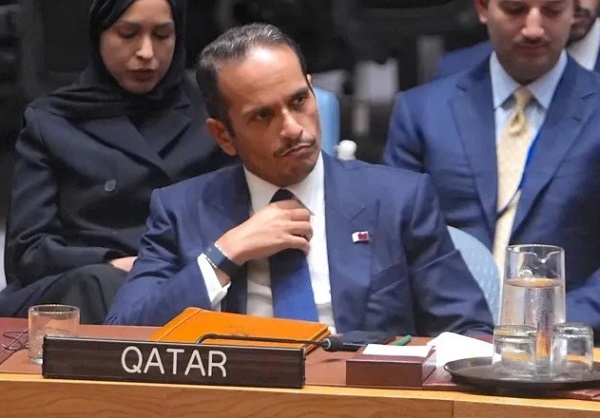
In a strongly worded address at the ministerial preparatory meeting for the Arab-Islamic Summit in Doha, Qatari Prime Minister and Foreign Minister Sheikh Mohammed bin Abdulrahman Al Thani condemned a recent Israeli airstrike on the Qatari capital as a “dangerous precedent” and a blatant act of “state terrorism.” The Prime Minister described the incident as a calculated attack, not merely on a physical location, but on the very principles of diplomacy, mediation, and international law.
Attack During Sensitive Negotiations
According to Sheikh Mohammed, the Israeli strike occurred while Qatar was hosting official, publicly acknowledged negotiations aimed at achieving a ceasefire in Gaza and securing the release of hostages and detainees. These talks were conducted with full knowledge of all parties, including Israel.
“Instead of appreciating Qatar’s efforts and preserving the progress made in the negotiations, Israel carried out an airstrike on a residential site that housed members of Hamas’s negotiation team,” he stated. “This was not just an attack on a location it was an assault on the principle of mediation itself, and on all that diplomacy represents as an alternative to war and destruction.”
The Prime Minister warned that such an action undermines any momentum toward de-escalation and highlights Israel’s ongoing disregard for peaceful resolutions to the Palestinian crisis. He accused the Israeli government of deliberately sabotaging diplomatic efforts and perpetuating a pattern of aggression that flouts international norms and endangers regional stability.
Violation of Sovereignty and International Law
Sheikh Mohammed made clear that Qatar views the attack as a direct violation of its sovereignty—a line that cannot be crossed without consequence. “Qatar’s sovereignty is non-negotiable. Any threat to our national security will be met with all the means guaranteed under international law,” he said.
He further stressed that the airstrike violates Article 2, Paragraph 4 of the United Nations Charter, which prohibits the use of force against the territorial integrity or political independence of any state. “This is not just a diplomatic or political affront; it is a breach of international legal and ethical standards,” he noted.
Call for Arab-Islamic Unity and Global Accountability
The Qatari Prime Minister criticized the international community for what he described as its silence or worse, its impotence in the face of repeated Israeli violations. “What encourages Israel to persist in this path is not just silence, but the international community’s failure to impose any consequences for its actions,” he said.
He called on Arab and Islamic nations to respond decisively and with unity, framing the attack as a test of regional resolve. “This must not be seen as an isolated incident. It is a dangerous precedent that requires a firm and collective response from our Arab and Islamic nations.”
Appreciation for International Solidarity
Sheikh Mohammed expressed gratitude to the Arab, Islamic, and friendly nations that had swiftly condemned the attack and expressed solidarity with Qatar. He affirmed that Qatar will pursue all legal and diplomatic channels to safeguard its sovereignty and security, emphasizing that any response will be within the framework of international law.
“This act will not pass as a mere incident,” he concluded. “It is a stark warning of the lengths to which extremist policies will go when left unchecked. It must be confronted—with strength, with law, and with unity.”
Broader Implications
The incident, and Qatar’s response, highlight the increasing volatility of the region amid the ongoing war in Gaza. As a key mediator and host of sensitive negotiations, Qatar has played a pivotal role in efforts to de-escalate violence and facilitate prisoner exchanges between Hamas and Israel. The Israeli strike, therefore, not only jeopardizes Qatar’s position as a neutral broker but may further complicate efforts to resolve one of the Middle East’s most intractable conflicts.
For now, Doha appears poised to take a more assertive diplomatic stance, demanding international accountability while reinforcing its sovereign rights. The coming days will test not only regional alliances but also the global community’s willingness to uphold the principles of international diplomacy in an increasingly polarized world.
