

Ahmed Kamel – Egypt Daily News
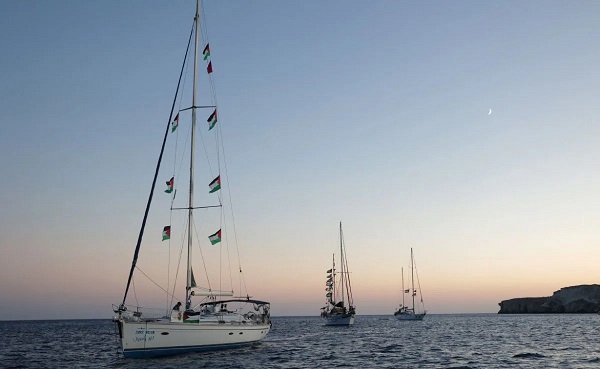
Israeli police announced on Thursday that more than 250 individuals who took part in the latest maritime convoy, known as the “Freedom Flotilla” or Asṭūl al-Ṣumūd (“Flotilla of Steadfastness”), have been detained and transferred to the Israel Prison Service after initial questioning. The group, intercepted at sea by the Israeli military, was seeking to challenge the naval blockade imposed on the Gaza Strip, an act Israeli authorities quickly halted.
The detainees were first captured by the Israeli Navy before being handed over to police forces for processing and interrogation. “We received over 250 participants from the military who were involved in the flotilla. They have been subjected to investigation and were transferred to the prison authority,” the Israeli police confirmed in a statement reported by Cairo News Channel.
Authorities have not yet released the identities or nationalities of the individuals, nor have they detailed the charges being considered. It remains unclear whether the detainees will face deportation, criminal prosecution, or prolonged detention.
Attempt to Break Gaza Siege
The flotilla is part of a long-standing effort by international activists, humanitarian groups, and pro-Palestinian organizations to highlight what they describe as the inhumane conditions in the Gaza Strip. The coastal enclave, home to over 2.2 million Palestinians, has been under a land, air, and sea blockade imposed by Israel (and partially by Egypt) since 2007, following Hamas’s takeover of the territory.
Organizers of the “Freedom Flotilla” have often included activists from across the globe, including medical personnel, journalists, politicians, and aid workers. Their missions are typically symbolic as well as humanitarian, aiming to raise awareness of the ongoing blockade, which the United Nations and various rights groups have repeatedly described as a form of collective punishment.
Previous flotillas have attempted similar journeys, most notably the 2010 “Mavi Marmara” incident in which Israeli commandos boarded a Turkish-flagged ship in international waters, resulting in the deaths of 10 activists and sparking a major diplomatic crisis between Israel and Turkey.
While recent flotillas have generally been stopped without lethal force, the political stakes remain high, and the Israeli government continues to assert its right to enforce the blockade for what it calls “security reasons,” citing the risk of weapons smuggling to Hamas and other militant factions.
Humanitarian Concerns and International Response
Human rights organizations have expressed concern about the treatment of the detainees and called for transparency regarding their legal status. “The international community must closely monitor the situation of these activists, many of whom may be peaceful civilians exercising their right to protest,” said a spokesperson from a European human rights NGO that had supported earlier flotilla missions.
There has been no immediate response from governments whose citizens may be among the detainees, though diplomatic channels are likely to be activated in the coming days. Some reports suggest that foreign nationals from Europe, North America, and the Middle East may be among those arrested.
Questions also remain about whether the flotilla carried humanitarian aid, such as food, medicine, or medical equipment, and if so, whether any of it will be allowed into Gaza. In past flotilla incidents, aid was either seized, destroyed, or re-routed under Israeli supervision, often after extensive delays.
A Broader Struggle for Gaza’s Future
The latest interception of the flotilla comes at a time of heightened tension in and around Gaza. The coastal enclave continues to suffer from severe humanitarian conditions, including high unemployment, limited access to clean water and electricity, and a struggling healthcare system exacerbated by repeated military conflicts.
The United Nations has repeatedly warned that Gaza is on the brink of becoming uninhabitable, with humanitarian agencies calling for an end to the blockade or at least greater easing of movement and access to goods and services.
Israel, however, maintains that the restrictions are necessary to prevent Hamas, which it designates as a terrorist organization, from acquiring weapons and materials that could be used in attacks against Israeli civilians.
Despite the risks, activists involved in flotilla efforts argue that direct action is necessary to draw attention to what they consider an unjust and unsustainable siege. “People in Gaza are being suffocated,” one flotilla organizer had said in a statement prior to departure. “We may not be able to break the blockade entirely, but the world must not look away.”
What Comes Next?
With over 250 people now in Israeli custody, the diplomatic, legal, and political ramifications of the flotilla’s interception are likely to unfold over the coming weeks. Humanitarian organizations are urging Israel to ensure that all detainees are treated in accordance with international law and granted access to legal counsel and consular representation.
The Israeli government, for its part, is expected to continue enforcing its maritime blockade, warning that future flotillas will be treated similarly.
As Gaza remains isolated and tensions in the region continue to simmer, the flotilla movement serves as a stark reminder of the unresolved political, humanitarian, and moral questions surrounding the Israeli-Palestinian conflict and the enduring global efforts to address them.
