

Ahmed Kamel – Egypt Daily News
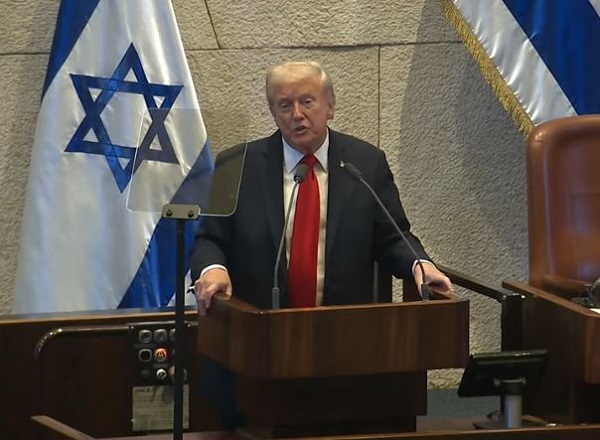
U.S. President Donald Trump delivered a defiant and characteristically unapologetic speech before Israel’s Knesset on Monday, declaring that “peace only comes through strength” and touting his administration’s military posture and diplomatic accomplishments as foundational to ending the war in Gaza.
Speaking just hours after all remaining living Israeli hostages were returned from Hamas captivity and amid preparations for a landmark international peace summit in Sharm el-Sheikh, Trump positioned himself as both peacemaker and power broker in the Middle East.
“In reality, my personality is about ending wars,” Trump told lawmakers. “We believe that peace only comes through strength. When you end eight wars, you prove them wrong,” he said, taking a swipe at critics who, he claimed, predicted his presidency would lead the United States into more conflict.
A Defiant Tone, a Familiar Message
The former president’s remarks before Israel’s parliament reflected his signature blend of bravado and strategic messaging. Referencing his 2016 election rival, Trump said:
“Hillary Clinton once said I would go to war with everyone. Well, I stopped the wars.”
He continued:
“We’ve built the greatest military in the history of the world. We have weapons no one has ever dreamed of. I hope we never have to use them.”
Trump acknowledged that some of the advanced U.S. weaponry had already been supplied to Israel. Addressing Prime Minister Benjamin Netanyahu directly, he said:
“Bibi always used to ask, ‘Can you give me this weapon?’ And you used it very well.”
He added that Israel’s use of American arms during the recent war had strengthened its deterrent power and contributed to the resulting peace:
“Israel used the weapons well. That’s why it became strong. And that strength led to peace.”
“Not War-Loving — Just Effective”
As applause broke out in the chamber, Trump further emphasized his administration’s approach:
“When you resolve conflicts in eight months, it means you don’t like war — it means you’re effective. People expected me to be harsh, but I was focused on results.”
He reaffirmed that military action remains an option only when absolutely necessary.
“We will never enter a war unless it’s absolutely needed — but if we do, we will win it in a way that the world has never seen before.”
Toward Sharm el-Sheikh
President Trump now travels to the Egyptian resort city of Sharm el-Sheikh, where he will co-chair the Sharm el-Sheikh Peace Summit with Egyptian President Abdel Fattah el-Sisi. The summit is being held to mark the formal signing of the ceasefire agreement between Israel and Hamas and to begin charting the path forward for Gaza and the wider region.
The summit, which begins Monday evening, brings together leaders and representatives from over 30 countries and major international organizations. Confirmed participants include:
- Middle East nations: Egypt, Israel, Jordan, the UAE, Bahrain, Saudi Arabia, Kuwait, Oman, and the Palestinian Authority
- Muslim-majority and Asian countries: Turkey, Pakistan, Indonesia, India
- European powers: France, Germany, Italy, Spain, the UK, Greece, Cyprus, Hungary, Armenia, Azerbaijan
- Global institutions: The United Nations Secretary-General, the Secretary-General of the Arab League, and the President of the European Council
The summit’s objectives, according to a statement from the Egyptian Presidency, are to reinforce the Gaza ceasefire agreement, promote political and humanitarian stability in the region, and “open a new chapter of regional peace and cooperation.”
Trump has positioned the summit as a direct extension of his vision for peace through strength, saying:
“We are not just celebrating the end of a war. We are setting a new course, one that brings security to Israel, dignity to Palestinians, and opportunity to the entire Middle East.”
A Legacy in the Making?
The combination of Trump’s high-profile speech, the return of hostages, and the Sharm el-Sheikh summit underscores his effort to cement his foreign policy legacy as a global dealmaker.
According to White House aides, Trump is expected to call for increased international investment in Gaza’s reconstruction, tighter security coordination, and long-term economic partnerships between Israel and Arab neighbors.
His message remains clear: diplomacy backed by overwhelming power is the only formula for peace.
As Trump put it before leaving the Knesset:
“You don’t get peace by asking nicely. You get peace by standing tall, being strong and making sure everyone knows it.”
