

Ahmed Kamel – Egypt Daily News
In a move underscoring Washington’s deepening involvement in Gaza’s post-war transition, U.S. Vice President J.D. Vance announced on Tuesday the official opening of a Civil-Military Cooperation Center (CMCC) for the reconstruction of the war-ravaged Gaza Strip. The center, according to Vance, will serve as a hub for coordinating humanitarian aid, infrastructure rebuilding, and security stabilization in collaboration with regional and international partners.
“Some residual violence in Gaza does not mean peace is failing,” Vance said in a press statement. “The situation is excellent, and we’re achieving remarkable progress.”
The announcement came during an emergency visit to Israel, where Vance is meeting with top Israeli leaders and U.S. envoys to assess the fragile ceasefire between Israel and Hamas a truce brokered earlier this month in Sharm el-Sheikh with support from Egypt, Qatar, and the United States.
U.S. Reaffirms It Won’t Send Troops to Gaza, Leaves Disarmament Timeline for Hamas Open-Ended
U.S. Vice President J.D. Vance reaffirmed on Tuesday that the United States will not deploy troops to the Gaza Strip, echoing previous assurances made by President Donald Trump. Speaking from southern Israel, Vance also clarified that Washington has not set a specific deadline for Hamas to disarm, despite this being a key clause in the U.S.-brokered ceasefire agreement.
“Hamas must comply with the agreement. If it doesn’t, very bad things will happen,” Vance said during a press conference in the city of Kiryat Gat.
“But I will not do what the president himself has wisely refrained from setting a hard deadline. These matters are complex and difficult to enforce.”
His remarks come amid rising concern over the fragility of the current ceasefire, which was reached under the “Sharm El-Sheikh Agreement” and is being closely monitored by regional and international stakeholders.
Egyptian-Israeli Talks to Preserve Ceasefire
Meanwhile, Egyptian intelligence chief General Hassan Rashad met with Israeli Prime Minister Benjamin Netanyahu in Jerusalem on the same day. The two officials discussed efforts to stabilize the truce in Gaza, coordinate aid delivery, and review progress on implementing the broader peace framework.
Egypt has emerged as a central player in mediating the ceasefire, alongside the U.S., Qatar, and Turkey. Cairo is also reportedly being considered to lead a multinational stabilization force in Gaza as part of a long-term political solution a proposal still under review by the United Nations Security Council.
Uncertainty Surrounds Disarmament Clause
Under the terms of the ceasefire agreement, Hamas is expected to begin handing over or dismantling parts of its military arsenal, including rockets, tunnels, and drones. However, the absence of a clear timetable has raised questions about enforcement mechanisms and potential repercussions.
U.S. officials have stated that any breach of the agreement by Hamas could trigger a coordinated response potentially led by allied nations in the region rather than direct U.S. military action.
Earlier this week, President Trump warned that U.S. allies in the Middle East are prepared to “discipline” Hamas if it deviates from the agreement. However, both Trump and Vance have made it clear that American boots will not be on the ground in Gaza.
High-Level Coordination with Israel
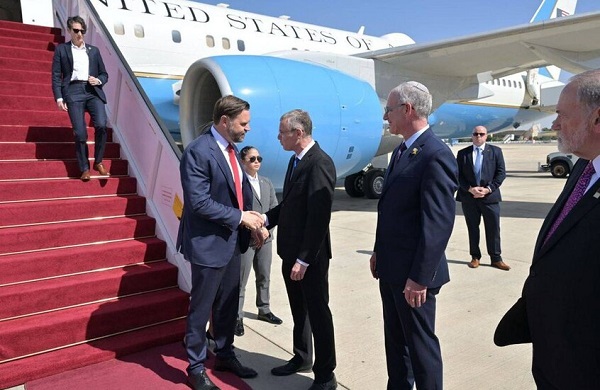
Upon his arrival, Vance held consultations with Israeli Prime Minister Benjamin Netanyahu, Defense Minister Yisrael Katz, and other senior officials to discuss the implementation of the ceasefire and broader regional challenges. Netanyahu said the meetings would focus on “regional opportunities and threats,” particularly in light of evolving U.S.-Israel cooperation and the regional security landscape.
The visit follows the arrival of senior Trump administration envoys Jared Kushner and Steve Witkoff, who met with Netanyahu on Monday. Both emphasized the importance of sustaining the ceasefire, warning that while self-defense remains legitimate, “any actions must not endanger the agreement.”
This marks Vance’s second visit to Israel in recent months. During his previous trip in June, he discussed possible U.S. coordination in future regional security operations, including potential strikes against Iranian targets. However, the current visit is focused squarely on Gaza’s stabilization and rebuilding process.
Gaza Reconstruction and U.S. Strategy
The newly launched Civil-Military Cooperation Center is expected to be headquartered in southern Israel, near border crossings with Gaza, and will coordinate logistics for aid convoys, infrastructure restoration projects, and security protocols for international personnel working on the ground.
The CMCC will work in tandem with international donors, non-governmental organizations, and select regional governments, with Egypt and Qatar playing lead roles. It reflects a shift toward more structured post-conflict engagement, combining U.S. oversight with localized implementation, a formula Washington hopes will avoid a resurgence of hostilities.
Sources close to the planning process indicate the center will also liaise with a 15-member Palestinian technocratic council, established under the broader Trump Peace Plan, to manage civil affairs and facilitate governance transitions in Gaza.
Hamas Responds to U.S. Engagement
In parallel with Vance’s visit, Hamas reiterated its commitment to the ceasefire. Speaking from Cairo, senior Hamas leader and chief negotiator Khalil al-Hayya said the group had received “clear American assurances” that the war was over, and that it remains committed to honoring the terms of the Sharm el-Sheikh agreement.
Still, implementation remains incomplete. Key challenges include the recovery of the bodies of Israeli captives, the restoration of essential services in Gaza, and the prevention of rearmament by militant groups. The CMCC is expected to support efforts to meet these conditions.
A New Model of Regional Security Involvement
Analysts view Vance’s announcement as part of a broader U.S. strategy to outsource field operations to capable allies, avoiding large-scale American military deployments while maintaining leadership in post-conflict stabilization. The strategy aligns with President Trump’s long-standing “America First” policy, favoring strategic delegation over direct involvement.
The center also represents a tangible step in Trump’s 20-point peace plan, which aims to reshape the governance and security landscape of Gaza and, eventually, establish a unified Palestinian entity incorporating the West Bank, East Jerusalem, and a demilitarized Gaza Strip.
While the challenges remain considerable from political fragmentation to logistical bottlenecks, the opening of the CMCC signals a new phase in U.S. regional engagement, one that blends military precision, diplomatic coordination, and reconstruction diplomacy.
As Vance’s visit continues, attention will turn to whether this initiative can move beyond symbolic announcements to generate real, on-the-ground momentum toward stability, recovery, and an eventual political resolution.
