

Ahmed Kamel – Egypt Daily News
Egypt and the European Union have pledged to deepen their long-term strategic partnership, launching preliminary discussions to establish a joint security and defence dialogue while reaffirming cooperation across a wide range of political, economic, and regional priorities.
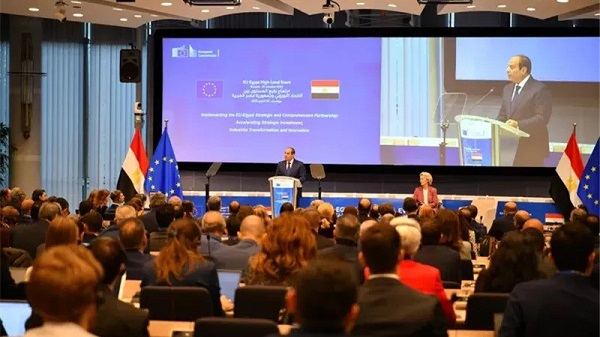
The announcement came in a joint statement following the first Egypt–EU summit, held this week in Brussels and attended by President Abdel Fattah el-Sisi and European Council President Charles Michel, alongside European Commission President Ursula von der Leyen and several EU heads of government.
According to the statement, both sides agreed to begin preparatory talks on creating a structured security and defence dialogue that would include cooperation on regional and maritime security particularly through the EU’s naval operations Aspides and Atalanta as well as counterterrorism, cybersecurity, and joint training initiatives to enhance response capabilities.
The summit marks a milestone in the 20-year partnership between Cairo and Brussels, expanding on the 2024 Comprehensive Strategic and Partnership Agreement and reaffirming commitments to shared stability, sustainable development, and global security.
€7.4 Billion EU Support Package and Renewed Investment Push
Acknowledging the economic and social pressures Egypt faces from regional crises, the EU reaffirmed a financial support package worth €7.4 billion announced in March 2024. The package includes €5 billion in concessional loans, €1.8 billion in mobilized investments, and €600 million in grants aimed at supporting Egypt’s macroeconomic stability and structural reforms in coordination with the International Monetary Fund.
The leaders emphasized that the assistance aligns with Egypt’s ongoing reform agenda and with EU decision 2025/1267, aimed at strengthening fiscal resilience, boosting investment, and promoting sustainable growth.
Over the past two decades, Egyptian exports to the European market have significantly increased under the EU–Egypt Association Agreement, contributing to diversification of Egypt’s economy. Both sides said they would continue to encourage private-sector investment, citing the 2024 EU–Egypt Investment Conference and related initiatives to expand innovation, employment, and entrepreneurship.
The EU’s development finance arm, the European Fund for Sustainable Development Plus (EFSD+), is expected to mobilize up to €5 billion in investments for Egypt through 2027.
Energy Transition and Water Security
The summit reaffirmed the EU and Egypt’s shared strategic interest in advancing the green transition across the Mediterranean under the T-MED initiative on energy and clean technologies. The two sides committed to accelerating the shift toward low-carbon, climate-resilient economies by harnessing Egypt’s vast potential in solar and wind power.
They also agreed to strengthen cross-border energy infrastructure, support Egypt’s flagship “Nuwafi” initiative for sustainable projects, and explore cooperation on methane reduction, carbon capture, and energy storage.
On water security, the EU acknowledged Egypt’s heavy dependence on the Nile River and expressed support for Egypt’s water stability “in accordance with international law, including matters related to the Ethiopian dam.” The statement strongly encouraged transboundary cooperation among Nile Basin countries on the basis of “prior notification, cooperation, and the principle of no significant harm.”
Commitment to Peace in Gaza and Support for a Two-State Solution
Addressing regional conflicts, the leaders reaffirmed their joint commitment to peace and stability in the Middle East, particularly the Gaza war. They welcomed the first phase of the U.S.-backed comprehensive plan to end the conflict proposed by President Donald Trump and praised Egypt’s mediation efforts.
Both sides voiced deep concern over the dire humanitarian situation in Gaza, calling for the immediate, safe, and unimpeded delivery of aid, the restoration of essential services, and full engagement of the United Nations and its agencies, including UNRWA.
Reiterating support for a lasting peace based on the two-state solution, Egypt and the EU condemned settler violence and settlement expansion in the West Bank as violations of international law. They firmly rejected any attempts at annexation or forced displacement of Palestinians.
The two sides emphasized the need to reunify Gaza and the West Bank under the Palestinian Authority, supporting the creation of an interim technocratic committee and urging an end to Hamas’s rule in Gaza under the principle of “one state, one law, one weapon.”
Egypt and the EU also pledged to co-host an international reconstruction conference for Gaza once a permanent ceasefire is in place.
Broader Regional and Global Coordination
Beyond the Middle East, the summit addressed global security challenges including the war in Ukraine, instability in Libya, the Sudanese conflict, and crises in the Horn of Africa. The leaders reaffirmed their commitment to international law, sovereignty, and peaceful conflict resolution, while backing ongoing UN-led initiatives in Libya and Sudan.
They expressed support for a unified Libyan state and the withdrawal of all foreign forces and mercenaries, and urged Sudanese parties to engage constructively in an inclusive, Sudanese-owned political process.
Governance, Human Rights, and Migration Cooperation
Recognizing the link between rule of law, inclusive governance, and sustainable development, Egypt and the EU agreed to intensify dialogue on human rights with a focus on protecting vulnerable groups, including women and girls, and safeguarding freedoms of expression and association.
Migration was another key theme. The EU praised Egypt’s role in hosting millions of refugees and asylum seekers, pledging €200 million in funding between 2024 and 2027 to support migration management, legal pathways, and community resilience. Both sides also committed to advancing the EU–Egypt “Talent Partnership” to create organized and mutually beneficial migration channels.
Looking Ahead
The summit concluded with the signing of several key agreements, including a €4 billion macro-financial assistance memorandum, a €75 million financing agreement for social and economic reforms, and Egypt’s formal accession to the “Horizon Europe” research program.
The EU also announced €110.5 million in additional funding for sustainable development and vocational training initiatives in 2025, along with €50 million in green transition projects targeting the private sector.
As part of their commitment to sustained cooperation, Egypt and the EU agreed to hold their next summit in Egypt in 2027 underscoring a shared vision of an “extended partnership” built on mutual respect, economic integration, and regional stability.
