


Ahmed Kamel – Egypt Daily News
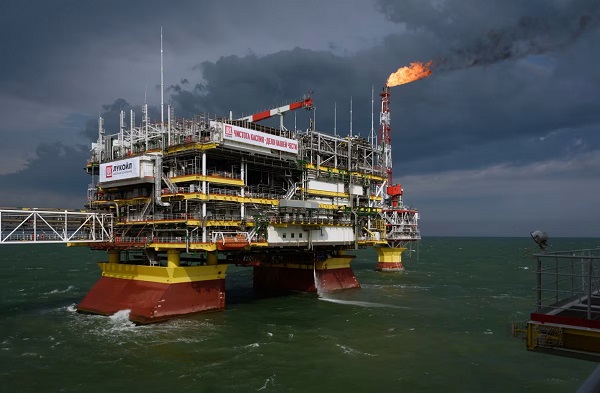
Ukraine has significantly escalated its long-range drone campaign against Russia’s energy sector, striking a major offshore oil platform in the Caspian Sea in what Kyiv says is the first attack of its kind. The previously undisclosed operation targeted the Filanovsky platform, Russia’s largest oil field in the Caspian marking a dramatic expansion of Ukraine’s efforts to choke off the energy revenues that underpin Moscow’s war machine.
A source within Ukraine’s Security Service (SBU) said the strike was intended as a message: “All Russian enterprises working for the war are legitimate targets.” The attack adds a new dimension to a campaign that has intensified sharply since August, hitting an increasingly broad array of Russian energy infrastructure including refineries, export terminals, pipelines and even oil tankers.
This surge in operations comes at a moment of both military strain and diplomatic upheaval. With U.S.-led peace efforts faltering and Russia advancing incrementally on the battlefield, Ukraine is turning to economic warfare to weaken Russia’s ability to finance its invasion. “You cannot allow Russia to retain so much of its critical energy revenue,” said Helima Croft, head of global commodity strategy at RBC Capital Markets. “It’s a systematic effort to close that energy ATM.”
An expanding target list
Data analysis show Ukraine has struck at least 77 Russian energy facilities between August and November nearly double the total for the first seven months of the year. November alone saw a record 14 refinery attacks and four strikes on export terminals.
Refineries like the Rosneft-owned Saratov plant have been hit repeatedly, eight times since August with the goal of keeping them permanently unstable. Analysts say Kyiv has shifted from symbolic damage to strategic disabling, targeting key components deep inside refining systems.
The growing frequency of attacks is taking a toll, in part due to fires that severely damage metal infrastructure over time. “Nobody really knows how many cycles of heating and cooling these structures can survive,” said Sergey Vakulenko, a longtime veteran of Russia’s oil and gas sector.
Ukraine’s strikes now extend across Russia’s energy export network. Key Black Sea and Baltic ports Novorossiysk, Tuapse and Ust-Luga have been hit multiple times, as has the Druzhba pipeline that supplies Russian oil to parts of the EU. These attacks have sparked diplomatic friction, especially with Hungary and Kazakhstan, whose oil exports have been disrupted.
Late November saw two strikes on the Caspian Pipeline Consortium, which carries 80 percent of Kazakhstan’s oil to global markets. One attack temporarily shut down the terminal, frustrating Kazakhstan and prompting warnings about damage to bilateral relations. Yet Ukraine remains undeterred.
This week, Kyiv carried out its third strike on oil tankers heading to Russia’s Black Sea ports, prompting President Vladimir Putin to denounce the actions as “piracy.” Turkey summoned both Russian and Ukrainian ambassadors in protest.
Ukraine argues that the strikes are necessary to reduce the flow of oil revenue sustaining Russia’s war. “If you can’t deliver sanctions, someone else will help you,” said Oleksandr Kharchenko, director of the Energy Industry Research Centre in Kyiv.
Western support quietly increases
Two major factors have enabled Ukraine’s escalating energy warfare: a shift in U.S. policy and falling global oil prices.
President Donald Trump signaled support for cross-border strikes earlier this year, writing on Truth Social: “It is very hard, if not impossible, to win a war without attacking an invader’s country.” After the failed Alaska summit between Trump and Putin, U.S. intelligence sharing with Kyiv expanded to include Russia’s energy infrastructure, according to sources. European officials have also dropped earlier reservations. “By the end of summer, no one in the room would even mention that Ukraine should restrain from hitting any target,” said former Lithuanian defense minister Dovilė Šakalienė.
A global oil surplus has further insulated the market from shocks, making Western governments more comfortable with Ukraine targeting Russian exports. “The goal is for these attacks to have consequences,” said one Western intelligence source, adding that the market can “take it.”
How much damage can Russia absorb?
Despite its outward confidence, Russia’s energy sector is showing signs of strain. Refinery capacity is down around 6 percent compared with last year, small but significant for a system that typically operates with very tight gasoline surpluses. Fuel shortages emerged in parts of Russia this autumn, forcing the government to temporarily ban gasoline exports.
At the same time, new U.S. sanctions announced in October have hit Russia’s two largest oil companies—Rosneft and Lukoil—leading to falling prices for Russian crude and a sharp drop in export revenues. In November, Russia’s oil and gas income was down nearly 34 percent year-on-year.
Analysts caution that Russia’s energy sector is vast and resilient, with some estimating it could survive even a 50 percent drop in export capacity. Yet the combined pressure of Ukrainian strikes, Western sanctions and reduced revenues is beginning to bite.
A test of endurance
Economists and security analysts agree that the effectiveness of Ukraine’s campaign hinges on duration. If Kyiv and its Western supporters sustain the pressure long enough, it could significantly alter Moscow’s calculations.
“The combination of infrastructure attacks focused on export targets and the staying power of sanctions could drive Russia back to the table,” Croft said. “But it has to be a longer-duration event.”
That long-term effort will now unfold alongside a growing diplomatic push, one complicated by Trump’s intensifying pressure on Kyiv to accept territorial concessions and accelerate peace talks.
For Ukraine, the question is whether it can weaken Russia’s financial foundations faster than the Kremlin can adapt, or before international pressure shifts again.
