

Ahmed Kamel – Egypt Daily News
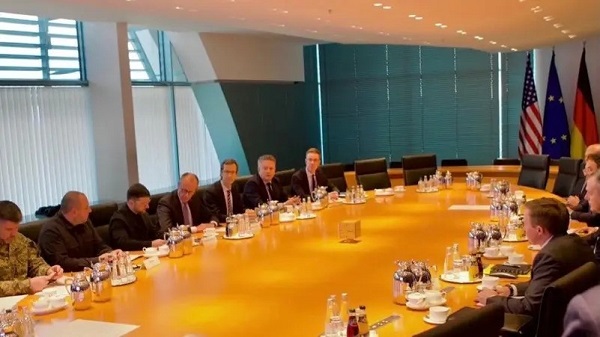
Talks aimed at exploring a possible ceasefire between Ukraine and Russia continued in Berlin on Monday, as diplomatic efforts intensified amid deep disagreements over territory, security guarantees, and the future architecture of peace.
While the specific proposals under discussion have not been made public, the very presence of a US delegation underscored cautious optimism in Washington about the potential for progress. The American team arrived in Germany on Sunday after the administration signaled it would only participate if there were credible prospects for advancing negotiations.
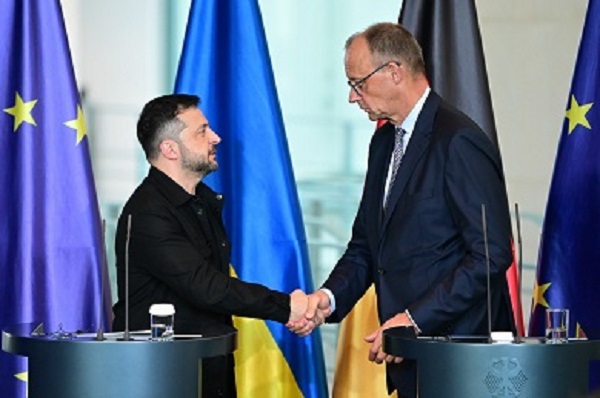
Berlin has become the focal point of a dense diplomatic agenda. German Chancellor Friedrich Merz was scheduled to hold economic talks with Ukrainian President Volodymyr Zelensky later on Monday, while also convening European leaders at the Chancellery to assess the state of negotiations and coordinate positions. At the same time, uncertainty remained over whether adviser-level talks between US and Ukrainian representatives would continue into a second day, and in what format.
Monday was expected to mark a second round of intensive discussions involving the US and Ukrainian delegations, alongside European allies. US envoy Steve Witkoff, who is leading the American delegation together with Jared Kushner, described Sunday’s discussions as positive, despite clear signs of strain behind closed doors.
In a significant signal of flexibility, President Zelensky revealed that Ukraine is prepared to relinquish its long-held aspiration to join NATO in exchange for binding US and European security guarantees, subject to approval by the US Congress. The announcement reflected Kyiv’s growing willingness to make painful concessions in pursuit of an end to the war, even as Moscow’s position appears largely unchanged.
However, several core disputes remain unresolved. Chief among them is Ukraine’s firm rejection of a US proposal calling for the withdrawal of Ukrainian forces from parts of eastern Donbas still under Kyiv’s control. European and Ukrainian officials have also pressed Washington to clarify what concrete steps it would take should Russia violate any future peace agreement and resume military action against Ukraine.
According to reporting by The Wall Street Journal, these two issues territorial concessions and enforceable security guarantees, are expected to dominate the Berlin talks. A person familiar with Sunday’s discussions described them as difficult, noting that the US side appeared unwilling to substantially revise its 20-point draft peace framework, which reportedly includes provisions requiring Kyiv to cede control of Donbas.
Although some limited agreements were reached, including a proposal to cap Ukraine’s peacetime armed forces at 800,000 troops, Kyiv has refused to accept demands to surrender territory in the Donetsk region still held by Ukrainian forces. Zelensky has repeatedly stressed that territorial concessions are among the most sensitive and controversial issues facing Ukraine. Under Ukrainian law, the president does not have the authority to give up national territory unilaterally; any such decision would ultimately require approval through a national referendum.
Meanwhile, European powers including the United Kingdom and France have drawn up detailed plans for assistance to Ukraine, potentially including the deployment of a reassurance force, and have discussed these ideas with US military officials. However, Washington has yet to make a political decision on the nature and scope of its own long-term support, according to European and Ukrainian sources.
On the Russian side, there has been little indication of flexibility. Kremlin foreign policy adviser Yuri Ushakov said on Sunday that Moscow would strongly object if peace proposals drafted by Kyiv and Brussels were incorporated into any final plan. He reiterated that Ukraine would never regain Crimea and would not be granted NATO membership.
Russia is also expected to oppose provisions establishing a demilitarized zone in parts of Donetsk. Ushakov and other senior Russian officials have repeatedly emphasized Moscow’s determination to retain control over Donbas, reinforcing the sense that territorial issues remain the central, and perhaps most intractable, obstacle to any negotiated settlement.
As talks continue in Berlin, the gap between Ukraine’s willingness to compromise and Russia’s insistence on its core demands highlights the fragile and uncertain nature of the diplomatic process, even as international pressure mounts to halt the fighting.
