

Ahmed Kamel – Egypt Daily News
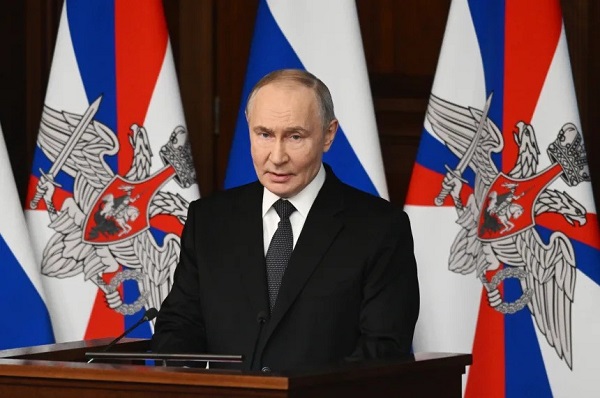
Russian President Vladimir Putin has delivered one of his clearest signals yet that Moscow is unwilling to compromise on its core demands in the war against Ukraine, even as US President Donald Trump intensifies diplomatic efforts to broker a peace agreement. Speaking Wednesday at the annual meeting of Russia’s Defense Ministry, Putin framed territorial concessions as non-negotiable and warned that Russia would pursue its objectives by force if diplomacy fails.
Putin’s remarks came amid a flurry of diplomatic activity involving Washington, European capitals and Kyiv, underscoring the growing gap between Western hopes for a negotiated settlement and Russia’s insistence on reshaping Ukraine’s borders. While Putin paid lip service to diplomacy, his message was unmistakably defiant. Russia, he said, would “eliminate the root causes of the conflict” either through negotiations or, failing that, through military means.
“If the opposing country and its foreign patrons refuse to engage in substantive discussions, Russia will achieve the liberation of its historical lands through military means,” Putin declared, using language that has become a hallmark of the Kremlin’s justification for the war. The reference to “historical lands” applies to Ukrainian territories Moscow claims as its own, particularly in the eastern Donbas region, which Russia illegally annexed but has yet to fully occupy.
Territory remains the central obstacle in ongoing peace discussions, alongside the issue of security guarantees for Ukraine. Russia is demanding that Kyiv cede regions it currently occupies or claims, a condition Ukraine has repeatedly rejected. Ukrainian President Volodymyr Zelensky reaffirmed this position earlier this week, stating that Kyiv would not recognize the temporarily occupied parts of Donbas as either legally or de facto Russian.
Zelensky also responded indirectly to Putin’s rhetoric, warning that the concept of “historical lands” carries implications far beyond Ukraine. “There are other countries in Europe that someone in Russia may one day call their ‘historical lands,’” he said, describing the Kremlin’s worldview as a threat to the entire continent. “We need real protection from this Russian history of madness.”
Despite Moscow’s sweeping claims, Russia’s progress on the battlefield has been slow and costly. Analysts at the Institute for the Study of War estimate that, at the current pace of advance, Russian forces would not fully seize the Donbas region until at least August 2027. That reality stands in sharp contrast to the confidence projected in Putin’s speech and raises questions about how long Russia can sustain its campaign under growing economic and military pressure.
Trump, for his part, has struck a far more optimistic tone. The US president has repeatedly said he believes a deal is within reach, telling reporters this week that negotiations are “closer now than we have been.” His administration has sought to position Washington as the central broker in talks with Moscow, a strategy that has unsettled some European allies who fear a settlement that prioritizes speed over Ukrainian security.
Those concerns were evident in Putin’s remarks, which drew a sharp distinction between the United States and Europe. While he said Russia was “engaged in a dialogue with the US,” he suggested that meaningful engagement with European leaders was unlikely under current political conditions. Any future cooperation with Europe, he implied, would depend on changes in its leadership.
“I hope the same engagement will happen with Europe,” Putin said, before adding pointedly that such talks may only become possible once Europe’s “current political elites” are replaced. The comment reinforced perceptions that Moscow views Europe not as an independent actor but as an obstacle aligned against Russian interests.
Putin’s comments came just ahead of a critical summit in Brussels, where European leaders are set to debate how best to sustain Ukraine’s war effort as the conflict drags on. Central to the discussion is whether to use frozen Russian assets to fund Ukraine’s defense or to rely on additional borrowing by European institutions.
European Commission President Ursula von der Leyen used a speech to the European Parliament on Wednesday to emphasize the stakes of the moment. Calling on Europe to take greater responsibility for its own security, she argued that supporting Ukraine is the continent’s most important act of self-defense. “There is no more important act of European defense than supporting Ukraine’s defense,” von der Leyen said. “The next days will be a crucial step for securing this. It’s up to us to choose how we fund Ukraine’s fight.”
The competing proposals now before European leaders reflect broader tensions within the alliance: how to balance financial risk, legal constraints and political will while maintaining unity in the face of Russian pressure. For Ukraine, the outcome of those debates could shape its ability to resist Russian advances and negotiate from a position of strength.
Putin, however, left little doubt about how Moscow views the current moment. If talks fail to deliver outcomes acceptable to the Kremlin, he said, Russia will continue to pursue its objectives on the battlefield. As diplomatic optimism from Washington collides with hardened positions in Moscow and mounting caution in Europe, the prospect of peace appears as contested and uncertain as ever.
