

Ahmed Kamel – Egypt Daily News
The European Union’s High Representative for Foreign Affairs and Security Policy, Kaja Kallas, has praised Egypt’s diplomatic leadership, describing it as “extremely important” in preventing further crises across the Middle East, as both sides reaffirmed their strategic partnership amid escalating regional instability.
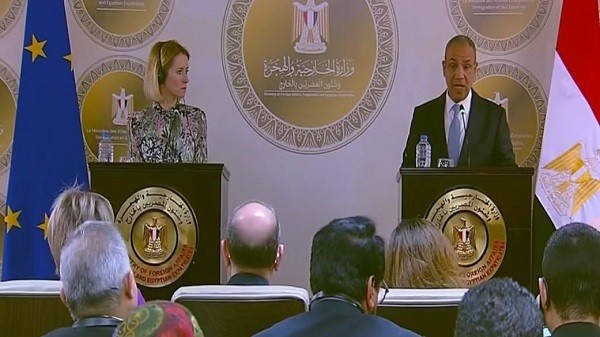
Speaking at a joint press conference in Cairo with Egypt’s Minister of Foreign Affairs and Emigration, Badr Abdelatty, Kallas said relations between the European Union and Egypt are strategic and will be significantly strengthened in the coming period. She stressed that Egypt and Europe stand side by side in efforts to achieve stability in the region, particularly as conflicts and security challenges deepen in several neighboring countries.
Kallas pointed to the fragile security situation in Syria, noting that the country faces major challenges and a clear deterioration in security conditions. She underlined the importance of coordinated international efforts to prevent further escalation, highlighting Egypt’s longstanding role as a stabilizing diplomatic actor in the Middle East.
For his part, Abdelatty used the press conference to outline Egypt’s firm positions on a range of regional crises, emphasizing what he described as “red lines” related to sovereignty, territorial integrity, and national security.
Addressing developments in the Horn of Africa, Abdelatty strongly condemned any unilateral recognition of the self-declared region of “Somaliland,” describing such moves as illegal, illegitimate, and a grave threat to Somalia’s stability and regional security. He said Egypt would participate in an upcoming ministerial meeting of the Organization of Islamic Cooperation in Jeddah to discuss the issue, warning that recognition of separatist entities undermines the sanctity of borders, a principle Egypt has inherited from previous generations and will not compromise.
The Egyptian foreign minister stressed that instability in Somalia directly affects security in the Red Sea and the Horn of Africa, both of which are vital to global trade. He said Cairo will continue working with African and Arab partners, as well as the European Union and the United States, to prevent further recognitions that could destabilize the African continent.
Abdelatty also addressed the situation in Yemen, reiterating Egypt’s belief that there are no military solutions to regional or international crises. He confirmed that Egypt has undertaken high-level diplomatic efforts with Gulf partners in recent days to de-escalate tensions and expressed hope that all Yemeni factions would engage constructively in an inclusive Yemeni-Yemeni dialogue expected to be launched soon in Riyadh. Egypt, he said, continues to support Yemen’s unity, territorial integrity, and legitimate government, as well as the protection of freedom of navigation.
On Sudan, Abdelatty delivered one of his strongest messages, categorically rejecting any attempts to divide the country or establish parallel entities. He said Egypt would not accept the collapse or fragmentation of the Sudanese state, stressing that the preservation of Sudan’s national institutions, particularly the Sudanese Armed Forces, is essential. “The security and stability of Sudan are inseparable from Egypt’s own national security,” he said, adding that no equivalence can be drawn between Sudan’s national army and armed militias.
Turning to Gaza, Abdelatty reaffirmed Egypt’s absolute rejection of any division of the territory or measures aimed at entrenching separation between Gaza and the West Bank. He called for the swift implementation of the first phase of international plans related to Gaza, the immediate opening of the Rafah crossing in both directions, and the rapid deployment of an international stabilization force to monitor a ceasefire. He stressed that there can be no sustainable solution in the region without guaranteeing Palestinian rights and establishing an independent Palestinian state.
Migration was another central topic of discussion, with Abdelatty highlighting the heavy burden Egypt bears by hosting millions of migrants and refugees fleeing conflicts in neighboring countries. He described irregular migration as a shared challenge for Egypt and the European Union and called for fair burden-sharing, including support to cover the costs of hosting displaced populations and the creation of legal migration pathways.
The minister also welcomed European investment in Egypt and noted ongoing efforts to remove obstacles facing Egyptian exports in European markets. He expressed appreciation for EU support in securing borders and combating irregular migration.
On broader regional security, Abdelatty underscored the strategic importance of the Red Sea, which carries more than 13 percent of global trade. He emphasized that governance of Red Sea security should remain the responsibility of the littoral states, while welcoming European efforts to protect maritime navigation through the EU’s Aspides mission, which Egypt supports logistically.
The talks also covered developments in the African Sahel, with discussions on the EU’s strategy for the region and Egypt’s engagement with Mali, Niger, and Burkina Faso to promote stability and cooperation.
Abdelatty concluded by reiterating that Nile water security remains an existential issue for Egypt. He said Cairo will continue to defend its vital interests under international law and the United Nations Charter, making clear that Egypt will not hesitate to protect what it considers fundamental to its survival.
The press conference reflected a convergence of Egyptian and European positions on many regional challenges, as both sides seek to navigate an increasingly volatile geopolitical landscape through closer coordination and diplomacy.
