

Ahmed Kamel – Egypt Daily News
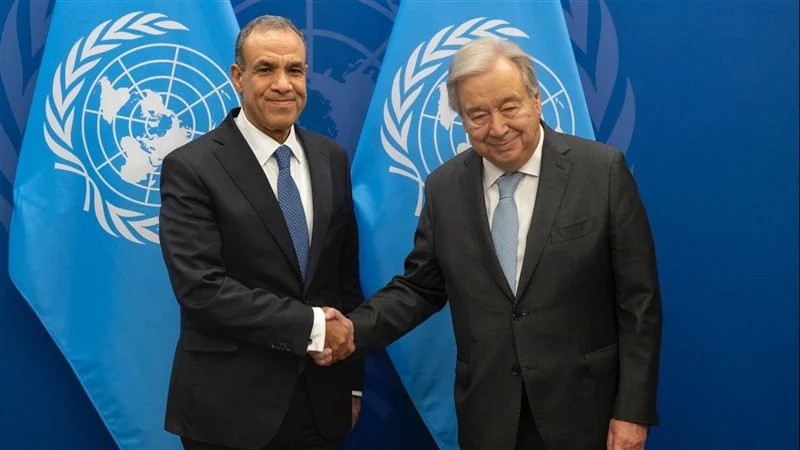
Egypt has renewed calls for a comprehensive political transition in Gaza and broader regional de-escalation during a high-level phone conversation between Foreign Minister Badr Abdelatty and United Nations Secretary-General António Guterres, underscoring Cairo’s push for an internationally anchored post-war framework.
According to a statement from Egypt’s Foreign Ministry, Abdelatty pressed for the immediate move to the second phase of the US-backed peace plan, arguing that delays risk deepening the humanitarian crisis and entrenching instability. He called for a full Israeli withdrawal from Gaza, the formation of a technocratic committee to administer the territory during a transitional period, and the deployment of an international stabilization force to oversee security arrangements.
The Egyptian minister stressed that any post-war governance structure must prioritize the rapid and unhindered delivery of humanitarian aid, while also laying the foundations for early recovery and large-scale reconstruction. Egyptian officials have repeatedly warned that prolonged uncertainty in Gaza could fuel further regional escalation and undermine prospects for a sustainable political settlement.
Israel has so far delayed moving to the agreement’s second phase, a stance analysts say reflects an effort to shape post-conflict outcomes unilaterally, particularly with regard to security control and governance arrangements in the enclave. Egypt, which has played a central mediation role since the outbreak of the war, maintains that an internationally supported transition is essential to prevent a security vacuum and renewed violence.
Beyond Gaza, the call addressed several other regional flashpoints. On Sudan, Abdelatty advocated for a humanitarian truce as a first step toward a comprehensive ceasefire, condemning what he described as serious violations against civilians in El-Fasher and North Kordofan. He emphasized the need to protect Sudan’s sovereignty, preserve state institutions, and ensure full, unhindered access for humanitarian assistance amid one of the world’s most severe displacement crises.
The situation in Yemen also featured prominently. Abdelatty reaffirmed Egypt’s support for Yemen’s unity and legitimate national institutions, calling for de-escalation and a Yemeni-led political process to resolve the conflict. He reiterated Cairo’s opposition to any actions that could further fragment the country or destabilize the Red Sea region.
In this context, the Egyptian foreign minister condemned Israel’s unilateral recognition of Somaliland, describing it as a violation of Somalia’s sovereignty and international law. He warned that such moves risk setting a dangerous precedent and carry serious security implications for the Horn of Africa and maritime routes vital to global trade.
Guterres, for his part, praised President Abdel-Fattah El-Sisi’s role in promoting regional stability and commended Egypt’s consistent commitment to the principles of the United Nations Charter. He also welcomed Cairo’s efforts to advance de-escalation, protect civilians, and support political solutions across multiple conflict zones.
The exchange reflects Egypt’s increasingly assertive diplomatic posture as it seeks to shape regional outcomes through multilateral frameworks, positioning itself as a key interlocutor between regional actors, the United Nations, and major international powers at a time of heightened instability across the Middle East and Africa.
