

Ahmed Kamel – Egypt Daily News
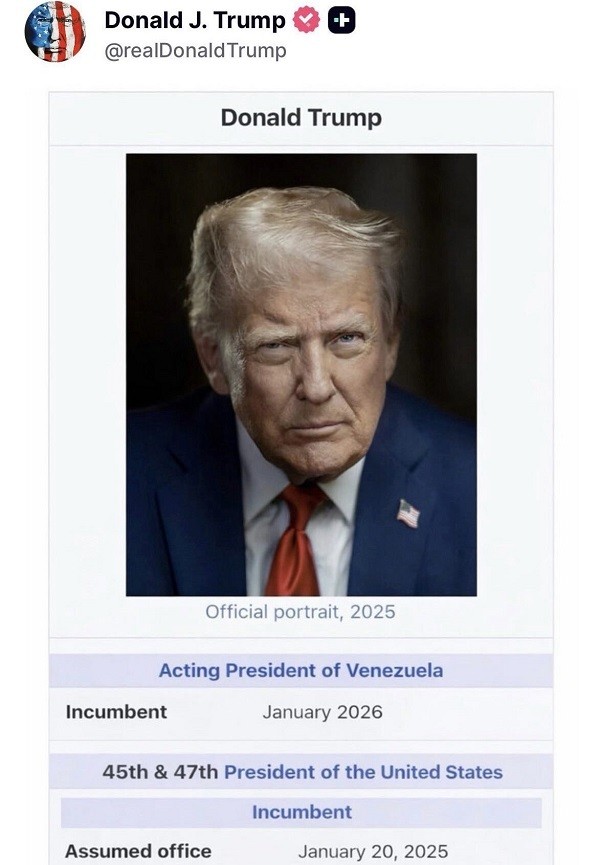
Former U.S. President Donald Trump sparked controversy and confusion after declaring himself the “interim president of Venezuela” in a satirical post on his Truth Social platform, reigniting debate over Washington’s role in the South American country’s long-running political crisis.
Trump accompanied his post with an altered image sourced from Wikipedia bearing the title “Acting President of Venezuela,” a move widely interpreted as mocking the legitimacy of Venezuela’s interim leadership following dramatic developments in Caracas. The post appeared to reference Delcy Rodríguez, Venezuela’s vice president, who assumed temporary authority after President Nicolás Maduro was reportedly detained on January 3 by a U.S. special operations force, an event that has yet to be independently confirmed and has fueled intense international speculation.
The former U.S. president’s remarks were framed in a characteristically sarcastic tone, echoing past episodes in which Washington challenged the legitimacy of Venezuela’s leadership. During Trump’s presidency, the United States formally recognized opposition figure Juan Guaidó as interim president in 2019, imposed sweeping sanctions on the Maduro government, and repeatedly stated that “all options” were on the table regarding Venezuela’s future.
In Caracas, interim President Delcy Rodríguez responded cautiously, emphasizing the need to safeguard national sovereignty. Writing on the X platform, Rodríguez said the government must “maintain political and sovereign authority to defend the country,” a statement widely seen as a rebuttal to what Venezuelan officials describe as foreign interference.
Meanwhile, senior U.S. officials have offered signals that Washington’s involvement in Venezuela may be prolonged. U.S. Energy Secretary Chris Wright said on Sunday that American oversight of the political transition could extend for years. Speaking to CBS News, Wright suggested that the current U.S. role in Venezuela might last “one or two years, or possibly longer,” depending on developments on the ground.
His comments come amid growing U.S. interest in Venezuela’s vast energy resources, particularly as global oil markets remain volatile. Venezuela holds the world’s largest proven oil reserves, and any political transition there carries significant implications for global energy supply, sanctions policy, and regional stability.
Analysts note that Trump’s provocative remarks, though framed as satire, underscore enduring tensions between Washington and Caracas and reflect a broader pattern of rhetorical escalation surrounding Venezuela’s governance. Whether symbolic or strategic, such statements continue to resonate in a country where questions of legitimacy, sovereignty, and foreign influence remain deeply contested.
As events unfold, the international community is closely watching to see whether the current situation leads to a negotiated political settlement, prolonged external oversight, or further instability in a nation already strained by years of economic crisis and political division.
