

Ahmed Kamel – Egypt Daily News
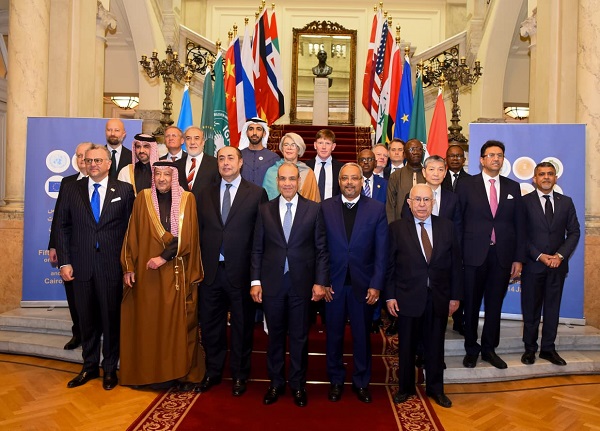
Cairo hosted on 14 January 2026 the fifth meeting of the Consultative Mechanism for Enhancing Coordination of Peace Efforts in Sudan, as Egypt continued to position itself as a central diplomatic hub for regional and international engagement on the Sudanese crisis. The meeting was convened by Egypt’s Ministry of Foreign Affairs under the chairmanship of Foreign Minister Badr Abdel Aaty and brought together a broad coalition of states and multilateral organizations seeking to stem the conflict and its widening regional fallout.
The gathering drew senior participation from the United Nations, the African Union, the Arab League, the European Union, and the Intergovernmental Authority on Development (IGAD), alongside representatives from major regional and international actors. Among the prominent attendees were Ramtane Lamamra, the UN Secretary-General’s Personal Envoy for Sudan; Djibouti’s Foreign Minister Abdoulkader Houssein Omar; Massad Boulos, Senior Adviser to the U.S. President for Arab and African Affairs; UAE Minister of State Sheikh Shakhboot bin Nahyan Al Nahyan; and Saudi Deputy Foreign Minister Waleed Al-Khuraiji. Delegations from Germany, Turkey, Norway, Qatar, the United Kingdom, China, Russia, France, Iraq, and Angola also took part.
In his opening remarks, Abdel Aaty underscored the urgency of coordinated international action, warning that the continued fighting in Sudan poses grave risks not only to the country’s population but to regional peace and security, particularly in neighboring states, the Horn of Africa, and the Red Sea basin. He stressed that the scale of the humanitarian catastrophe and the risk of state fragmentation require “sincere and unified efforts” to halt the violence and prevent further destabilization.
The Egyptian foreign minister reiterated what he described as the “non-negotiable constants” of Egypt’s position on Sudan, referencing a presidential statement issued on 18 December. These principles include preserving Sudan’s unity and territorial integrity, rejecting any attempt to partition the country, and safeguarding national state institutions from collapse or parallel structures. According to Abdel Aaty, these red lines are essential to preventing a prolonged civil war and ensuring that any political transition remains viable.
Egypt’s diplomatic engagement, he noted, has included the launch of the Sudan Neighbors Initiative in July 2023, which called for an immediate ceasefire, inclusive political consultations, and unimpeded humanitarian access. Cairo has also participated in multiple international tracks, including the international Quartet and the African Union’s expanded mechanism, while continuing to advocate for a comprehensive humanitarian truce that could pave the way for a durable ceasefire.
Abdel Aaty pointed to Egypt’s hosting of Sudanese political and civil forces under the framework of “Cairo Dialogue I” in July 2024 as part of efforts to encourage a Sudanese-owned political process. He emphasized that ending the conflict requires a phased approach: an urgent humanitarian pause, followed by a sustained cessation of hostilities, and ultimately an inclusive political process that preserves state institutions and prevents the emergence of rival governing authorities.
The humanitarian situation featured prominently in the discussions, with Egypt renewing its call for donor countries and international organizations to honor their pledges amid worsening conditions on the ground. Aid agencies have repeatedly warned that access constraints, funding shortfalls, and continued fighting are exacerbating food insecurity and displacement across Sudan and into neighboring countries.
Statements delivered by participating delegations reflected broad consensus on the need to intensify diplomatic pressure for a ceasefire, enhance civilian protection, and facilitate the delivery of humanitarian assistance without obstruction. Many speakers also highlighted the importance of aligning the various mediation initiatives underway to avoid fragmentation and ensure that regional and international efforts reinforce, rather than compete with, one another.
As the war in Sudan enters another year with no decisive military outcome, the Cairo meeting illustrated both the complexity of the diplomatic landscape and the growing recognition that a coordinated, inclusive approach remains the only viable path toward ending the conflict. For Egypt and its partners, the challenge now lies in translating declarations of unity into concrete steps that can halt the fighting and lay the groundwork for a sustainable political settlement that meets the aspirations of the Sudanese people for security, stability, and peace.
