

Ahmed Kamel – Egypt Daily News
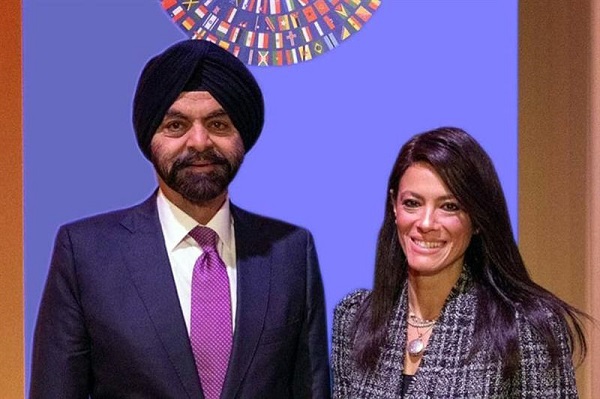
Egypt’s Minister of Planning, Economic Development and International Cooperation, Rania Al-Mashat, held talks with World Bank Group President Ajay Banga on the sidelines of the World Economic Forum in Davos, as part of efforts to strengthen strategic cooperation amid mounting global economic and geopolitical challenges.
The meeting focused on the evolving landscape of international development finance and the need to adapt global partnerships to address intersecting crises, including slowing growth, rising debt burdens, climate pressures, and geopolitical uncertainty. Al-Mashat, who also serves as Egypt’s Governor to the World Bank, said the discussions reflected a shared understanding of the urgency facing developing economies.
Al-Mashat highlighted messages delivered by President Abdel Fattah El-Sisi during his participation in Davos, noting that they underscored the scale of transformation underway in the global economic system. She said these changes demand a reassessment of international cooperation frameworks to safeguard sustainable development and preserve momentum in global partnerships at a time of compounded global shocks.
The minister emphasized that multilateral development banks, led by the World Bank Group, are increasingly expected to play a more proactive role in supporting developing countries. This includes expanding access to long-term development financing, scaling up concessional and innovative funding instruments, and strengthening countries’ resilience in the face of current economic and geopolitical pressures.
Al-Mashat outlined Egypt’s ongoing economic transition toward a model more firmly anchored in the real economy, with growth driven by production, exports, and investment rather than short-term financial flows. She said the government continues to pursue structural reforms aimed at raising productivity, expanding export-oriented sectors, and encouraging both domestic and foreign investment.
She added that human development, industrial localization, increased investment, and improved labor market efficiency form the core pillars of Egypt’s “National Narrative for Comprehensive Development,” a framework designed to deliver more sustainable and inclusive growth with the private sector as the primary engine.
The minister noted that cooperation between Egypt and the World Bank Group has undergone a qualitative shift in recent years, moving beyond traditional financing toward deeper engagement on policy reform, private sector empowerment, and business climate improvement. She pointed to the Bank’s growing role as a knowledge partner, including advisory services related to Egypt’s state asset offering program and collaboration with the unit overseeing state-owned enterprises.
Al-Mashat said recent economic indicators suggest a gradual improvement in Egypt’s outlook, with the private sector increasing its contribution to growth and total investment alongside continued structural reforms and an improving investment climate. She stressed the importance of sustaining close cooperation with the World Bank Group in the coming period to mobilize additional investment and implement projects with broad developmental impact.
She also highlighted the role of the World Bank’s private-sector arms, including the International Finance Corporation and the Multilateral Investment Guarantee Agency, in supporting Egypt’s development priorities through financing, risk mitigation, and private investment mobilization.
The meeting took place as global leaders and financial institutions at Davos debated reforms to the international financial architecture, including proposals to expand the lending capacity of multilateral development banks and align development finance more closely with climate goals, poverty reduction, and private-sector-led growth in emerging economies.
