

Ahmed Kamel – Egypt Daily News
Tensions between the United States and Iran have resurfaced sharply after U.S. President Donald Trump announced that a “large” American naval force is moving toward the Middle East, while warning Tehran against suppressing protests or resuming sensitive nuclear activities.
Speaking to reporters aboard Air Force One during his return to Washington from the World Economic Forum in Davos, Trump said the deployment was precautionary and expressed hope that it would not be used. “I don’t want escalation,” he said. “But we’re watching very closely. We have a war fleet moving in that direction, and we may not have to use it.”
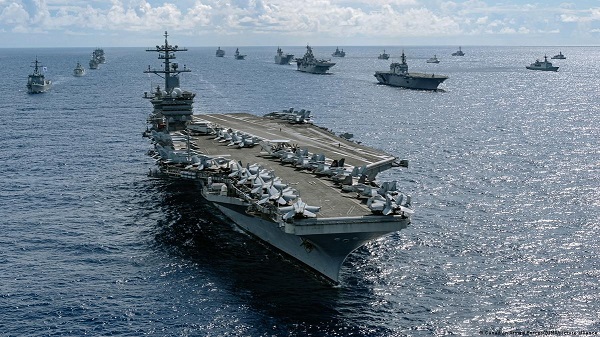
U.S. officials confirmed that the aircraft carrier USS Abraham Lincoln, accompanied by several guided-missile destroyers, is expected to arrive in the region in the coming days after leaving the Asia-Pacific last week. According to Reuters, Washington is also considering sending additional air defense systems to reinforce its regional posture.
The latest moves follow a period of heightened confrontation after Washington supported and participated in Israel’s 12-day war with Iran in June, aimed at weakening Tehran’s nuclear and missile programs. Trump has repeatedly kept the option of further military action on the table, particularly in response to Iran’s handling of domestic unrest and its nuclear ambitions.
Trump reiterated claims that his warnings to Tehran had led to a halt in executions of detainees linked to protests, asserting that Iranian authorities canceled around 840 hangings after he threatened stronger retaliation. “I told them if you execute these people, you’ll get hit harder than ever before,” he said, adding that any such strike would dwarf previous U.S. actions against Iran’s nuclear facilities.
Oil markets reacted quickly to the renewed rhetoric. Brent crude rose to $64.41 a barrel on Friday, while U.S. West Texas Intermediate climbed to $59.69, rebounding after a nearly 2 percent drop the previous day amid fears that any military clash could disrupt regional supply routes.
Iran responds with warnings
Iranian officials responded with stark warnings of their own. Major General Mohammad Pakpour, commander of Iran’s Islamic Revolutionary Guard Corps (IRGC), said Tehran was on the highest level of alert, declaring that Iran’s “finger is on the trigger.”
In a statement broadcast on state television, Pakpour cautioned the United States and Israel against “miscalculations,” urging them to draw lessons from history and from the recent 12-day conflict. “The IRGC and Iran are more prepared than ever to carry out orders issued by the Supreme Leader, Ali Khamenei,” he said.
Separately, Ali Abdollahi Aliabadi, commander of Iran’s Khatam al-Anbiya Central Headquarters, warned that any attack would render “all American interests, bases, and centers of influence” legitimate targets for Iran’s armed forces.
The IRGC has been accused by international rights organizations of violently suppressing protests and is designated as a terrorist organization by the United States, Canada, and Australia. Pakpour assumed command of the force last year after his predecessor, Hossein Salami, was killed in Israeli strikes during the June conflict, which also claimed the lives of several senior Iranian military figures.
Mounting toll from protests
Iranian authorities this week released their first official death toll from the recent wave of protests, with state television citing the Foundation of Martyrs and Veterans Affairs as saying 3,117 people were killed. Of these, 2,427 including members of the security forces—were classified as “martyrs,” described as innocent victims, many of whom were reportedly bystanders hit by gunfire.
Human rights groups have challenged the credibility of those figures. Mahmoud Amiri-Moghaddam, director of Iran Human Rights, said evidence from inside the country suggests the real number is significantly higher. His organization estimates at least 3,428 deaths so far, while the U.S.-based Human Rights Activists News Agency (HRANA) says it has verified more than 4,510 protest-related deaths, including over 4,250 demonstrators, with thousands of cases still under review.
Arrests have also surged. Rights groups report at least 26,541 people detained, while Iranian state television announced on Thursday that more than 200 additional arrests were made in provinces including Kermanshah in the west and Isfahan in central Iran.
Nuclear file under scrutiny
Meanwhile, Iran is expected to submit a report to the International Atomic Energy Agency (IAEA detailing the status of nuclear sites struck by U.S. forces and the fate of nuclear materials believed to have been stored there. Among them is an estimated 440.9 kilograms of uranium enriched to 60 percent purity—an amount that, if further enriched, could be sufficient for several nuclear weapons, according to IAEA assessments.
The agency has been unable to verify Iran’s stockpile of highly enriched uranium for at least seven months, despite inspection mechanisms that typically require monthly checks.
At Davos, Trump said Iran was signaling a willingness to talk, and that Washington was open to negotiations. He reiterated that the United States had struck Iranian uranium enrichment facilities last year to prevent Tehran from acquiring a nuclear weapon. “That can’t be allowed to happen,” Trump said. “Iran wants to talk, and we will talk.”
As diplomatic signals and military warnings unfold in parallel, analysts say the risk of miscalculation remains high, even as all sides publicly insist they are seeking to avoid a wider conflict.
