

Ahmed Kamel – Egypt Daily News
After nearly two decades of stalled negotiations, India and the European Union have concluded what both sides describe as a historic free trade agreement, a deal shaped as much by geopolitics as by economics. While the pact promises to deepen commercial ties between two of the world’s largest economies, its timing and momentum reflect growing uncertainty over the United States’ trade policy under President Donald Trump.
The agreement comes as global trade patterns are being reshaped by rising protectionism, geopolitical rivalry and the weaponization of tariffs. For both New Delhi and Brussels, the deal is widely seen as a strategic hedge against the unpredictability of Washington, where Trump has revived aggressive tariff policies targeting both allies and competitors.
The European Union is already India’s largest trading partner, with bilateral trade in goods reaching $142.3 billion in 2024, accounting for 11.5 percent of India’s total trade. India, in turn, ranks as the EU’s ninth-largest trading partner. Despite these strong fundamentals, negotiations launched in 2007 languished for years due to disagreements over tariffs, agriculture, intellectual property, and market access.
What changed, analysts say, is the global political climate.
Trump’s return to the White House has brought renewed trade tensions. The United States has imposed tariffs totaling 50 percent on Indian goods, including a 25 percent penalty linked to India’s continued purchases of Russian oil. European countries have also faced tariff threats, including a recent episode in which Trump warned of new duties against EU states opposing his proposal to annex Greenland, before later backing down.
Against this backdrop, countries around the world have accelerated efforts to diversify trade partnerships. The India–EU agreement is the seventh trade deal India has concluded recently and follows the EU’s long-awaited accord with the Mercosur bloc in South America, finalized earlier this month after 25 years of negotiations. Canada and the United Kingdom have also moved to reset trade ties with China, underscoring a broader global realignment.
Michael Kugelman, senior fellow for South Asia at the Atlantic Council, said the “Trump factor” played a decisive role. Both India and the EU, he noted, were hit by US tariffs they did not anticipate, creating a strong incentive to overcome longstanding differences and finalize the deal.
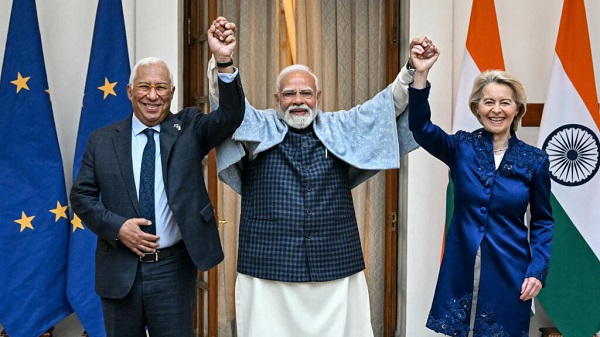
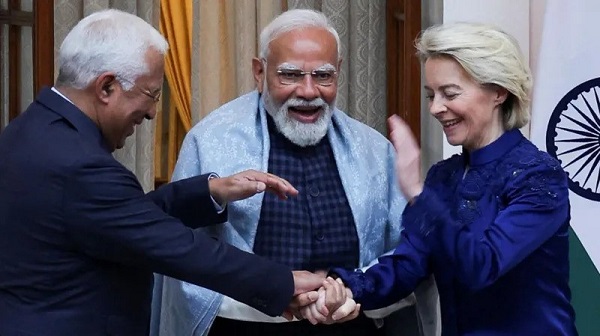
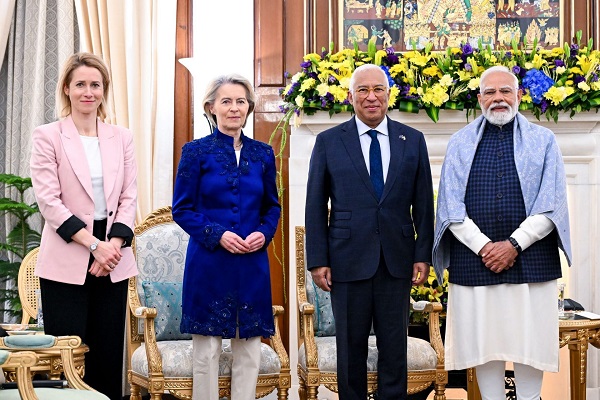
European Commission President Ursula von der Leyen and Indian Prime Minister Narendra Modi jointly hailed the agreement as “the mother of all deals,” underscoring its strategic significance. Speaking in New Delhi, von der Leyen described the pact as a partnership between two global giants that reduces strategic dependencies at a time when trade is increasingly used as a political weapon. Modi said the global order is in “great turmoil” and that the agreement would strengthen supply chains and serve as a new blueprint for shared prosperity.
The deal aims to significantly expand market access on both sides. The European Commission estimates that EU goods exports to India could double by 2032. Under the agreement, Indian tariffs on European cars will gradually fall from 110 percent to 10 percent, while duties on machinery, chemicals and pharmaceuticals will largely be eliminated. Tariffs on EU wines will be cut in stages from 150 percent to 20 percent, and levies on olive oil will be phased out over five years.
In return, the EU will reduce tariffs on Indian exports, benefiting labor-intensive sectors such as textiles, tea, spices, gems and jewelry. Indian officials say the agreement supports domestic manufacturing while opening new opportunities for exporters hit hard by US trade measures.
The deal also carries political and security implications. For India, closer economic ties with Europe may help balance China’s dominance in global trade and reduce reliance on Russia, particularly in defense procurement. While India maintains long-standing ties with Moscow, the agreement complements its growing defense and industrial cooperation with countries such as France and other European partners.
For the EU, India represents a vast and relatively underpenetrated market, as well as a potential alternative to China in key supply chains. Brussels has increasingly framed trade policy as part of a broader push for strategic autonomy, a theme von der Leyen emphasized recently at the World Economic Forum in Davos.
Not everyone in Washington is pleased. US Treasury Secretary Scott Bessent criticized the deal, accusing the EU of “financing the war against themselves” by deepening trade with India, citing New Delhi’s continued imports of Russian oil. Indian officials have repeatedly rejected such claims, arguing that energy security for a population of more than 1.4 billion people cannot be subordinated to external pressure.
Despite the celebratory tone, the agreement still faces hurdles. Legal experts from both sides must finalize the text, after which it will require approval from EU member states and the European Parliament, a process that could take months and may encounter resistance, as seen with the Mercosur deal. Outstanding issues remain around agriculture, intellectual property rights and carbon-related regulations.
Economists caution that while the deal carries strong symbolic weight, its immediate economic impact may be modest. Daniel Kral of Oxford Economics described it as having “large symbolic importance in a world of rising protectionism,” even if it does not dramatically boost growth in the short term.
Still, business groups on both sides have welcomed the agreement as a critical first step. European and Indian industries affected by US tariffs see it as a pathway to greater stability and diversification.
Neither India nor the EU is seeking to abandon trade ties with the United States, which remains a vital market for both. But by striking this landmark deal, New Delhi and Brussels are signaling that they are prepared to look beyond Washington to safeguard their economic interests.
Whether the agreement ultimately strengthens their hand in future negotiations with President Trump remains to be seen. In a global trade environment increasingly shaped by uncertainty, one thing is clear: the India–EU pact is about far more than tariffs, it is a statement of intent in an era of fractured globalization.
