

Ahmed Kamel – Egypt Daily News
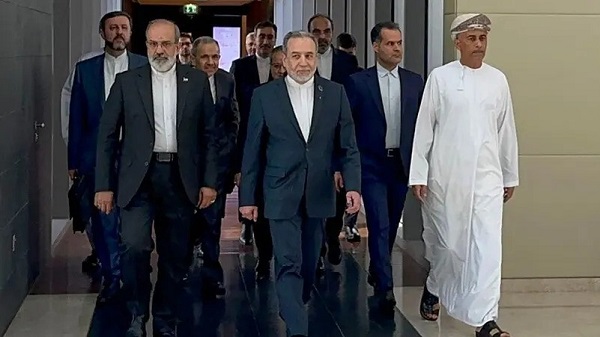
Iran’s Foreign Minister Abbas Araghchi described talks with the United States held in Oman on Friday as “very positive,” confirming that both sides agreed to continue negotiations, while stressing that discussions were strictly limited to Iran’s nuclear program and did not extend to other contentious issues.
Speaking to Iran’s state television following the meeting, Araghchi said the atmosphere of the talks was constructive and marked by an exchange of views and arguments. “In a very positive environment, we exchanged positions and presented our perspectives to the other side,” he said, adding that Iran and the United States had agreed in principle to pursue further negotiations. He noted, however, that decisions regarding mechanisms and timing would be made after consultations in Tehran and Washington.
Araghchi said the two sides had also exchanged concerns and assessments during the talks, expressing cautious optimism that continued dialogue could lead to a workable framework for an agreement. He identified the main challenge as overcoming the deep-seated mistrust between Tehran and Washington, a legacy of decades of hostility and failed diplomatic efforts.
Emphasizing Iran’s position, Araghchi made clear that the talks were confined exclusively to the nuclear file. “We are not negotiating on any issues other than the nuclear issue with the United States,” he said, rejecting Washington’s broader agenda. He reiterated that future steps would depend on internal consultations in both capitals before negotiators determine how to move forward.
Earlier, Araghchi had written on X that Iran was entering this round of diplomacy “with open eyes and a memory that includes what happened last year,” underscoring Tehran’s cautious approach. He called for mutual respect, saying Iran would engage in good faith while firmly defending its rights. “Mutual respect and shared interests are not just slogans, but an absolute necessity,” he wrote.
The talks in Muscat come amid heightened regional and international tensions surrounding Iran’s nuclear program, with growing concerns that failure to revive diplomacy could increase the risk of a broader conflict in the Middle East. While both sides have signaled a willingness to give diplomacy another chance, significant differences remain over the scope and objectives of the negotiations.
U.S. Secretary of State Marco Rubio said earlier this week that Washington wants the talks to address not only Iran’s nuclear program but also its ballistic missile capabilities, its support for armed groups across the region, and its domestic human rights record. Iran has firmly rejected this approach, insisting that only nuclear-related issues be discussed between Araghchi and U.S. Middle East envoy Steve Witkoff in Oman.
Iranian officials have repeatedly stated that Tehran is participating in the talks “from a position of strength,” aiming for what they describe as a fair and mutually acceptable understanding that preserves the country’s dignity and rights regarding its nuclear activities. Foreign Ministry spokesperson Esmail Baghaei said on Thursday that Iran hopes the U.S. side will demonstrate “responsibility, realism, and seriousness” during the process.
The diplomatic engagement unfolds against a backdrop of escalating military pressure. Iranian leaders remain deeply concerned about the possibility that U.S. President Donald Trump could act on repeated threats to strike Iran, particularly after Washington reinforced its naval presence in the region. Trump has described the deployment as a large “fleet” and warned that “bad things” could happen if no agreement is reached.
The tensions have been further fueled by unrest inside Iran following a government crackdown on protests last month, developments that have contributed to a sharper tone in U.S.-Iran relations. In response, Iran has warned that it would retaliate forcefully against any military attack and has cautioned neighboring countries hosting U.S. bases that they could become targets if they are involved in an assault on Iranian territory.
As consultations continue in both capitals, the future of the talks remains uncertain. While the initial round has been framed by Tehran as constructive, the sharp disagreement over the scope of negotiations suggests that translating cautious optimism into a concrete agreement will be a difficult and politically sensitive process for both sides.
