

Ahmed Kamel – Egypt Daily News
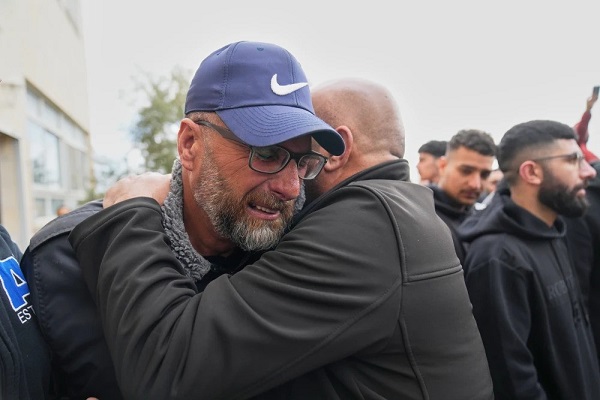
A 19-year-old Palestinian-American was shot and killed during clashes in the occupied West Bank, Palestinian officials and witnesses said, in the latest episode of mounting violence involving Israeli settlers and local residents.
The Palestinian Health Ministry identified the victim as Nasrallah Abu Siyam, who died of critical wounds sustained Wednesday afternoon near the village of Mukhmas, northeast of Ramallah. His mother told The Associated Press that he was a U.S. citizen, making him the second Palestinian-American reported killed by Israeli settlers in less than a year.
According to Raed Abu Ali, a resident of Mukhmas, a group of Israeli settlers entered the village and attacked a farmer, prompting local residents to intervene. Clashes followed. Abu Ali said Israeli forces later arrived and used tear gas, sound grenades and live ammunition.
“When the settlers saw the army, they were encouraged and started shooting live bullets,” he said, alleging that armed settlers shot Abu Siyam and injured several others. He also claimed that some of the wounded were beaten after falling to the ground.
The Israeli military said it had received reports of Palestinians throwing rocks and responded with what it described as “riot dispersal methods.” It denied that its forces had fired live ammunition and said “suspects” had shot at Palestinians, who were later evacuated for medical treatment. It did not say whether any arrests had been made.
A spokesperson for the U.S. Embassy said Washington “condemns this violence.”
Rising West Bank Violence
Abu Siyam’s death comes amid a broader surge in violence in the West Bank. According to the United Nations Office for the Coordination of Humanitarian Affairs, Israeli forces and settlers killed 240 Palestinians last year. Over the same period, Palestinians killed 17 Israelis, six of them soldiers.
The Palestinian Authority’s Wall and Settlement Resistance Commission said Abu Siyam was the first Palestinian reported killed by settlers in 2026.
Mukhmas and its surrounding areas, much of which fall under Israeli civil and military administration, have become a flashpoint. Palestinian residents and Israeli human rights groups say settler attacks, including arson, physical assaults and the establishment of outposts considered illegal under Israeli law have intensified in recent years.
Rights advocates contend that Israeli authorities frequently fail to prosecute settlers accused of violence. Israeli officials have rejected such claims, saying law enforcement agencies investigate incidents and act when sufficient evidence exists.
U.N. Raises Alarm Over Displacement and “Ethnic Cleansing” Concerns
The killing coincided with the release of a report by the U.N. human rights office accusing Israel of practices that may constitute war crimes in the West Bank. The Office of the High Commissioner for Human Rights said Israeli policies that displace Palestinians and alter the territory’s demographic composition “raise concerns over ethnic cleansing.”
Covering the period from November 2024 to October 2025, the report described what it called a “concerted and accelerating effort to consolidate annexation” while maintaining a system of domination over Palestinians.
It cited expanding settlements and outposts, demolition orders and repeated settler attacks as factors contributing to the displacement of Palestinian communities. Israeli rights group B’Tselem has reported that roughly 45 Palestinian communities have been completely emptied since the start of the Israel–Hamas war.
The U.N. office also criticized Israeli military operations in the northern West Bank, saying they employed tactics “designed for warfare,” including airstrikes and the forced transfer of civilians. Israel has said those operations target militant groups and are necessary for security.
In addition, the report accused Palestinian security forces of using excessive force in some instances and cited cases of intimidation and mistreatment of journalists and critics by the Palestinian Authority.
Israel’s Foreign Ministry did not immediately respond to the report and has previously accused the U.N. human rights office of bias.
Journalists’ Treatment Under Scrutiny
Separately, the Committee to Protect Journalists said dozens of Palestinian journalists detained during the Gaza war reported abuse, including physical assault, stress positions, sensory deprivation, sexual violence and medical neglect.
The group documented the detention of at least 94 Palestinian journalists and one media worker from the West Bank, Gaza and Israel. Thirty remain in custody, according to the organization. It said about half were held under Israel’s administrative detention system, which allows authorities to detain individuals without charge for renewable six-month periods if they are deemed security threats.
Israel’s prison service did not immediately comment on the report but has previously rejected similar allegations, stating that its facilities operate under the law and are subject to oversight.
Gaza’s Reconstruction Measured in Years
While tensions escalate in the West Bank, the humanitarian crisis in Gaza continues to deepen.
The United Nations Development Programme estimates that clearing the vast rubble left by months of fighting could take at least seven years. Former Belgian Prime Minister Alexander De Croo, who recently returned from Gaza, said only 0.5% of the debris has been removed.
He described living conditions as the worst he has witnessed, with approximately 90% of Gaza’s 2.2 million residents living in rudimentary tents amid rubble that poses both health risks and dangers from unexploded ordnance.
According to De Croo, the UNDP has constructed 500 improved temporary housing units and has 4,000 more ready, but estimates that between 200,000 and 300,000 units are ultimately required. He called for expanded access for reconstruction materials and greater involvement from the private sector.
An Expanding Crisis
The violence in Mukhmas and the broader findings by international organizations underscore the widening scope of the Israeli-Palestinian conflict beyond Gaza. With settlement expansion, displacement, legal battles and humanitarian collapse unfolding simultaneously, the situation across the occupied territories remains volatile.
As diplomatic efforts struggle to gain traction and accountability mechanisms face political constraints, incidents like the killing of Nasrallah Abu Siyam risk further inflaming tensions in a region already strained by war, displacement and deepening mistrust.
