

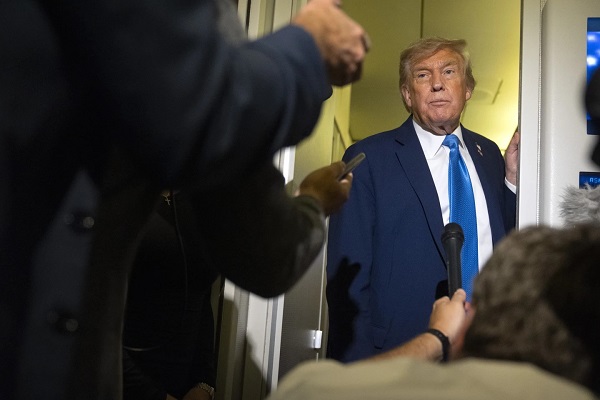
Egypt Daily News – U.S. President Donald Trump has harshly criticized French President Emmanuel Macron’s announcement that France intends to formally recognize a Palestinian state during the United Nations General Assembly this September. In comments made from the White House, Trump downplayed the significance of Macron’s statement, calling it “has no weight” and lacking practical impact.
“Macron is a very nice guy, I like him,” Trump said. “But his words don’t carry any weight. This statement means nothing.” He further criticized what he described as Hamas’s deliberate sabotage of ceasefire negotiations in Doha, arguing the group has no genuine interest in reaching an agreement.
“We pulled out of the Gaza talks, and it’s unfortunate. Hamas wasn’t serious about any deal,” Trump added. “They know what’s coming after the hostages are returned — that’s why they don’t want an agreement. There has to be a fight, and Hamas must be eliminated.”
Trump also revealed that he had spoken with Israeli Prime Minister Benjamin Netanyahu about the need to facilitate humanitarian aid into Gaza but did not provide additional details.
Macron’s Announcement Divides the International Community
Macron’s Thursday announcement about recognizing a Palestinian state drew mixed reactions worldwide. He expressed hope that the move would revive momentum for peace in the Middle East and offer a political horizon after months of deadly conflict.
While Hamas, Saudi Arabia, and several other countries welcomed the declaration, Israel and the United States reacted with swift condemnation. Israeli Prime Minister Benjamin Netanyahu accused France of “rewarding terrorism,” while U.S. Secretary of State Marco Rubio called the decision “reckless.”
Britain Under Pressure, Germany Remains Cautious
According to a Bloomberg report, British Prime Minister Keir Starmer is under growing pressure from senior government officials and from Macron to follow suit and immediately recognize Palestinian statehood. The calls come amid worsening humanitarian conditions in Gaza.
Starmer responded by announcing emergency talks with France and Germany to discuss the situation in Gaza, denouncing the suffering and starvation in the enclave as “unimaginable and indefensible.”
Germany, however, said it does not intend to recognize a Palestinian state in the near future. In a statement, the German government emphasized that its current priority is to achieve “long-overdue progress” toward a viable two-state solution.
Ceasefire Talks Collapse Amid Accusations
In Doha, negotiations aimed at brokering a ceasefire between Israel and Hamas have stalled. U.S. envoy to the Middle East Steve Witkoff announced that the American delegation was withdrawing from the talks, citing Hamas’s latest response as evidence of its unwillingness to reach a ceasefire.
Hamas responded with surprise to Witkoff’s statement, issuing a communiqué affirming its “commitment to the negotiation track” and expressing readiness to overcome obstacles in pursuit of a lasting ceasefire.
Israeli public broadcaster KAN cited a political source who emphasized that Israel’s delegation returning to Tel Aviv did not signify a collapse of talks. “We’ll go back to Qatar once there’s tangible progress,” the source said.
Gaza Faces Escalating Humanitarian Emergency
Meanwhile, Gaza’s humanitarian crisis continues to worsen. The Ministry of Health in the enclave reported nine additional deaths over the past 24 hours due to hunger and malnutrition, raising the total number of such fatalities to 122, including 83 children.
A coalition of 109 humanitarian organizations including Save the Children and Doctors Without Borders sounded the alarm over “unprecedented levels” of acute malnutrition, blaming Israel’s blockade on aid deliveries for creating catastrophic shortages.
World Health Organization (WHO) Director-General Tedros Adhanom Ghebreyesus stated bluntly that the famine unfolding in Gaza is a direct result of Israel’s obstruction of humanitarian access. The World Food Programme added that one in every three people in Gaza now goes days without food, warning that only a sustained flow of aid could stop mass starvation.
Mounting International Criticism of Israel
The international community is increasingly voicing outrage over the unfolding disaster. Canadian Prime Minister Mark Carney accused the Israeli government of violating international law by blocking Canadian-funded aid deliveries and failing to prevent a humanitarian catastrophe.
Australian Prime Minister Anthony Albanese described the crisis as a “humanitarian disaster” and called for immediate and unimpeded delivery of aid to the Gaza Strip.
In Italy, Foreign Minister Antonio Tajani declared that “massacres and famine in Gaza can no longer be tolerated.” However, he rejected the notion of recognizing a Palestinian state at this stage, unlike France. Tajani argued that recognition should happen only in parallel with reciprocal acknowledgment of the Israeli state, a stance that drew criticism from opposition lawmakers.
A Fractured Diplomatic Landscape
As the war in Gaza drags on and the humanitarian toll deepens, the international diplomatic landscape appears increasingly fractured. While some European nations push to recognize Palestinian statehood as a political lever, others call for caution and renewed focus on negotiated solutions.
Trump’s hardline position reflects a deepening divide between those calling for immediate state recognition and those urging a more security-focused approach, all while Gaza’s 2.3 million residents continue to suffer under siege.
