

Ahmed Kamel – Egypt Daily News
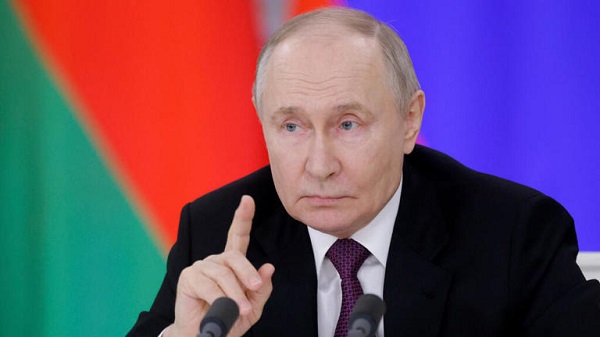
Russian President Vladimir Putin stated on Tuesday that Moscow has never opposed Ukraine’s potential membership in the European Union but remains firmly against the country joining the NATO military alliance. His comments came during an official visit to China, where he held a series of bilateral meetings with regional leaders, including Slovak Prime Minister Robert Fico.
“In terms of Ukraine joining the European Union, we have never objected to that,” Putin said. “But NATO is another matter entirely. That is something we cannot accept.”
The Russian president’s remarks highlight the Kremlin’s long-standing distinction between Ukraine’s economic and political alignment with Europe and its potential military alignment with the West. Moscow has repeatedly framed NATO expansion as a direct threat to Russian national security, particularly in regions it considers part of its historical sphere of influence.
Putin also dismissed recent warnings by European leaders of a possible wider Russian military escalation on the continent, calling such concerns “hysteria” and “scare stories.”
“These are exaggerated narratives meant to stir panic,” he said, suggesting that the West is intentionally provoking fear over Russian intentions.
On the ongoing war in Ukraine, which began with Russia’s full-scale invasion in February 2022, Putin reiterated Moscow’s justification: that the move was a response to what he described as Western efforts to pull former Soviet territories into its orbit through NATO expansion. “We were forced to react,” he said, once again framing the invasion as a preemptive security measure rather than an act of aggression.
In a surprising revelation, Putin mentioned that he had discussed Ukraine’s security with former U.S. President Donald Trump during a summit held on August 15 in Alaska. Although the details of that meeting have not been independently confirmed, Putin claimed there was space for dialogue once the war ends.
“There are ways to ensure Ukraine’s security if the conflict comes to an end,” he said. “It seems to me there is a possibility for consensus on this issue.”
His comments come at a time of shifting global alliances and growing speculation about the West’s long-term commitment to Kyiv. While Ukraine continues to press for stronger security guarantees and accelerated integration into Western institutions, the war’s economic and political toll is also fueling cautious recalibrations in some European capitals.
Meanwhile, Moscow appears eager to present itself as open to negotiations, albeit on its own terms. The suggestion that Russia is willing to engage in discussions about Ukraine’s post-war security arrangements so long as NATO membership is off the table could signal a renewed push to shape the eventual terms of any peace settlement.
Despite Western skepticism, Putin’s statements reflect an ongoing attempt to reshape the narrative around the war and frame Russia as a rational actor defending its strategic interests, rather than an aggressor seeking territorial expansion.
As diplomatic tensions persist, Ukraine’s future—both within Europe and in relation to NATO remains one of the most contentious geopolitical questions of the current era. For now, the Kremlin’s message is clear: European integration may be tolerable, but military alignment with NATO crosses a red line.
