

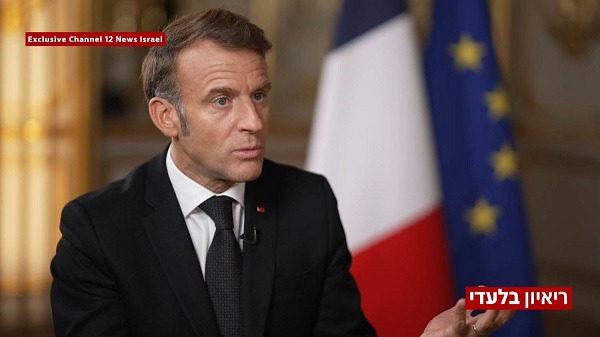
Ahmed Kamel – In a rare and strongly worded interview with Israel’s Channel 12, French President Emmanuel Macron reaffirmed France’s unwavering commitment coordinated with Saudi Arabia to a two-state solution as the only viable path to resolving the Israeli-Palestinian conflict. Speaking from Paris ahead of a high-level diplomatic conference on the two-state solution scheduled to be held next week in New York, Macron criticized Israel’s ongoing military campaign in Gaza and its expansion of settlements in the West Bank, calling both morally and legally indefensible.
“I do not support you at all when you build settlements or displace residents in Gaza,” Macron stated bluntly. He described the Israeli military operation in Gaza City as a “grave mistake” and a “violation of international law,” arguing that it would not lead to long-term security. “This campaign will not achieve its stated goals,” he added.
The French president emphasized that contrary to Israeli claims, military operations have not weakened Hamas. “The number of fighters in the movement is the same as it was two years ago,” Macron said. “But the real outcome has been thousands of civilian deaths, which have severely damaged Israel’s international credibility and moral standing.”
Macron also sharply criticized a recent Knesset vote advancing the resettlement of areas in the West Bank, asserting that such measures have nothing to do with combatting Hamas. “This has nothing to do with Hamas, it is about depriving Palestinians of their legitimate right to a state,” he said.
He stressed that recognizing a Palestinian state is the best strategy to isolate Hamas politically and ideologically. “This may be the last moment before the two-state solution becomes impossible,” Macron warned, calling for urgent international action.
As part of the upcoming diplomatic efforts, Macron unveiled a joint French-Saudi initiative that includes the formation of a new Palestinian government, the revitalization of the Palestinian Authority, and the establishment of clear commitments from its leadership. The plan also envisions the deployment of an international security force under UN mandate to help stabilize the region, alongside accelerated training of Palestinian security forces under transparent Israeli supervision.
Macron did not rule out the possibility of sanctions against Israel if the Gaza offensive continues. “If the operation in Gaza City persists as a decision of the Israeli government, this will certainly become a matter of discussion,” he said. “What is happening in Gaza is a serious and unacceptable error and goes against international law.”
The interview marks one of the most direct and critical statements by a European leader toward Israel’s current policies and reflects growing international impatience with the lack of progress on a political resolution to the long-standing conflict. As momentum builds ahead of the New York conference, Macron’s comments signal a potential shift in international engagement with the region, one that might include diplomatic pressure, recognition of Palestinian statehood, and even punitive measures if the situation on the ground continues to deteriorate.
