

Ahmed Kamel – Egypt Daily News
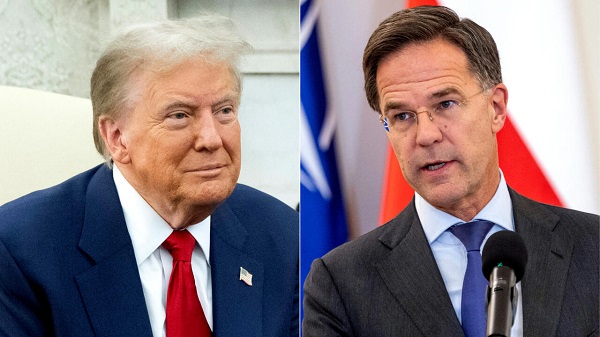
NATO Secretary General Mark Rutte said on Monday that security in the Arctic has become “a priority” for the alliance, following controversial remarks by U.S. President Donald Trump in which he declared that the United States would take control of Greenland “one way or the other.”
Trump’s comments have sent shockwaves through the 32-member NATO alliance, particularly as Greenland is an autonomous territory within the Kingdom of Denmark, itself a NATO member. The U.S. president has repeatedly refused to rule out the use of military force to seize the island, framing his position as necessary to counter growing Russian and Chinese activity in the Arctic.
Speaking to journalists during a visit to Croatia, Rutte said that allies were aligned on the strategic importance of the region. “All allies agree on the importance of the Arctic and Arctic security, because we know that with sea lanes opening up there is a risk that the Russians and the Chinese will be more active,” he said. He added that NATO was now discussing practical steps to translate those concerns into concrete action.
Diplomats say alliance members are exploring ideas such as launching a new NATO mission focused on the Arctic, though discussions remain at an early stage and no formal proposals have yet been presented. The push to strengthen Arctic security is widely viewed as an effort to address U.S. concerns while keeping the issue within NATO’s collective framework, rather than through unilateral American action.
The debate has sparked sharp warnings from European leaders. European Commissioner for Defence and Space Andrius Kubilius said on Monday that a U.S. military takeover of Greenland would effectively spell the end of NATO. He echoed similar remarks by Danish Prime Minister Mette Frederiksen, who has warned that an armed attack by one NATO member on another would dismantle the post-Second World War security order.
“I agree with the Danish prime minister that it will be the end of NATO,” Kubilius told Reuters at a security conference in Sweden, adding that such a move would have a deeply negative impact on public opinion and transatlantic relations.
Frederiksen reiterated her stance in recent television interviews, stating that if the United States were to militarily attack Greenland, “everything would stop – that includes NATO.” Denmark has received strong backing from several European allies, with leaders from the United Kingdom, France, Germany, Italy, Poland, Spain, and Denmark issuing a joint statement affirming that Greenland belongs to its people and that only Denmark and Greenland can decide on their future.
Trump, however, has dismissed concerns about alliance unity. Posting online, he claimed credit for strengthening NATO by pressuring European countries to increase defense spending. “I’m the one who SAVED NATO!!!” he wrote. Speaking to reporters aboard Air Force One, Trump said reaching a deal with Greenland would be “easier” than taking it by force, but insisted that U.S. control of the territory would happen regardless.
“If we don’t take Greenland, Russia or China will take Greenland, and I’m not gonna let that happen,” he said, adding that the territory would benefit from closer U.S. ties, particularly in defense. He downplayed Greenland’s current security arrangements, claiming its defense amounted to “two dogsleds,” while warning of increased Russian and Chinese naval activity in the region.
The Greenlandic government firmly rejected Trump’s assertions, stating that it “cannot accept under any circumstances” the U.S. desire to control the island. In an official statement, it emphasized that Greenland is part of the Kingdom of Denmark and, through the Danish Commonwealth, a member of NATO. It stressed that the defense of Greenland must take place under NATO auspices and within the framework of alliance cooperation.
Greenland’s Prime Minister Jens-Frederik Nielsen also defended the territory’s democratic rights and adherence to international law. “We are a democratic society that makes our own decisions,” he said in a social media post. “Our security and defense belong in NATO. It is a fundamental and firm line.”
Public reaction in Greenland has been largely negative. Some residents described Trump’s remarks as alarming and intrusive, saying they simply want to be left alone. The controversy has also resonated elsewhere in Europe, with Sweden’s Deputy Prime Minister Ebba Busch warning that countries must safeguard their strategic assets amid growing great-power competition.
Despite criticism that NATO is bending too far to accommodate Trump, Rutte defended his approach, arguing that the U.S. president has played a decisive role in pushing allies to increase defense spending. He said he was convinced that without Trump, NATO would not have reached last year’s agreement in The Hague to raise defense spending targets to 5 percent of GDP.
As tensions rise, the Greenland dispute has become a flashpoint in a broader debate about sovereignty, alliance unity, and the future of transatlantic security at a time of intensifying competition in the Arctic.
