

Ahmed Kamel – Egypt Daily News
Israeli Prime Minister Benjamin Netanyahu took an unusually long and circuitous flight route to the United States this week, apparently to avoid airspace over countries that could enforce an outstanding arrest warrant against him issued by the International Criminal Court (ICC).
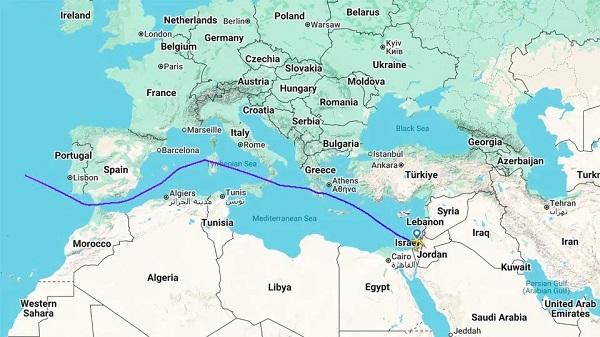
Netanyahu departed Tel Aviv on Wednesday evening en route to New York, where he is scheduled to address the United Nations General Assembly and hold high-level talks with U.S. President Donald Trump. However, flight tracking data revealed that instead of taking the conventional path over Europe, his aircraft diverted southward, flying along the length of the Mediterranean Sea before passing through the Strait of Gibraltar and into the Atlantic.
According to tracking platforms like FlightRadar24 and ADS-B Exchange, the flight briefly crossed the airspace of Greece and Italy, but notably avoided France and Spain, both member states of the ICC. The detour added several hours to the journey.
While the Prime Minister’s Office (PMO) has not commented publicly on the unusual route, the circumvention of European airspace comes amid heightened legal risks for Netanyahu. In November of last year, the ICC issued an arrest warrant against the Israeli leader for alleged war crimes and crimes against humanity related to military operations in Gaza and the occupied Palestinian territories. As signatories to the Rome Statute, European Union nations are theoretically obligated to arrest individuals subject to ICC warrants if they enter or transit their jurisdiction.
Though Netanyahu is not the only Israeli official named in ICC proceedings, his role as head of government has made him the primary focus of international legal scrutiny. While the chances of a sitting prime minister being detained mid-flight remain slim, the legal exposure remains a significant concern for Israel’s leadership.
Interestingly, a French diplomatic source confirmed that France had, in fact, granted Israel permission for Netanyahu’s plane to fly over its airspace. “Eventually they decided to take another route and we don’t know the reason,” the diplomat told reporters. Netanyahu’s previous trip to the United States in July had included a direct flight path over Greece, Italy, and France.
Adding another layer of complexity to the trip, the PMO announced two weeks prior that certain journalists and members of Netanyahu’s entourage would not accompany him. Officially, this was attributed to “technical arrangements related to seating and security,” but Israeli media, including The Jerusalem Post, reported that the move was aimed at reducing the aircraft’s weight to compensate for the additional fuel required by the longer flight path.
Neither Israel nor the United States are members of the ICC and thus are not bound by its jurisdiction. However, many European countries are signatories and theoretically compelled to enforce its warrants.
The ICC case has been politically explosive. Israeli officials have denounced the court’s investigation as biased and illegitimate, while supporters of the ICC process argue that it represents a step toward accountability in one of the world’s longest-running conflicts.
As Netanyahu continues his visit in New York, the altered flight route serves as a stark reminder of the increasingly complex international legal landscape facing Israeli leaders—and the diplomatic balancing act required to navigate it.
