

Ahmed Kamel – Egypt Daily News
On the first full day of the latest federal government shutdown, the U.S. Senate once again failed to pass competing funding proposals, underscoring the deepening partisan divide on Capitol Hill and virtually guaranteeing that the shutdown will stretch on for at least several more days.
Wednesday’s legislative session echoed the gridlock seen just 24 hours earlier, when two key procedural votes collapsed along party lines. The stalemate has left thousands of federal employees working without pay, disrupted services across multiple agencies, and fueled a blame game between Republicans and Democrats.
The Senate’s first vote on Wednesday targeted a Democratic-backed funding proposal that includes expanded healthcare provisions an effort to shore up key policy priorities even as negotiations over broader funding continue. The measure failed by a 47-53 vote, with every Democrat voting in favor and every Republican opposing it.
The second vote was on a stop-gap funding bill originally passed by the House and supported by Republicans. That measure also failed, 55-45, with a few defections from both sides. Democratic Senators Catherine Cortez Masto and John Fetterman, along with independent Senator Angus King, crossed the aisle to support the GOP proposal. However, Republican Senator Rand Paul voted against it, leaving the measure short of the 60-vote threshold required to advance.
Senate Majority Whip John Thune acknowledged the setback but insisted Republicans would continue efforts to win over more Democratic votes for what they are framing as a “clean” continuing resolution. “We’re close, but we need just a few more Democrats to put partisanship aside and do what’s right for the American people,” Thune said.
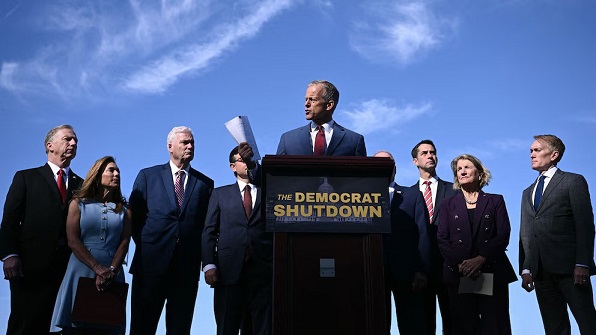
With no resolution in sight, both parties took to the Senate floor and dueling press conferences to cast blame for the shutdown.
Thune accused Democrats of yielding to “far-left demands” and shutting down the government at the expense of essential workers. “As of this morning, critical federal employees including members of the military, border patrol agents, and air traffic controllers are working without pay. A number of vital services are unavailable or at risk,” he said.
Across the aisle, Senate Minority Leader Chuck Schumer countered by blaming Republicans and former President Donald Trump for the impasse. “Donald Trump and Republicans have barreled us into a shutdown because they refuse to protect America’s health care,” Schumer said, adding that Democrats would not be “bullied” into abandoning their legislative priorities.
At a press conference earlier in the day, Speaker Mike Johnson also put the responsibility squarely on Democrats. “Every single bit of this was entirely avoidable,” he said. “Democrats in Congress have dragged our country into another reckless shutdown to satisfy their far-left base.”
Democrats fired back with equal force. “Republicans control the Senate, the House, and the White House. They need Democratic votes to fund the government, so it’s on them to talk with us,” said House Democratic Caucus Vice Chair Pete Aguilar. “This is not about political games, this is about people’s lives.”
Schumer reiterated his call for bipartisan negotiations, saying that Democrats were willing to sit down and hammer out a deal but not on Republican terms alone. “We’re not going to accept a my-way-or-the-highway approach,” he said Tuesday night following the failed votes.
With Congress now expected to recess for Yom Kippur, no additional votes on government funding are anticipated before Friday at the earliest delaying any chance of reopening the government until the weekend or beyond.
In the meantime, the shutdown’s impact is expected to grow. Federal agencies have begun scaling back operations, while millions of Americans could see delays in services such as passport processing, food assistance programs, and national park operations. Economic analysts warn that a prolonged shutdown could begin to erode consumer and investor confidence at a critical time for the U.S. economy.
Unless Congress can reach an agreement soon, the political cost of the impasse may be felt on both sides of the aisle but it will be American families and federal workers who bear the brunt of the fallout.
