

Ahmed Kamel – Egypt Daily News
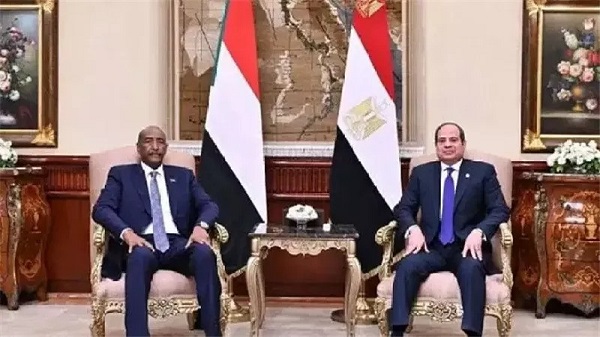
President Abdel Fattah el-Sisi and Sudanese Sovereign Council Chairman General Abdel Fattah al-Burhan have jointly reiterated their unequivocal rejection of any unilateral measures taken on the Blue Nile, particularly those that contradict international law and threaten the shared water interests of both nations.
The declaration came during al-Burhan’s official visit to Cairo on Wednesday, where he was received by President Sisi at the Ittihadiya Presidential Palace. The high-level meeting, attended by senior officials from both countries, underscored the growing cooperation and coordination between Egypt and Sudan in the face of mounting concerns over Ethiopia’s Grand Ethiopian Renaissance Dam (GERD) project.
In a statement issued following the meeting, both leaders emphasized the alignment of Egyptian and Sudanese positions on the critical issue of Nile waters. They expressed firm opposition to any unilateral steps particularly those by Ethiopia that may alter the flow or utilization of the Blue Nile without consensus or prior agreement with downstream nations.
“The two sides rejected any unilateral measures that are inconsistent with international law and could affect the interests and rights of Egypt and Sudan,” the statement read.
General al-Burhan, speaking alongside President Sisi, highlighted the unity between the two nations, stating that their positions on the GERD are fully coordinated and reflect a shared national interest. “Our two countries have identical interests when it comes to the Nile,” he said, reaffirming Sudan’s support for Egypt’s water security.
The leaders agreed to intensify bilateral mechanisms for consultation and coordination to safeguard the water rights of both nations, which heavily rely on the Nile for agriculture, electricity, and human consumption.
Strategic and Security Cooperation
The meeting was attended by top-ranking officials from both sides, reflecting the strategic weight of the discussions. Egypt was represented by Foreign Minister Badr Abdelatty and General Intelligence Chief Hassan Rashad. From the Sudanese delegation, Foreign Minister Mohieddin Salem, Intelligence Director General Ahmed Ibrahim Mufaddal, and Sudan’s Ambassador to Egypt, General Emad al-Din Adawi, were present, alongside senior security officials.
While GERD dominated the agenda, the talks also touched on broader regional developments and the ongoing political instability in Sudan. President Sisi reaffirmed Egypt’s steadfast support for Sudan’s unity, sovereignty, and stability, amid the ongoing civil conflict between the Sudanese Armed Forces and the paramilitary Rapid Support Forces.
Both leaders emphasized the need for regional cooperation to prevent further escalation and reiterated their commitment to joint Arab-African solutions that respect the sovereignty of all states involved.
Background: The GERD Dispute
The Grand Ethiopian Renaissance Dam, built on the Blue Nile a major tributary of the Nile River has long been a source of tension between Ethiopia, Sudan, and Egypt. While Ethiopia views the dam as essential for its national development and electricity generation, Egypt and Sudan fear that its unilateral filling and operation could severely reduce their share of Nile waters, threatening agriculture and water supplies.
Despite years of negotiations, the three countries have failed to reach a binding agreement on the dam’s filling and operation. Egypt and Sudan have consistently called for a legally binding accord that ensures equitable water sharing and offers dispute resolution mechanisms, while Ethiopia has pushed ahead with the project, citing its sovereign right to development.
Wednesday’s meeting reinforced the entrenched position of Egypt and Sudan against what they describe as Ethiopia’s “go-it-alone” strategy on the Nile a stance that is expected to shape upcoming diplomatic efforts and influence regional alignments.
Looking Ahead
With negotiations over GERD stalled and Ethiopia having already completed several stages of dam filling, the statements by President Sisi and al-Burhan signal renewed diplomatic pressure on Addis Ababa. Both Cairo and Khartoum are likely to seek stronger international support particularly from the African Union, Arab League, and United Nations to press for a legally binding agreement.
For now, the message from Cairo is clear: Egypt and Sudan are standing shoulder to shoulder, committed to defending their water rights, and prepared to deepen their coordination on all levels to prevent unilateral threats to their vital lifeline the Nile.
