

Ahmed Kamel – Egypt Daily News
Egypt is intensifying its diplomatic efforts to address two major crises gripping the region, ongoing fighting in Sudan and the worsening humanitarian situation in Gaza. Over the weekend, Egyptian Foreign Minister Badr Abdel Aaty outlined coordinated moves with international and regional partners aimed at ending conflict and paving the way for recovery in both countries.
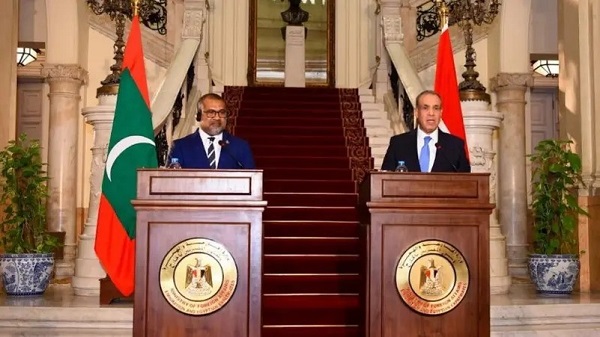
Speaking at a joint press conference in Cairo with Maldivian Foreign Minister Abdulla Shahid, Abdel Aaty said Egypt is working closely with Saudi Arabia through the established “quartet mechanism” which also includes the United States and the United Arab Emirates to push for a ceasefire in Sudan.
“There are significant Egyptian-Saudi efforts to end the war in Sudan as quickly as possible,” Abdel Aaty said, adding that Egypt fully supports the Sudanese state and military institutions. He stressed the need for a humanitarian truce to stop the violence and called for a halt to arms flowing into the country to allow political talks to begin. The minister also expressed concern about the situation in El Fasher, where fighting has intensified, urging all parties to show restraint.
Abdel Aaty emphasized Egypt’s broader interest in regional stability, stating that developments in Sudan have direct implications for Egypt’s national security.
Focus on Gaza: Urgent Aid and Reconstruction Plans
The Egyptian foreign minister also addressed the humanitarian crisis in Gaza, where thousands of civilians remain displaced amid ongoing military operations and a worsening humanitarian situation. He said an immediate priority is providing medical care and shelter, especially ahead of the winter months.
“There are around 50,000 severely injured Palestinians who need mobile medical clinics and urgent care,” Abdel Aaty said. “We also need to secure safe areas for the displaced and ensure the availability of basic services.”
He confirmed that Egypt is finalizing plans for an international conference on Gaza’s reconstruction, to be held in Cairo this November. A number of countries have already expressed interest in taking part and supporting the rebuilding process.
Abdel Aaty noted that Egypt has completed an updated assessment of damage in coordination with the Palestinian government. The first stage of reconstruction will focus on clearing rubble and unexploded ordnance to allow for the delivery of aid.
In a phone call on Friday, Abdel Aaty and Palestinian Prime Minister Mohammad Mustafa discussed the preparations for the upcoming reconstruction and recovery conference. Talks focused on expected outcomes, including financial pledges and international support.
Egypt is organizing the event under a broader Arab-Islamic initiative, previously approved by regional and international partners. Abdel Aaty expressed hope for strong participation from across the international community, adding that the conference would also align with wider efforts to launch the second phase of the Sharm El-Sheikh agreement aimed at securing a long-term political settlement after a ceasefire.
Rafah Border Remains Closed Amid Dispute
Meanwhile, the Rafah border crossing between Egypt and Gaza remains a point of contention. On Saturday, the Palestinian Embassy in Cairo announced that the crossing would reopen on Monday to allow Palestinians residing in Egypt to return to Gaza.
However, that announcement was later contradicted by Israeli authorities. The office of Prime Minister Benjamin Netanyahu said the crossing would remain closed “until further notice,” and tied any reopening to the return of the remains of Israeli hostages believed to be held by Hamas in Gaza.
“The prime minister has instructed that Rafah remain closed,” the statement said. “Its reopening will depend on Hamas meeting its obligations to return the bodies of Israeli hostages and on compliance with ceasefire terms.”
The back-and-forth highlights the political complexities surrounding humanitarian access to Gaza. While Egypt is seeking to ease restrictions and respond to urgent civilian needs, Israel insists that any movement across the border must be linked to security guarantees and the fate of hostages.
A Diplomatic Balancing Act
As both conflicts evolve, Egypt is positioning itself as a key diplomatic player. Its efforts in Sudan and Gaza reflect a broader strategy to stabilize its immediate neighborhood while maintaining relations with a range of international actors.
However, progress remains fragile. With no clear resolution in either Sudan or Gaza, Cairo’s balancing act between mediation, humanitarian support, and regional politics will face ongoing challenges in the weeks ahead.
