

Ahmed Kamel – Egypt Daily News
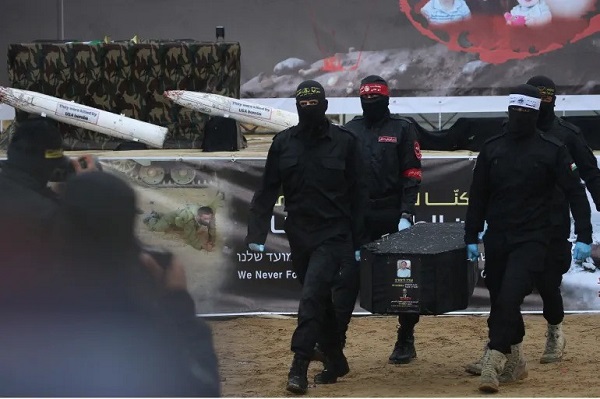
The Red Cross confirmed late Friday that it had transferred the unidentified remains of three individuals to Israel. An Israeli military official, speaking on condition of anonymity, said the remains were still under examination and may not belong to missing hostages. The remains had previously been handed over to the Red Cross by Hamas in Gaza.
The transfer comes a day after Israel returned the bodies of 30 Palestinians to Gaza authorities, marking the completion of a staggered exchange that began with militants returning the remains of two Israeli hostages. The delicate process reflects the gradual progress in implementing the tense ceasefire agreement between Israel and Hamas, despite ongoing hostilities in the region.
This week’s violence, including Israeli strikes on Gaza that killed over 100 people following the killing of an Israeli soldier, underscores the fragility of the truce. The Red Cross has acted as intermediary in both the return of Palestinian remains and the handover of Israeli hostages, highlighting the critical role of neutral organizations in maintaining temporary pauses in the conflict.
Medical teams at Nasser Hospital in Khan Younis, southern Gaza, are working to identify the returned bodies. Many were transferred in white body bags, laid out in rows, while health officials face challenges due to limited access to DNA testing. Gaza’s Health Ministry reports that 225 Palestinian bodies have now been returned by Israel, only 75 of which have been positively identified by families. It remains unclear whether those returned were killed during Israel’s response to the October 7, 2023 attack, died in Israeli custody, or were recovered from Gaza by troops during military operations.
“The bodies were torn apart and exhumed. Their flesh had melted, their faces erased by fire, leaving behind only bones and teeth,” said Munir al-Bursh, director general of Gaza’s Health Ministry. While Israeli authorities maintain that the returned bodies are combatants, families of some identified remains dispute this claim.
Meanwhile, Israel confirmed that the remains of two hostages, Sahar Baruch and Amiram Cooper, were returned by Hamas since the start of the ceasefire. Seventeen hostages have now been repatriated, with 11 still in Gaza awaiting transfer. Small gatherings of Israelis, including in Tel Aviv’s Hostages Square, have prayed for the return of the remaining hostages. “We cannot give up until everybody, all the bodies, will be here,” said Rimona Velner, a local resident.
The ceasefire’s enforcement remains a source of tension. U.S. mediators conveyed messages to Hamas requiring its fighters to vacate the so-called “yellow zone” within 24 hours or face targeted strikes. The deadline passed Thursday evening, with U.S. officials warning Israel would respond to violations. Hamas did not comment on the notice.
Despite the ceasefire, violence continues. On Friday, Mohamed Abu Selmiya, director of Shifa Hospital in Gaza, reported one death from Israeli gunfire in northern Gaza, attributed to troops responding to a perceived threat. A new UN assessment revealed that 81% of buildings in Gaza have been destroyed or damaged since early October, highlighting the immense humanitarian toll of the conflict.
Efforts toward stabilization continue on the diplomatic front. Turkish Foreign Minister Hakan Fidan confirmed that government officials from eight Arab and Muslim nations will meet in Istanbul on Monday to discuss the next steps for Gaza, following consultations with U.S. officials at the United Nations. These talks aim to advance the creation of an International Stabilization Force for Gaza, part of a broader 20-point U.S. plan.
The Israel-Hamas conflict, triggered by the October 2023 Hamas attack that killed approximately 1,200 Israelis and took 251 hostages, has led to a devastating Israeli military offensive in Gaza, which Gaza’s Health Ministry reports has killed more than 68,600 Palestinians over two years. Independent experts consider the Ministry’s records generally reliable, though Israel disputes the figures without releasing an official tally.
The conflict’s toll is also evident in the occupied West Bank, where violence has surged alongside military operations. On Friday, mourners gathered in Silwad for the funeral of 15-year-old Yamen Hamed, shot by Israeli forces, according to Palestinian health officials. Eyewitnesses reported delays in medical aid due to army checkpoints. Israeli authorities described the teen as a threat, alleging he carried an explosive, a claim not independently verified.
The West Bank has seen a significant rise in military killings of Palestinian minors since the war’s onset, including sniper fire and raids in densely populated areas. Israeli authorities describe these operations as targeting militants, but the civilian toll has exacerbated tensions and deepened the humanitarian crisis in the region.
As the ceasefire efforts continue, both Israel and Hamas face the challenge of balancing security concerns with the urgent humanitarian need to identify and return the dead, while the international community monitors every step of a conflict that remains one of the deadliest in the region’s recent history.
