

Ahmed Kamel – Egypt Daily News
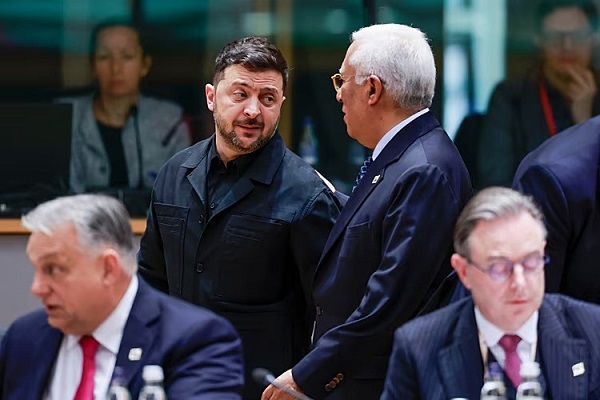
European Union leaders gathered in Brussels for a high-stakes summit aimed at securing Ukraine’s financial survival over the next two years, as President Volodymyr Zelensky warned that delays or indecision could push his country toward a severe economic crisis by early 2026. The talks unfolded against a backdrop of internal European divisions and growing uncertainty over the future role of the United States in supporting Kyiv.
At the center of the discussions is how to finance Ukraine’s military and economic needs for 2026 and 2027. Estimates by European institutions and the International Monetary Fund put those needs at around €137 billion, most of which is now expected to come from Europe after Washington froze military and financial aid and urged its allies to assume greater responsibility.
One of the most controversial proposals under debate involves the use of frozen Russian sovereign assets. Roughly €193 billion belonging to Russia is currently held by the Belgium-based financial services firm Euroclear. The European Commission argues that these assets could underpin a long-term loan of up to €90 billion for Ukraine, providing crucial funding without placing a direct burden on EU taxpayers.
However, the plan has exposed sharp fault lines within the bloc. Belgium, which hosts the frozen assets, has emerged as a key obstacle, demanding ironclad guarantees from its European partners against potential Russian legal or financial retaliation. Belgian officials are particularly concerned after Russia’s central bank filed a lawsuit against Euroclear, raising fears that Belgium could face disproportionate legal and financial risks if the assets are mobilized.
Prime Minister Bart De Wever made clear that Brussels would not move forward alone, insisting on collective responsibility. “If we jump, we jump together,” he said, reflecting concerns that Belgium could otherwise become a primary target of Russian countermeasures.
Opposition to the proposal is not limited to Belgium. Hungary and Slovakia have rejected the idea of using Russian assets altogether, while Germany and several other countries remain unconvinced by alternative plans that would rely on large-scale borrowing from international markets. European diplomats warn that bypassing Belgian objections could damage the EU’s consensus-based decision-making process and set a precedent with long-term institutional consequences.
Zelensky arrived in Brussels to press for urgency and political resolve. He urged European leaders to activate the use of Russian assets before the end of the year, warning that Ukraine would face “major problems” in the first quarter of 2026 without firm financial commitments. From Kyiv’s perspective, he argued, the moral case is clear: the funds belong to the country responsible for the destruction of Ukraine.
Addressing Belgian concerns directly, Zelensky told EU leaders that the risk of Russian lawsuits should not outweigh the real and immediate danger posed by Moscow’s military aggression. “Some may fear legal action,” he said, “but that cannot be compared to the real threat when Russia is on your borders.”
Beyond Europe, Zelensky also turned his attention to the United States, publicly calling on Washington to clarify its security commitments. He said he has yet to receive an answer to a crucial question: what the US would do if Russia launched another large-scale attack. The absence of clarity, he suggested, complicates Ukraine’s strategic planning at a moment when American support can no longer be taken for granted.
Despite the divisions, the European Commission has framed the summit as a defining test of the EU’s political will. Commission President Ursula von der Leyen described the potential use of Russian assets as a “moment of European independence” and a direct signal to Moscow that the bloc is prepared to act decisively.
Diplomats expect negotiations to continue for hours, and possibly days, as leaders seek a compromise that balances legal caution with geopolitical urgency. The stakes are high: failure to reach an agreement could weaken Europe’s political and military standing in the Ukraine war and offer Russia greater room to maneuver.
As the summit continues, Brussels faces a stark choice. Either the European Union finds a way to unite behind a bold financial strategy for Ukraine, or internal divisions risk undermining what could become the most consequential funding decision in the history of Europe’s support for Kyiv.
