

Ahmed Kamel – Egypt Daily News
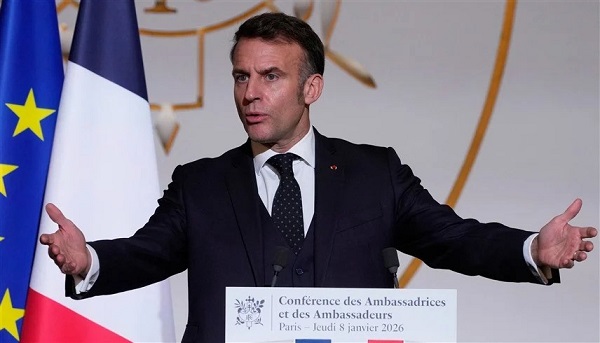
French President Emmanuel Macron on Thursday issued a sharp critique of U.S. foreign policy, warning of what he described as a growing “new colonial aggressiveness” and accusing Washington of gradually abandoning allies and disregarding the international rules it once championed.
Macron made the remarks during his annual address to French ambassadors at the Élysée Palace, at a time when European powers are seeking to craft a coordinated response to recent U.S. actions in the Western Hemisphere. These include Washington’s reported detention of Venezuela’s ousted president Nicolás Maduro and former U.S. President Donald Trump’s renewed push to annex Greenland, an autonomous territory of Denmark.
“The United States remains a solid power,” Macron said, “but it is gradually abandoning some of its allies and ignoring international rules that it was still promoting until quite recently.” He added that the performance of multilateral institutions is steadily declining, warning that the world is entering an era dominated by major powers eager to divide global influence among themselves.
Macron rejected what he termed both “new colonialism” and “new imperialism,” while also cautioning against passivity or defeatism in the face of shifting global dynamics. “We reject new colonialism and new imperialism,” he said, “but we also reject dependency and defeatism.”
The French president argued that Europe’s recent trajectory has been moving in the right direction, pointing to efforts to strengthen strategic autonomy and reduce dependence on both the United States and China. He called on European countries to more assertively defend their interests, particularly in the technology sector, and to reinforce European regulatory frameworks governing digital markets.
Macron stressed the importance of protecting academic independence and praised the idea of a supervised information space where opinions can be exchanged freely without being shaped by the algorithms of a small number of powerful actors. His comments echoed longstanding European concerns about the influence of major technology companies on public debate and democratic processes.
In recent years, the European Union has adopted a robust legal framework aimed at curbing the power of big tech firms, notably through the Digital Markets Act, which focuses on competition, and the Digital Services Act, which addresses content oversight. U.S. officials have criticized these regulations, arguing that they amount to an attempt to pressure American social media platforms into censoring viewpoints that conflict with European positions.
Macron’s speech underscored growing transatlantic tensions as Europe navigates an increasingly fragmented global order. While reaffirming France’s commitment to alliances, the president made clear that Paris and its European partners intend to pursue greater autonomy and resist what he portrayed as a return to power politics reminiscent of an earlier era.
