

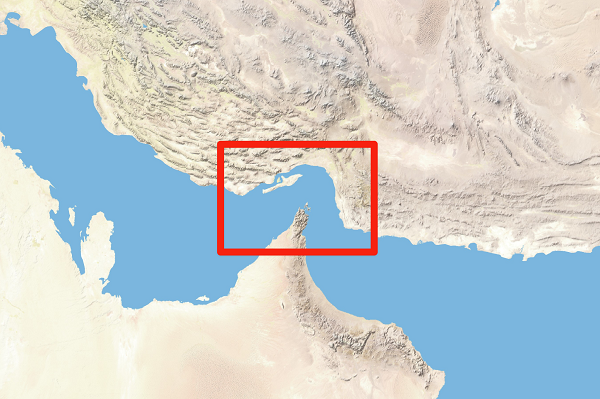
Egypt Daily News – As the Middle East edges closer to a full-scale regional confrontation, Iran’s Parliament has voiced strong support for the closure of the Strait of Hormuz in response to recent U.S. airstrikes on the country’s nuclear facilities. The highly sensitive measure which could have far-reaching global economic consequences, remains under review by Iran’s Supreme National Security Council, the body with final authority on national security decisions.
Brigadier General Esmail Kowsari, a senior member of Iran’s parliamentary National Security and Foreign Policy Committee, confirmed in a statement on Sunday that the Parliament has reached “a clear conclusion” that the closure of the strait is necessary. “The matter is now on our official agenda and will be implemented when deemed necessary,” he said, according to Iranian state media.
Strategic Chokepoint at Risk
The Strait of Hormuz, nestled between Iran to the north and the UAE and Oman to the south, serves as a crucial artery for the global energy market. Roughly 40% of the world’s seaborne oil, 20% of liquefied natural gas (LNG), and 22% of essential commodities pass through this narrow waterway that links the Persian Gulf to the Arabian Sea.
Kowsari noted that the Parliament’s recommendation does not automatically translate into action. “The final decision rests with the Supreme National Security Council,” he clarified.
Nuclear Treaty Withdrawal Also Under Consideration
In a further sign of Iran’s growing strategic recalibration, Kowsari revealed that the government is actively considering withdrawing from the Treaty on the Non-Proliferation of Nuclear Weapons (NPT), a move that would signal a dramatic shift away from previous diplomatic engagements.
“The issue is under discussion,” he said, indicating that formal deliberations are ongoing among Iran’s top decision-making bodies.
Rising Fears of Regional Conflagration
Tensions have surged since June 13, when Israel launched a series of coordinated strikes targeting Iranian nuclear facilities, missile bases, military leaders, and nuclear scientists. Tehran responded by launching ballistic missiles and drones deep into Israeli territory, in what has become the most direct military confrontation between the two regional adversaries to date.
The crisis escalated dramatically early Sunday when the United States joined the fray. President Donald Trump announced a “highly successful” attack on three of Iran’s primary nuclear facilities, Fordow, Natanz, and Isfahan, using advanced stealth bombers and 30,000-pound bunker-busting bombs.
Writing on Truth Social, Trump said U.S. aircraft “dropped a full payload of bombs” on the targeted sites before exiting Iranian airspace “safely.”
Threat of Maritime Sabotage
U.S. officials, speaking to The New York Times, warned that should Iran move to close the Strait of Hormuz, it is likely to do so by deploying naval mines or other forms of maritime sabotage. The Pentagon has already begun monitoring the region for such activity, according to defense sources.
Kowsari’s remarks reinforce those concerns. Just last week, he told Iran’s Tasnim News Agency that closing the strait was “under serious consideration,” and that Tehran would make “the best decision” in light of mounting aggression.
The World Watches
The potential closure of the Strait of Hormuz has triggered alarm among global energy markets and governments. A disruption to the vital shipping lane would not only cripple oil and gas supply chains but could also prompt a broader military response from U.S. allies in the Gulf and beyond.
For now, the decision remains in the hands of Iran’s Supreme National Security Council. But with calls for retaliation growing louder in Tehran, and military activity intensifying on multiple fronts, the threat to one of the world’s most critical maritime corridors has never been more real.
