

Ahmed Kamel – Egypt Daily News
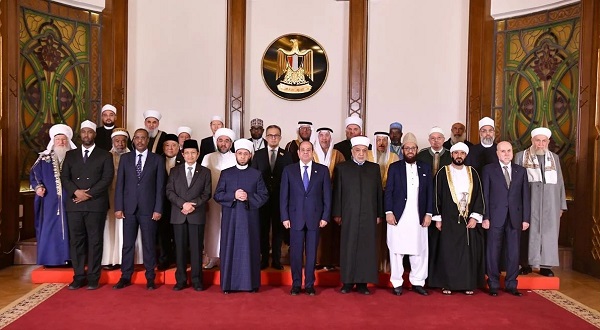
President Abdel Fattah El-Sisi has warned against the instrumentalisation of religion for purposes of extremism, violence, or political confrontation, calling for the preservation of what he described as the “authentic and balanced” nature of religious discourse. His remarks came during a meeting in Cairo with international delegations attending a major religious conference hosted by Egypt on January 19 and 20.
Speaking at the presidential palace, Al-Sisi stressed the growing need to protect religious messages from ideological manipulation, arguing that distorted interpretations of faith have been increasingly exploited by extremist groups to justify terrorism and destabilise societies. He urged religious institutions to remain vigilant and proactive in confronting such abuses, particularly in an era marked by rapid technological change and the widespread influence of digital platforms.
The meeting took place on the sidelines of a conference themed “Professions in Islam: Ethics, Impact, and Future in the Age of Artificial Intelligence,” which focuses on the moral, religious, and societal implications of technological transformation. Participants examined how emerging technologies, including artificial intelligence, are reshaping professional life and ethical frameworks within Muslim societies.
Delegations from Saudi Arabia, Malaysia, Mongolia, Kyrgyzstan, Russia, and several other countries attended the event, underlining its international scope and Egypt’s continued role as a convening centre for religious and intellectual dialogue. Discussions highlighted the importance of promoting moderate religious thought and reinforcing a genuine understanding of Islam that is resistant to radical interpretations.
President El-Sisi reaffirmed Egypt’s historical position in the Islamic world, pointing to the enduring influence of Al-Azhar as a leading religious and intellectual authority. For centuries, the Cairo-based institution has been regarded as a reference point for Sunni Islamic scholarship, and Egyptian officials have increasingly emphasised its role in countering extremist narratives at both regional and global levels.
The president argued that Islam is inherently capable of engaging with contemporary realities, describing it as “a living religion” able to interact constructively with developments such as artificial intelligence and the digital revolution. He framed the conference as an essential bridge between Islamic values and the challenges of the modern world, particularly as technological advances reshape communication, labour markets, and social relations.
President El-Sisi also reiterated that investment in human development remains a strategic priority for the Egyptian state. He said Egypt’s goal is to cultivate a conscious and enlightened generation equipped to address modern challenges without falling prey to extremist ideologies. In this context, he called on scholars and religious institutions to assume greater responsibility in the digital sphere, especially on social media platforms, which have become key battlegrounds for competing religious and political narratives.
According to the president, religious leaders must actively promote messages centred on development, national security, and social cohesion, while countering extremist rhetoric that exploits grievances or spreads misinformation. He stressed the importance of careful selection, proper training, and sustained institutional support for religious figures, alongside ensuring decent living conditions that allow them to fulfil their roles effectively.
President El-Sisi also highlighted the need for mosques to function as integrated institutions serving religious, educational, and social purposes. He argued that beyond worship, mosques should contribute to strengthening community bonds, promoting ethical values, and supporting social stability.
The conference and the president’s remarks reflect Egypt’s broader effort to position itself at the forefront of debates on religious renewal, moderation, and the ethical dimensions of technological change. As extremist groups continue to adapt their messaging to digital environments, Egyptian officials and religious leaders appear increasingly focused on reclaiming religious discourse and aligning it with the demands of a rapidly evolving world.
