

Ahmed Kamel – Egypt Daily News
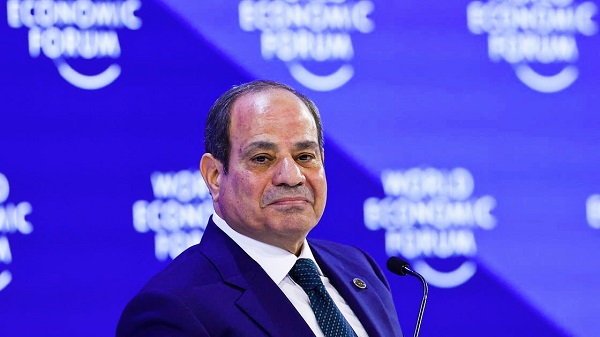
President Abdel Fattah El-Sisi used his participation in the World Economic Forum’s 2026 annual meeting in Davos to project Egypt as both a pillar of regional stability and an increasingly attractive destination for global investment, holding a series of high-level meetings and taking part in a special dialogue session dedicated to Egypt’s economic prospects and regional role.
On the sidelines of the forum, President El-Sisi met with Børge Brende, President and CEO of the World Economic Forum, where both sides emphasized the depth of cooperation between Egypt and the WEF and the importance of sustained international dialogue at a time of accelerating global change. According to Presidential Spokesman Ambassador Mohamed El-Shennawy, President El-Sisi praised the forum’s role as a premier global platform that brings together heads of state, policymakers, and business leaders to coordinate responses to shared economic, political, and security challenges.
The Egyptian president commended the forum’s 2026 agenda for focusing on urgent global issues that underscore the growing need for multilateral cooperation, particularly in an era marked by geopolitical fragmentation, economic uncertainty, and rapid technological transformation. He stressed that such cooperation is essential to ensuring that global transformations translate into prosperity that benefits all societies, not only advanced economies.
For his part, Brende welcomed President El-Sisi’s participation and highlighted the WEF’s decision to dedicate an Egypt-focused dialogue session during this year’s meeting. The session, held under President El-Sisi’s patronage, was designed to showcase Egypt’s economic reform agenda and investment opportunities, while also providing a platform for Cairo to outline its vision for restoring stability in the Middle East. Brende praised Egypt’s efforts, and President El-Sisi’s personal role, in supporting regional stability amid ongoing conflicts and humanitarian crises.
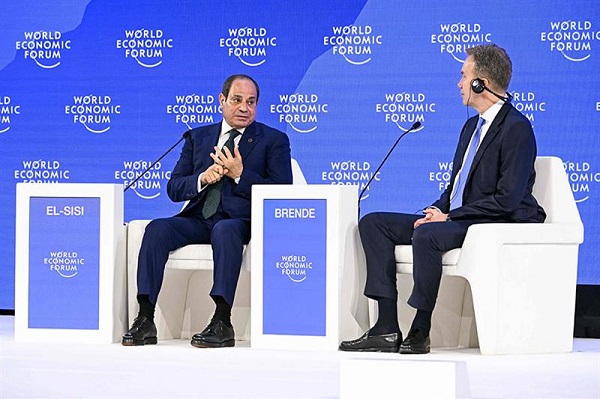
The special dialogue session brought together a number of heads of state and senior international officials, including Libyan Presidential Council Chairman Mohammad Al-Manfi and Lebanese Prime Minister Nawaf Salam. Opening the discussion, Brende noted the long-standing partnership between Egypt and the World Economic Forum, describing Egypt as a key regional actor whose economic and political choices carry broader implications for the Middle East and emerging markets more generally.
In his remarks, President El-Sisi addressed the escalating geopolitical tensions in the region, arguing that sustainable stability can only be achieved through peaceful solutions and the avoidance of further escalation. He emphasized that restoring security in the Middle East requires genuine support for the nation-state, respect for sovereignty and territorial integrity, and the strengthening of state institutions so they can effectively serve their societies.
President El-Sisi placed particular emphasis on the Palestinian issue, describing it as the central pillar for achieving a just and lasting peace in the region. He called for a comprehensive and equitable resolution based on international legitimacy, warning that the absence of such a settlement would continue to fuel cycles of violence and instability.
Beyond the regional context, President El-Sisi urged world leaders to uphold the international order established after World War II, portraying it as a cornerstone of global stability and sustainable development. While acknowledging the system’s shortcomings, he argued that preserving and reforming this framework is preferable to allowing it to erode amid rising unilateralism and power politics.
Economically, the Egyptian president used the Davos platform to highlight the progress of Egypt’s economic reform program, describing it as a key driver of improved macroeconomic indicators and enhanced resilience in the face of successive global and regional shocks. He noted that balanced fiscal and monetary policies, combined with expanded social protection programs, have helped mitigate the impact of inflation and external pressures on Egyptian citizens.
President El-Sisi also outlined ongoing efforts to boost competitiveness and improve the business climate, including expanding the role of the private sector, modernizing investment and tax legislation, and accelerating digital transformation. He pointed to major investments in infrastructure, ranging from transport networks and ports to economic zones and new cities, as well as a growing emphasis on green public investment and renewable energy.
Brende, in turn, expressed optimism about the Egyptian market, citing what he described as significant opportunities across multiple sectors. He said the WEF looks forward to deepening coordination with the Egyptian government to support economic development, increase growth rates, and attract further foreign direct investment.
In addition to his engagements with WEF leadership, President El-Sisi is scheduled to meet U.S. President Donald Trump on the margins of the forum. The talks are expected to cover regional and international developments and ways to strengthen Egyptian-American cooperation in support of regional and global stability, reflecting Cairo’s continued emphasis on strategic partnerships as part of its broader foreign policy.
The 2026 World Economic Forum meeting is being held under the theme “The Spirit of Dialogue,” signaling a renewed focus on diplomacy and consensus-building at a time of heightened geopolitical tensions and economic fragmentation. The agenda centers on restoring global growth, managing geopolitical divisions, advancing climate action and the energy transition, and governing rapid technological change, particularly in artificial intelligence and digitalization.
With dedicated sessions on the Middle East, debt sustainability in emerging markets, supply-chain resilience, and humanitarian challenges, Davos 2026 has underscored the interconnected nature of today’s crises. For Egypt, the forum has served not only as a venue for debate, but as a platform for economic diplomacy, investment outreach, and the articulation of a vision that links domestic reform to regional stability and a more balanced global economic order.
President El-Sisi’s Speech at a Special Dialogue Session at the World Economic Forum
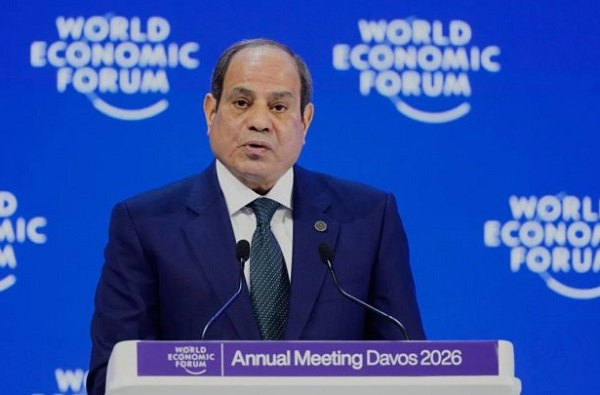
“In the Name of Allah, the Most Gracious, the Most Merciful”
Mr. Børge Brende
President and CEO of the World Economic Forum
Ladies and gentlemen,
It gives me great pleasure, at the outset of my speech, to extend my deepest gratitude and appreciation to Mr. Børge Brende for his kind invitation to join the Annual Meeting of the World Economic Forum. This prominent platform offers us a precious opportunity to address global issues and current challenges as we work together toward our common goal of building a more prosperous and equitable future for all.
Today, our world is grappling with formidable challenges to the paths of development. We are witnessing profound transformations in the patterns of international cooperation, alongside the rising role of innovative tools based on technological progress, digital transformation and Artificial Intelligence applications. These challenges necessitate concerted efforts to join forces and strengthen joint cooperation and action, empowering us not only to keep pace with these transformations but also harness their potential for the greater good of all our peoples. Guided by this spirit of cooperation, Egypt remains committed to building solid and enduring regional and international partnerships that deliver mutual growth and drive sustainable development.
Egypt also continues to foster a conducive business environment that attracts private investment, viewing the private sector as an essential partner in our journey toward development, progress and prosperity.
However, we must acknowledge that these efforts are being tested by unprecedented challenges at both the regional and international levels. Escalating geopolitical conflicts and the defiance of the foundations of international legitimacy by some parties are undermining our drive for economic growth, weakening efforts to maintain international peace and security and limiting opportunities for joint action among the nations.
For these reasons, Egypt maintains that the sole path to securing sustainable peace, stability and development requires the following:
First: Adherence to dialogue and intentional cooperation, upholding the values of mutual respect and peaceful coexistence, and respecting international law and the United Nations Charter.
Second: Commitment to settling disputes through peaceful means, avoiding escalation, and creating an environment conducive to reaching sustainable solutions for various crises.
Third: Striving to foster integration and inclusion among nations, while prioritizing the eradication of poverty and hunger and achieving shared prosperity for all peoples of the world.
Fourth: Strengthening the role of national, regional, and international business institutions, and empowering the private sector to play a pivotal role in efforts to achieve comprehensive development.
Ladies and gentlemen,
The Palestinian cause remains at the forefront of priorities in the Middle East. It is the heart of regional stability and a fundamental fulcrum for achieving a just and comprehensive peace.
In this regard, I would like to express my appreciation for the efforts of U.S. President Donald Trump. We value his commitment to ending the war in the Gaza Strip and his endeavors to alleviate the human suffering that has weighed so heavily on our brotherly Palestinian people for more than two years.
The convening of the ‘Sharm El-Sheikh Peace Summit’ on October 13, 2025, was the crowning achievement of Egypt’s tireless efforts, in coordination with its partners, to secure a ceasefire, solidify the foundations of peace, and open up new prospects that hold hope for regional stability. It further aimed to launch a meaningful political trajectory for a just and comprehensive settlement of the Palestinian cause, one that secures the legitimate rights of the Palestinian people and enhances opportunities for security and development throughout the entire region.
From this perspective, I underscore the vital necessity of building upon the gains of the Sharm El-Sheikh Summit, stabilizing the ceasefire, and ensuring the unfettered flow of humanitarian aid into the Gaza Strip, while moving urgently to launch the early recovery and reconstruction process across all areas of the Strip.
Furthermore, I welcome the U.S. announcement regarding the commencement of the second phase of the agreement to end the war, viewing it as a crucial step toward implementing the peace plan and de-escalating tensions in the region, thereby reinforcing stability and opening new horizons for international cooperation.
I wish to reaffirm that Egypt, guided by its deep-rooted historical role in supporting the Palestinian cause, will spare no effort in continuing its engagement with all concerned parties. We remain dedicated to a just, comprehensive, and enduring solution to this issue based on the two-state solution and the resolutions of international legitimacy, envisaging the establishment of an independent Palestinian State along the June 4, 1967 borders, with East Jerusalem as its capital.
Ladies and gentlemen,
Despite the many regional and global crises, we face, Egypt has remained steadfast in its ambitious economic reform program. This has been achieved through an integrated package of measures aimed at stabilizing the state’s fiscal and monetary policies, restoring investor confidence in the Egyptian market, and developing the legislative environment governing investment, in addition to offering attractive incentives for investors.
Central to our strategy was the empowerment of the private sector, an indispensable primary partner in achieving economic growth and development. To ensure this, the state has placed a cap on government investments and launched a well-studied plan for state divestment from certain public investments, thereby creating space for the private sector to expand its contribution to economic activity.
These efforts have resulted in a remarkable improvement in economic performance indicators, rising growth rates, and a significant increase in private investment inflows. This progress has earned the acclaim of international financial institutions, most notably the International Monetary Fund (IMF), and has led global credit rating agencies to upgrade Egypt’s credit rating.
I emphasize that Egypt will continue its path of economic reform and advance its developmental trajectory. We remain committed to implementing the ‘State Ownership Policy Document,’ which defines the general framework for the operation of government and state-owned enterprises, and executing the government’s IPO program and divestment plan. These measures aim to bolster private sector participation and double its contribution to driving economic growth.
Ladies and gentlemen,
Today, The Egyptian market is a landscape of investment opportunities across various sectors. The state is committed to providing the facilitations and incentives businesses need to thrive, particularly in the fields of new and renewable energy and the automotive industry, including electric vehicles, as well as the pharmaceutical and logistics industries, and the telecommunications and information technology sectors, with a special focus on Artificial Intelligence applications.
I invite you to seize these opportunities and leverage the world-class infrastructure that Egypt has completed over the past years in the areas of roads, telecommunications, transport, logistics, and free zones, most notably the Suez Canal Economic Zone, which represents a premier strategic platform for global trade and investment.
I want to reaffirm that for the investor who chooses to operate in Egypt, the gains are not limited to the promising domestic market alone; rather, a broader horizon opens up through the network of free trade agreements Egypt has concluded, both within the African and Arab frameworks. This grants access to massive, established markets, multiplying the opportunities for growth and regional and international expansion.
Ladies and gentlemen,
In conclusion, let me reiterate Egypt’s unwavering commitment. Egypt will continue its leading, active role in consolidating the pillars of security and stability at both the regional and international levels, while remaining steadfast in its pursuit of sustainable development and economic growth.
Moreover, Egypt looks forward to strengthening its cooperation with all partners as we strive toward these desired goals.
It gives me great pleasure to welcome your announcement regarding the organization of a special session dedicated to business in Egypt this year under my auspices. I look forward to further advancing coordination with you in the coming period to ensure the success of this significant event.
I seize this opportunity to wish you all a highly productive and successful forum.
Thank you
