

Ahmed Kamel – Egypt Daily News
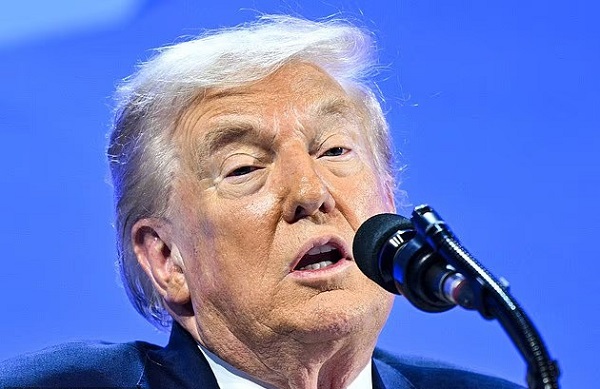
U.S. President Donald Trump on Wednesday delivered a confrontational address to European leaders at the World Economic Forum in Davos, reviving his demand for U.S. control of Greenland while declaring that Europe would be “speaking German and a little Japanese” today were it not for American intervention in the Second World War.
Speaking to a packed audience of political and business leaders, Trump framed Greenland as a vital U.S. national security interest and accused Europe of ingratitude, even as he ruled out using military force to acquire the Arctic island. His remarks deepened an already tense transatlantic standoff that has begun to spill into trade, markets, and diplomacy.
“The United States won the war,” Trump said, referring to World War II. “After the war we gave Greenland back. How stupid were we to do that? But we did it. How ungrateful are they now?” He went on to warn that the world faces unprecedented security risks due to advanced weapons systems, arguing that American control of Greenland is essential to counter threats from Russia and China.
Greenland is a self-governing territory within the Kingdom of Denmark, an EU member state. European leaders have repeatedly rejected Trump’s calls for U.S. ownership, describing them as violations of sovereignty and international law. Denmark has insisted that Greenland’s future can only be decided by its people.
Although Trump explicitly ruled out military action, his language remained sharply coercive. “We probably won’t get anything unless I decide to use excessive strength and force, where we would be, frankly, unstoppable,” he said, before adding, “But I won’t do that.” He then warned that refusal would have consequences: “You can say yes, and we will be very appreciative. Or you can say no and we will remember.”
Trump said he was seeking “full ownership” of Greenland rather than a lease or expanded defense agreement, arguing that only outright control would allow the United States to defend the territory effectively. He described Greenland as an “uninhabited, underdeveloped big beautiful piece of ice” located at a critical strategic crossroads between North America, Europe, and Asia, and suggested it could host major U.S. missile defense infrastructure, including what he called the “greatest golden dome ever built.”
The speech also reignited Trump’s long-running attacks on NATO and Europe more broadly. He claimed the alliance would not exist without his intervention during his first term, asserting that European countries had failed to meet defense spending commitments until he forced them to do so. “We give so much, and we get so little in return,” Trump said, adding that NATO had treated the United States “very unfairly.”
Trump also criticized Europe over immigration, energy policy, and economic performance, saying parts of the continent were “not even recognisable” due to what he called unchecked mass migration. “Europe is not heading in the right direction,” he said, urging European leaders to abandon what he described as a destructive culture of the past decade. “They’re destroying themselves. We want strong allies, not seriously weakened ones.”
Despite the criticism, Trump said the United States “cares greatly” about Europe, citing his own Scottish and German ancestry and emphasizing what he called shared Western civilization values. He framed his remarks as a warning rather than a rejection, saying Washington wanted Europe to “do great,” but insisted fundamental changes were needed on energy, trade, immigration, and growth.
He singled out the United Kingdom for criticism, claiming it now produces only a third of the energy it did in 1999 despite sitting atop major North Sea reserves, a situation he said had led to “catastrophically low” energy output and high prices.
Trump contrasted Europe’s trajectory with what he described as an American “economic miracle,” claiming inflation had been defeated, borders secured, and growth achieved on a scale “perhaps no country has ever seen before.” Markets, however, reacted nervously to his broader trade threats linked to Greenland, with U.S. stocks falling sharply earlier in the week before partially recovering.
The fallout was swift. The European Parliament formally suspended work on a trade agreement with the United States, with German lawmaker Bernd Lange, chair of the parliament’s trade committee, saying negotiations were halted “until further notice.” In a social media post, Lange said European sovereignty and territorial integrity were at stake and that “business as usual” was impossible.
European governments are now preparing potential countermeasures after Trump threatened to impose 10 percent tariffs on several European countries, including Denmark and the United Kingdom, from February 1, rising to 25 percent by June 1 unless they acquiesce to his Greenland proposal.
British Prime Minister Keir Starmer responded forcefully in Parliament, saying “the future of Greenland is for the people of Greenland and the Kingdom of Denmark alone” and condemning the use of tariffs to pressure allies. Chancellor Rachel Reeves echoed that stance in Davos, saying the UK would not be “buffeted around” by trade threats.
Trump also accused Denmark of failing to adequately defend Greenland, claiming it had not honored a 2019 pledge to increase military spending on the island, though he did not acknowledge Copenhagen’s recently announced $2 billion defense package that includes new ships, drones, and satellite capabilities.
At several points in his remarks, Trump mistakenly referred to Greenland as “Iceland,” a slip that drew quiet reactions among delegates but did not alter the substance of his message.
By the end of the speech, Trump had tied together Greenland, NATO, trade, and Western identity into a single narrative: that the United States has carried the burden of global security and is now prepared to use economic pressure to reshape alliances. For European leaders already alarmed by his rhetoric, the address reinforced concerns that a dispute over a remote Arctic island could become a defining flashpoint in transatlantic relations.
