

Ahmed Kamel – Egypt Daily News
Russian President Vladimir Putin on Friday underscored the growing strategic and economic importance of the Northern Sea Route, describing it as vital not only for Russia but also for international trade, as global interest in Arctic shipping continues to rise.
Speaking during a meeting with students from the Moscow Institute of Physics and Technology, Putin said Russia has been a pioneer in Arctic exploration for decades, pointing to its unmatched fleet of icebreakers as a cornerstone of that leadership. “For many decades, Russia has been a leader in developing the Arctic,” he said. “We are building giant icebreakers that have no equivalent anywhere else in the world.”
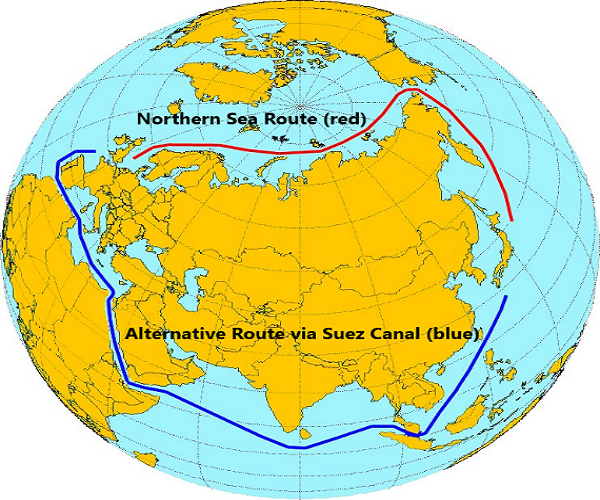
The Northern Sea Route is a major maritime corridor linking the Atlantic and Pacific oceans along Russia’s Arctic coastline, stretching from the Barents Sea across Siberia to the Far East. The route offers a significantly shorter alternative to traditional shipping lanes such as the Suez Canal, potentially cutting transit times between Europe and Asia by up to two weeks. However, navigation is currently possible without icebreaker assistance for only about two months a year, making icebreaking capacity critical to its commercial viability.
Russia operates the world’s largest icebreaker fleet, including eight nuclear-powered vessels such as Arktika and Yamal, alongside roughly 34 conventional icebreakers. These ships are capable of breaking through ice up to three meters thick, ensuring year-round or near year-round navigation in some Arctic waters.
Moscow has increasingly positioned the Northern Sea Route as a key pillar of its long-term economic strategy, particularly as climate change reduces Arctic ice coverage and geopolitical tensions reshape global trade patterns. The route is already used to transport energy resources, minerals, and bulk cargo from Siberian ports, and Russia has been encouraging foreign partners, especially from Asia to incorporate it into their logistics chains.
Plans are also underway to further expand the icebreaker fleet with new nuclear-powered vessels, including Chukotka, Leningrad, and Stalingrad. Russian officials argue that these additions will strengthen the country’s logistical resilience, enhance its control over Arctic shipping, and solidify its strategic influence in the region.
While proponents see the Northern Sea Route as a future backbone of global commerce, critics raise concerns about environmental risks, high operating costs, and the geopolitical implications of Russia’s dominance over Arctic infrastructure. Nevertheless, Putin’s remarks reflect Moscow’s determination to push forward with Arctic development, positioning the route as both an economic opportunity and a strategic asset in an increasingly competitive polar region.
The Northern Sea Route (NSR) is approximately 30% to 40% shorter than the Suez Canal route between Northern Europe and China. The route reduces the journey by about 10–15 days, covering roughly 12,800–13,000 km compared to the 21,000 km, or 12,500 nautical miles, required for the Suez path.
