

Ahmed Kamel – Egypt Daily News
A large-scale Russian missile and drone attack struck Kyiv and other Ukrainian cities on Saturday, killing at least one person, injuring dozens, and knocking out power to more than a million homes, as landmark peace talks between Russia and Ukraine concluded in Abu Dhabi without a major breakthrough.
Ukrainian officials said the attack, which targeted energy infrastructure and residential areas, left approximately 1.2 million properties without electricity nationwide, with temperatures in the capital hovering near minus 10 degrees Celsius. Kyiv and Kharkiv were among the cities hit. Ukraine’s Foreign Minister Andrii Sybiha described the strikes as deliberate and timed to undermine diplomatic efforts.
“Cynically, Putin ordered a brutal massive missile strike against Ukraine right while delegations are meeting in Abu Dhabi to advance the America-led peace process,” Sybiha wrote on X. “His missiles hit not only our people, but also the negotiation table.”
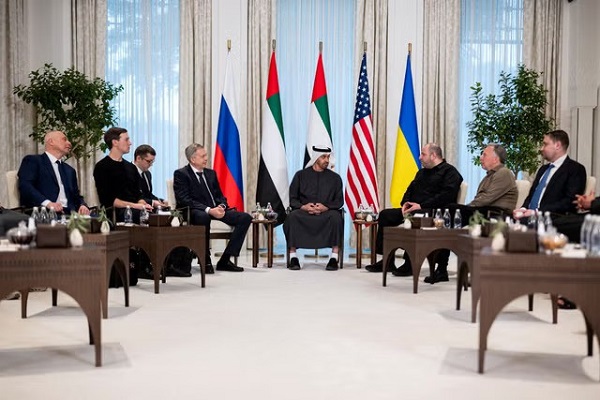
The two-day negotiations in the United Arab Emirates, mediated by the United States, marked the first direct talks between Russian and Ukrainian delegations since the war began in February 2022. Despite the lack of concrete agreements, U.S. officials portrayed the talks as a step forward, emphasizing renewed dialogue after years of diplomatic paralysis.
A senior official in the Trump administration said the discussions were “respectful” and “fluid,” noting that representatives from both sides had not engaged face-to-face in a long time. “Getting everyone together was a big step,” the official said, adding that progress had been made in clarifying the details needed for a potential settlement.
According to U.S. officials, the talks addressed de-escalation measures, confidence-building steps, and what would be required to ensure any future agreement brings a durable end to the conflict. Territorial issues, particularly the status of the Donbas region including the largely Russian-occupied Donetsk and Luhansk areas, remained the central point of contention.
The White House confirmed that a further round of trilateral talks is scheduled for next weekend in Abu Dhabi, citing a growing willingness on both sides to discuss land-related arrangements. U.S. officials also said a direct meeting between Russian President Vladimir Putin and Ukrainian President Volodymyr Zelensky could be “very close,” though no timeline was provided.
President Zelensky described the Abu Dhabi talks as “constructive” and said additional meetings could take place in the coming days. He added that military representatives from both sides had identified a list of issues for further discussion. Russia’s Foreign Ministry, meanwhile, said Moscow remains open to continued dialogue, according to state media, including possible future meetings in Istanbul.
The UAE, which hosted the talks, said discussions focused on the “outstanding elements” of the U.S.-proposed peace framework and featured direct engagement between Russian and Ukrainian officials in what it described as a constructive atmosphere.
The negotiations followed high-level diplomacy in Moscow earlier in the week, where U.S. envoy Steve Witkoff and Jared Kushner met with President Putin. Kremlin aide Yury Ushakov said Putin reaffirmed Russia’s commitment to a political and diplomatic resolution but stressed that a lasting settlement would require addressing territorial questions based on previously discussed frameworks.
Despite diplomatic momentum, Saturday’s strikes underscored the fragile reality on the ground. Ukrainian officials said the attack demonstrated Moscow’s continued reliance on military pressure even as negotiations proceed, raising doubts among Ukrainians about Russia’s intentions.
As Ukraine grapples with power outages and civilian casualties, and diplomats prepare for another round of talks, the contrast between battlefield escalation and diplomatic engagement highlights the uncertain path toward ending Europe’s deadliest conflict in decades.
