

Ahmed Kamel – Egypt Daily News
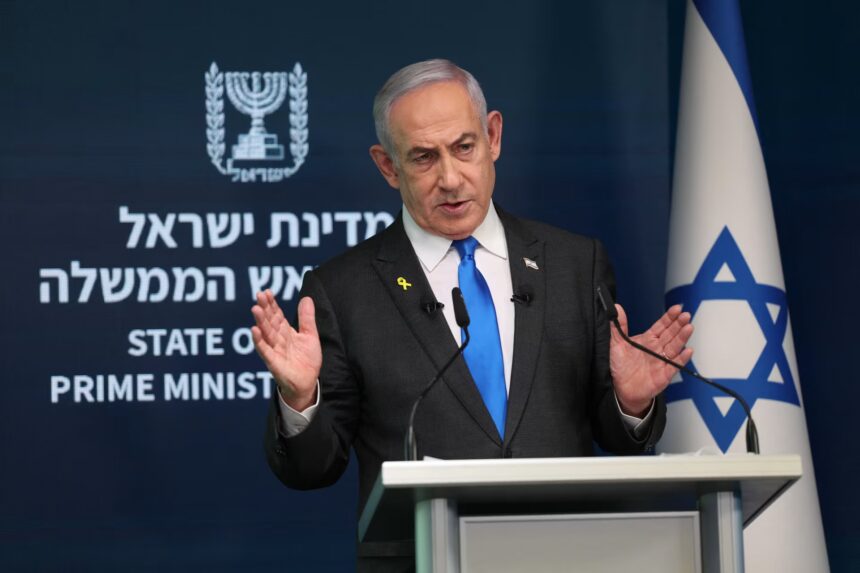
Israeli Prime Minister Benjamin Netanyahu on Saturday reaffirmed his government’s commitment to targeting Hamas leaders abroad, justifying the controversial airstrike earlier this week in the Qatari capital, Doha, which killed several members of the Palestinian movement and sparked regional and international condemnation.
Netanyahu claimed that assassinating senior Hamas figures is necessary to remove what he described as “the main obstacle” to both the release of Israeli hostages and the end of the war in Gaza.
“The Hamas leaders in Qatar have blocked every attempt at a ceasefire in order to prolong the war indefinitely,” Netanyahu wrote in a post on X (formerly Twitter). “Eliminating them would remove the primary barrier to freeing all our hostages and ending the war.”
The Israeli airstrike in Doha on Tuesday targeted a Hamas delegation engaged in indirect negotiations over a possible ceasefire and prisoner exchange, mediated by Qatar and Egypt with U.S. involvement. Although senior Hamas official Khalil al-Hayya survived, the strike killed his son, his chief of staff Jihad Labbad, and three aides. A member of Qatar’s internal security forces also died in the attack.
Qatar condemned the strike in the strongest terms, calling it “state terrorism” and warning that it reserves the right to respond. The Gulf state also reiterated its role as a mediator, emphasizing that Hamas leaders were present in Doha as part of an internationally supported framework to facilitate dialogue.
Hamas confirmed that its negotiating team narrowly escaped the assassination attempt, which it said was a deliberate effort by Israel to sabotage ceasefire talks. The group said the attack would not deter its efforts to reach a deal that includes a prisoner exchange and an end to hostilities in Gaza.
Netanyahu’s remarks came as he faced growing criticism not only from abroad but also from within Israel’s political establishment.
Yair Golan, head of the Israeli Democratic Party, accused Netanyahu of “pushing Israel into political isolation from the Western world” and undermining strategic peace agreements with Egypt and Jordan.
Opposition leader Yair Lapid went further, saying the Netanyahu government has “destroyed Israel’s international standing” and must be replaced. “This government is more concerned with its political survival than with Israel’s security or diplomacy,” Lapid said.
Critics within Israel argue that Netanyahu is intentionally prolonging the war in Gaza to serve his own political interests and appease the far-right elements of his coalition government, which oppose any ceasefire or negotiations with Hamas.
The airstrike in Qatar reflects a broader shift in Israeli military operations beyond Gaza. In recent months, Israel has expanded its regional footprint, launching airstrikes in Lebanon, Syria, and Yemen, and conducting a direct attack inside Iran in June.
Since the start of the war on October 7, 2023, Israel’s military campaign in Gaza backed by the United States, has been widely condemned as a campaign of collective punishment, with human rights groups and international legal bodies accusing Israel of committing war crimes and genocide.
According to the latest figures released by Palestinian health authorities and humanitarian groups, the war has left at least 64,803 people dead and more than 164,264 injured, the vast majority of them women and children. More than 420 Palestinians have died from hunger-related causes, including 145 children, amid a growing famine. Hundreds of thousands remain displaced.
The International Court of Justice has ordered Israel to halt its operations, but the ruling has been ignored. Netanyahu’s recent threats to strike Hamas leaders “wherever they are” suggest that Israel is prepared to escalate its campaign beyond Gaza’s borders—at the risk of inflaming tensions with key regional players and allies.
The strike on Doha has raised alarm across the Arab world, with Egypt also reportedly uncovering Israeli plots to assassinate Hamas leaders on its soil. Egyptian officials warned that any Israeli operation on their territory would be treated as an act of war.
As Israel faces mounting criticism from within and beyond, Netanyahu remains defiant—insisting that the war must continue until Hamas is eradicated, regardless of diplomatic fallout or regional destabilization.
