

Ahmed Kamel – Egypt Daily News
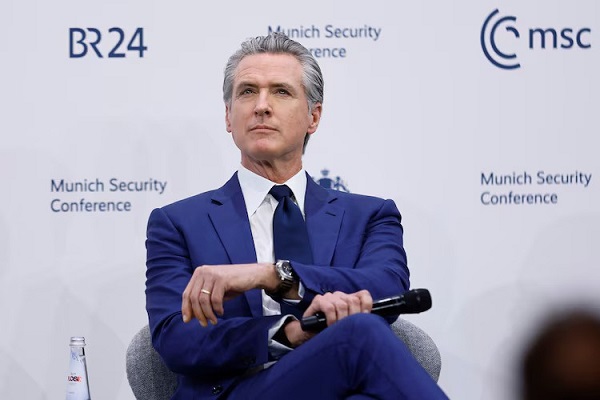
At the annual Munich Security Conference, California Governor Gavin Newsom delivered a blunt message to world leaders unsettled by Washington’s recent foreign policy shifts: “Donald Trump is temporary. He’ll be gone in three years.”
Speaking before diplomats, lawmakers and defense officials in Germany, Newsom urged allies not to view the current administration as a permanent reordering of American commitments. His remarks, focused heavily on climate policy but resonating across broader geopolitical concerns, reflected mounting anxiety in Europe about the durability of U.S. alliances under President Donald Trump.
“I hope if there is nothing else I communicate today,” Newsom said, “Donald Trump is temporary.”
The California governor, widely viewed as a potential 2028 presidential contender, encouraged European leaders to “call this guy out” and push back against what he characterized as erratic policies on climate, trade and security. Framing himself as both political adversary and institutional counterweight, Newsom described being under daily attack from the president, criticizing Trump’s rhetoric as unbecoming of the office.
A Transatlantic Crossroads
Newsom was not alone in Munich. The conference featured several U.S. political figures seen as future White House hopefuls, underscoring how deeply domestic American politics now shape transatlantic relations.
Senator Ruben Gallego signaled a contrasting vision before arriving, pledging to focus on “rebuilding alliances and restoring steady American leadership.” His remarks pointed to bipartisan concern among some lawmakers that Washington’s increasingly transactional approach risks weakening long-standing partnerships, particularly as competition with China intensifies.
The debate unfolded against the backdrop of last year’s conference, where Vice President JD Vance sharply criticized European governments, accusing them of restricting right-wing political movements and failing to curb illegal migration. Since then, Trump’s renewed tariff threats, calls for NATO allies to boost defense spending, and provocative statements about Greenland have further strained relations.
In addition, Trump’s second term has seen more assertive military deployments, including strikes on Iranian nuclear facilities and expanded operations in Latin America. Supporters frame the actions as decisive leadership; critics warn they contribute to global instability and erode confidence in U.S. predictability.
A “New Era” in Global Order
The sense that the post–World War II order is undergoing profound change was echoed by Mark Carney, who recently argued that middle powers must collaborate more closely in an era of shifting power balances. “If we’re not at the table, we’re on the menu,” he warned in a speech last month, capturing a sentiment increasingly shared across Europe and Canada.
Democratic lawmakers attending the Munich summit sought to reassure allies that strong transatlantic ties remain a core American value. Representative Alexandria Ocasio-Cortez urged democracies to embrace what she called “working class-centered politics” as a defense against authoritarianism.
She warned that a retreat from global engagement could create spheres of influence dominated by strongmen, citing concerns about Russia and broader authoritarian consolidation. At the same time, she called for Western democracies to address perceived inconsistencies in their foreign policies, arguing that “hypocrisies are vulnerabilities” that weaken democratic credibility abroad.
Her comments, which also touched on economic inequality and the need for systemic reforms such as wealth taxation, prompted questions about her own presidential ambitions, a sign that even policy panels in Munich now double as stages for future American campaigns.
Administration Defends Its Approach
Leading the U.S. delegation, Secretary of State Marco Rubio defended the administration’s strategy, describing the summit as an opportunity for “honesty” about shifting geopolitical realities.
“We live in a new era in geopolitics,” Rubio said, arguing that both the United States and its allies must reassess their roles and expectations.
For European observers, the juxtaposition was striking: American officials from opposing parties presenting competing visions of U.S. leadership on the same global stage.
Temporary or Transformational?
Whether Trump’s policies represent a temporary deviation or a lasting transformation of U.S. foreign policy remains the central question for America’s allies. Newsom’s assertion that the president is “temporary” sought to reassure partners wary of unpredictability. Yet the intensity of the debate in Munich suggested that deeper structural shifts in trade, defense burdens, and public attitudes toward globalization, may endure beyond any single administration.
As the conference concluded, one reality stood out: the future of the transatlantic alliance is now inseparable from the trajectory of American domestic politics. For Europe, Canada and other longstanding partners, preparing for either continuity or reversal in Washington has become a defining diplomatic challenge of the decade.
