

Ahmed Kamel – Egypt Daily News
Leaked documents obtained by the British newspaper The Guardian have revealed plans by the administration of U.S. President Donald Trump to construct a large-scale military base in the southern Gaza Strip, capable of housing up to 5,000 personnel as part of a proposed international peacekeeping force.
According to the documents, the installation would span more than 350 acres and serve as the central operations hub for a multinational stabilization force intended to operate in Gaza following the ongoing conflict. The force, described as temporary but potentially long-term in mandate, would reportedly be assembled from troops pledged by various countries.
The plans are attributed to an entity referred to as the “Peace Council,” an organization said to be chaired by Trump and partially led by his son-in-law Jared Kushner. The council is reportedly envisioned as the administrative authority responsible for governing Gaza during a transitional period. Its charter, approved through a United Nations framework, allegedly grants it broad executive powers, with Trump retaining permanent leadership and command authority.
A Phased Military Complex
The proposed base would be developed in stages, ultimately measuring approximately 1,400 meters by 1,100 meters. The site would include 26 armored watchtowers mounted on trailers, a live-fire shooting range, reinforced fortifications, equipment depots and a network of hardened structures equipped with advanced ventilation systems. Each fortified unit would measure roughly six by four meters with a height of 2.5 meters, designed to protect troops from artillery and aerial bombardment.
The entire perimeter would be enclosed with barbed wire and layered defensive barriers. The documents also mandate a comprehensive geophysical survey of the land prior to construction to detect underground voids, tunnels or large cavities, an apparent reference to the extensive subterranean network built by Hamas over the years.
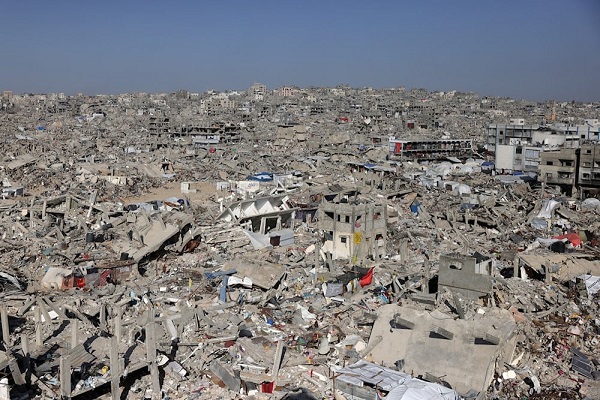
The selected site is described as a barren stretch of flat land in southern Gaza, currently marked by desert scrub and debris from prolonged Israeli bombardment. Much of southern Gaza remains under effective Israeli military control following months of fighting.
International Participation and Indonesian Offer
In a notable development, reports indicate that Indonesia has offered to contribute up to 8,000 troops to the proposed multinational force. The Indonesian president was reportedly scheduled to attend a founding meeting of the Peace Council in Washington alongside three other Southeast Asian leaders.
More than 20 countries are said to have formally joined the initiative. However, participation appears limited relative to broader international membership at the United Nations, with many states reportedly declining involvement amid legal, political and security concerns.
Mandate and Unresolved Questions
According to the documents, the Peace Council has secured authorization from the United Nations Security Council to establish a temporary international peacekeeping force tasked with securing Gaza’s borders, maintaining internal order, protecting civilians and training vetted Palestinian police forces.
Yet critical questions remain unanswered. Chief among them are the rules of engagement governing the force in the event of renewed hostilities, whether from Israeli airstrikes or militant attacks. It is also unclear whether the multinational contingent would be authorized to disarm Hamas, a key Israeli demand for approving large-scale reconstruction efforts.
Another unresolved issue concerns land ownership. The documents do not clarify who holds legal title to the territory designated for the base. Southern Gaza has been heavily depopulated during the conflict, and United Nations estimates suggest that at least 1.9 million Palestinians have been displaced since hostilities began.
Humanitarian and Legal Concerns
The plans include a specific protocol for handling human remains discovered during construction. Contractors would be required to halt work immediately, secure the area and notify authorities if suspected human remains or archaeological artifacts are uncovered. Gaza’s civil defense agency estimates that approximately 10,000 Palestinians remain buried beneath rubble across the territory.
Legal experts note that the establishment of a foreign-administered security zone in Gaza would raise complex questions under international law, particularly regarding sovereignty, occupation and long-term governance structures. Previous multinational peacekeeping missions in places such as Lebanon, Kosovo and East Timor, have operated under distinct mandates with clearly defined command arrangements, often under direct UN oversight.
Strategic Implications
If implemented, the base would represent one of the largest foreign military footprints ever established in Gaza. Analysts suggest the move could significantly alter the post-war balance of power, embedding an international security architecture in the enclave while potentially reshaping Palestinian political dynamics.
Supporters argue that an international force could stabilize the territory, prevent renewed militant control and facilitate reconstruction. Critics counter that without a comprehensive political settlement, a heavily fortified foreign base risks becoming a long-term flashpoint.
Neither the White House nor United Nations officials have publicly confirmed the full scope of the reported plans. As negotiations over Gaza’s future continue, the documents underscore the scale of strategic thinking underway and the profound uncertainties surrounding what a post-conflict order in Gaza might ultimately look like.
