

Ahmed Kamel – Egypt Daily News
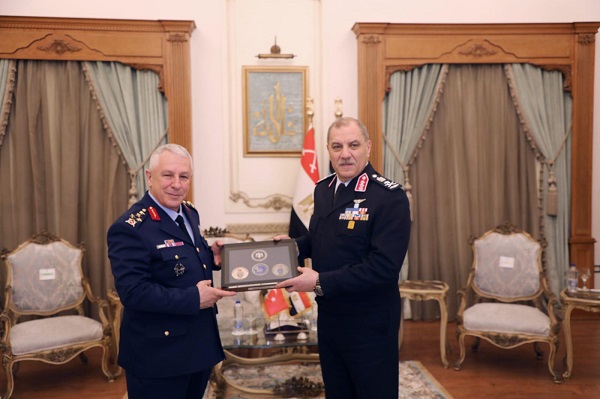
Military relations between Egypt and Turkey have entered a new phase following a high-level visit by the Commander of the Turkish Air Force, General Ziya Cemal Kadioglu, to Cairo a move widely seen as signalling a qualitative shift in bilateral ties.
General Kadioglu was received at the Egyptian Air Force headquarters by Lieutenant General Amr Saqr, Commander of the Egyptian Air Force. Discussions focused on expanding cooperation in training, armament and defence technology transfer, underscoring growing military momentum between the two former regional rivals.
The meeting follows a military framework agreement signed last month during Turkish President Recep Tayyip Erdogan’s landmark visit to Cairo, where he held talks with President Abdel Fattah el-Sisi. That accord laid the institutional groundwork for deeper defence collaboration, including defence manufacturing and the exchange of military expertise.
From Normalisation to Strategic Alignment
The latest engagement reflects a broader evolution in relations that began cautiously in 2023 after nearly a decade of estrangement. Ties between Cairo and Ankara deteriorated sharply following political upheaval in Egypt in 2013, with tensions spilling into regional flashpoints including Libya and disputes over maritime boundaries in the Eastern Mediterranean.
Gradual diplomatic re-engagement including the restoration of ambassadorial relations and reciprocal high-level visits, has since paved the way for what officials on both sides now describe as a pragmatic reset rooted in shared strategic interests.
The Turkish delegation’s tour of key Egyptian Air Force facilities, including West Cairo Air Base, was viewed as particularly significant. Observers note that access to operational units and exposure to training systems suggests a growing level of mutual confidence, extending beyond symbolic diplomacy.
Expanding Military and Industrial Cooperation
According to officials familiar with the discussions, both sides are exploring ways to intensify joint exercises, enhance operational coordination and deepen partnerships in military industries. Reports indicate potential defence deals worth approximately $350 million are under consideration, including short-range air defence systems.
Cooperation may also extend to participation in Turkish defence industry programmes, including Ankara’s fifth-generation national fighter jet project. Should such collaboration materialise, analysts say it could mark a turning point in the development of a joint defence industrial base, reducing dependence on traditional Western suppliers.
Joint exercises are also being revived, including the planned “Sea of Friendship 2025” naval drills, signalling that the rapprochement spans air, land and maritime domains.
Regional Drivers
The accelerating defence alignment comes amid rapid strategic shifts across the Middle East. Competition over energy resources and maritime corridors in the Eastern Mediterranean remains intense. Instability persists in Libya and Sudan, tensions continue in the Red Sea, and the conflict in Gaza has further reshaped regional security calculations.
For Egypt, diversifying arms suppliers and strengthening domestic defence capabilities are seen as central to preserving strategic autonomy. For Turkey, expanding defence partnerships offers an opportunity to solidify its position as a regional power and counterbalance past diplomatic isolation.
Regional Reactions and Strategic Implications
The emerging partnership is being closely monitored by other regional actors. Israel, in particular, is attentive to evolving military arrangements in its strategic environment, especially those that could influence the balance of power in the Eastern Mediterranean and Red Sea theatres.
Some analysts also suggest that expanded joint defence production could carry broader geopolitical implications, potentially signalling a gradual shift away from heavy reliance on Western arms suppliers.
Officials in both Cairo and Ankara have emphasised that their cooperation is not aimed at forming antagonistic blocs but at reinforcing regional stability. They frame the partnership as centred on counter-terrorism, maritime security and safeguarding critical trade routes.
Challenges Ahead
Despite its current momentum, the durability of the rapprochement will depend on both countries’ ability to manage lingering divergences on sensitive regional issues. Libya, maritime demarcation disputes and differing tactical approaches to certain non-state actors remain potential friction points.
Translating framework agreements into sustainable, operational programmes will require sustained political will and bureaucratic coordination on both sides.
Nevertheless, the visit of Turkey’s air force chief to Cairo marks a symbolic and substantive step forward. After years of rivalry, Egypt and Turkey appear to be opening a new chapter, one defined by an emerging defence partnership shaped by shared interests in an increasingly volatile regional landscape.
