

Ahmed Kamel – Egypt Daily News
Taba, the small Egyptian resort town on the northern tip of the Sinai Peninsula, has rapidly transformed into a major transit hub for Israelis and foreign nationals seeking to leave Israel after the country closed its airspace amid the ongoing war with Iran.
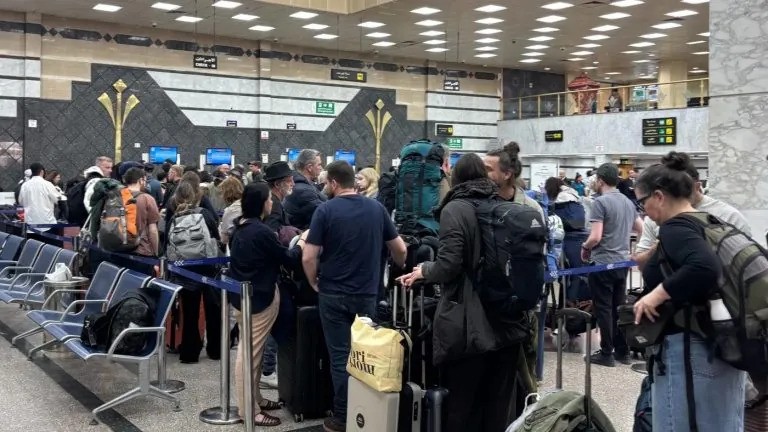
Long lines now form daily at the Taba border crossing between Egypt and Israel as hundreds of travelers attempt to cross in both directions. Many are entering Egypt to catch flights from Taba International Airport to Europe and other destinations, while others are arriving by air in Taba before continuing into Israel by bus.
The surge in traffic began shortly after Israel and the United States launched their first strikes against Iran on 28 February, triggering escalating regional tensions and leading Israeli authorities to shut down the country’s civilian airspace.
Since then, thousands of travelers have streamed across the Sinai border crossing, turning the normally quiet Red Sea town into one of the region’s busiest evacuation corridors.
Taba International Airport, located just a short drive from the Israel–Egypt border near Eilat, has been fully reopened to handle the influx of passengers. Although the airport was expanded for international service in 2020, it had seen limited commercial traffic in recent years and rarely handled large-scale charter operations.
According to an Egyptian government official speaking on condition of anonymity, the airport was reopened within two days of the first Israeli strikes on Iran in order to accommodate emergency travel demand. Flights are being sold directly by participating airlines as governments and carriers scramble to evacuate citizens and reroute flights across the region.
Airlines quickly moved to establish new routes through the airport after Israeli airspace closed. On 1 March, one day after the shutdown, the Israeli airline Arkia announced flights between Taba and Athens. Another Israeli carrier, Israir, later confirmed it would operate flights connecting Taba with six European cities.
Additional routes have been introduced by Greek and Cypriot airlines, while Israel’s flagship carrier El Al reportedly examined the possibility of diverting some of its flights through Taba before ultimately deciding against the move due to security concerns.
The flights form part of Israel’s emergency repatriation effort known as the “Lion’s Wings” program, launched after the start of Operation Roaring Lion, Israel’s military offensive against Iran.
Airport workers say the demand for seats remains overwhelming.
“All of the flights coming in and out of Taba are full,” said one airport employee involved in ground operations, adding that the airport is now handling up to 15 departures a day — a level of activity rarely seen since its modernization.
Both Israeli and American authorities have encouraged citizens to use the route. The United States ambassador to Israel, Mike Huckabee, posted a video message on the social media platform X directing travelers toward organized bus services transporting passengers from major Israeli cities to the Taba border crossing.
Israel’s National Security Council has also issued security guidance to citizens traveling through the Sinai Peninsula, advising them to move directly from the border crossing to the airport and avoid displaying items that might identify them as Israeli or Jewish.
At the border crossing itself, hundreds of travelers queue daily, many carrying suitcases as they wait to enter Egypt or return to Israel after arriving on flights.
“The border crossing was surprisingly easy,” said a Canadian woman in her early fifties who had been visiting Jerusalem when Israel closed its airspace. “There were consular officials from the US and Canadian embassies, and from several other countries.”
Once inside Egypt, travelers must arrange transportation along the desert highway connecting the border crossing with Taba’s airport. Passengers arriving by plane, meanwhile, are typically greeted with bottled water and snacks before boarding organized coaches that take them directly to the crossing.
The sudden surge in travelers has also brought a temporary economic boom to the area. Workers from across Egypt have traveled to Sinai hoping to find employment in a travel sector suddenly energized by the regional crisis.
“I came from Cairo to work here this week,” said a driver waiting outside a hotel near the border crossing. “I knew there would be many people leaving, and that I could make good money driving them.”
Hotels in Taba, which have struggled in recent years as tourism declined across parts of Sinai due to regional instability, are now operating near full capacity.
An employee at one international hotel chain said occupancy levels had not been this high “in a very long time,” noting that room prices had risen sharply due to the surge in demand.
For many travelers, the journey through Taba represents an urgent attempt to escape a rapidly escalating conflict.
“When the missiles started hitting Tel Aviv, I knew we had to leave,” said a young mother traveling to Europe with her partner and children.
Precise figures on how many Israelis are leaving through Taba remain unclear. One Canadian national who frequently divides his time between New York and Tel Aviv estimated that roughly 60 percent of those crossing into Egypt were foreign nationals, while the remaining travelers were Israelis.
For residents of Sinai, the current wave of cross-border movement brings back memories of a similar surge in travel during a previous regional escalation involving Iran last year, when hotels in Taba were also filled with travelers waiting for flights, many of which departed from the larger airport in Sharm el-Sheikh.
This time, however, Taba itself has become the focal point of the evacuation route.
For those working in the town, the sudden activity has brought both opportunity and unease.
“I am definitely benefiting financially from all the travelers in Taba,” said one local taxi driver. “But God willing, the violence will end soon. All of it.”
