

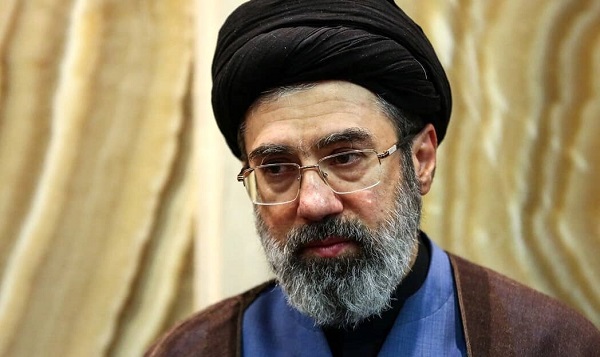
Ahmed Kamel – Egypt Daily News
Mojtaba Khamenei, the newly installed supreme leader of Iran, has warned that Tehran will continue targeting American military bases across the Middle East and called for the continued closure of the strategic Strait of Hormuz, escalating tensions as the regional conflict intensifies.
In his first public remarks since assuming the leadership of the Islamic Republic earlier this week, Khamenei said Iran considers the presence of US forces in the region a direct threat to the sovereignty of neighboring states. Speaking in a televised address carried by Iranian state media and cited by international outlets including CNBC and Reuters, he insisted that Iranian strikes would focus specifically on American military facilities rather than regional governments.
“Iran does not seek confrontation with the nations of the region,” Khamenei said. “But we are compelled to continue targeting the American bases located there.”
The statement comes amid a dramatic escalation in hostilities following a wave of US-Israeli strikes on Iranian military and strategic infrastructure that began in late February. The attacks culminated in the killing of Iran’s longtime leader Ali Khamenei, who died in an airstrike on February 28 targeting a compound in Tehran. Several members of his family were also reported killed in the strike, while Mojtaba Khamenei himself was wounded.
Khamenei, 56, formally assumed the role of supreme leader on March 9 after Iran’s clerical establishment selected him as his father’s successor. Long viewed as a powerful but largely behind-the-scenes figure within Iran’s political and security establishment, analysts say his elevation signals a more hardline posture in Tehran’s confrontation with the United States and Israel.
In his address, Khamenei also urged governments across the Middle East to shut down American military installations on their territory, arguing that such bases serve Washington’s geopolitical interests rather than regional stability.
“These bases exist to control the countries of the region and influence their policies,” he said, adding that Iran would continue confronting what he described as external enemies through military, political and economic means.
A central element of Iran’s strategy, he suggested, is the continued disruption of shipping through the Strait of Hormuz, one of the world’s most critical oil transit routes linking the Persian Gulf to global markets. Nearly a fifth of the world’s seaborne oil normally passes through the narrow waterway.
Oil tanker traffic through the strait has largely halted since the outbreak of hostilities, sending global energy markets into turmoil. Benchmark oil prices have surged above $100 per barrel, and Iranian officials have warned that prices could climb as high as $200 if the confrontation continues.
Khamenei said maintaining pressure through the waterway was necessary to force adversaries to reconsider their military campaign.
“The closure of the Strait of Hormuz must continue as a means of pressuring the enemy,” he declared.
The Iranian leader also vowed retaliation for the damage inflicted during the ongoing military strikes against Iran. Tehran would demand compensation from its adversaries, he said, warning that if such demands were rejected Iran would respond by destroying equivalent assets.
“We will obtain compensation from the enemy in any way,” Khamenei said. “If they refuse, we will destroy their property accordingly.”
Iran has already intensified retaliatory actions in recent days, including attacks on oil tankers in or near the Strait of Hormuz and missile strikes aimed at US military installations in the region.
Meanwhile, the United States has continued its military operations alongside Israel against Iranian targets. There are few signs that the campaign is nearing an end, as US and Israeli forces expand air and naval strikes on Iranian military infrastructure.
Donald Trump expressed skepticism about Iran’s new leader, telling Fox News that he was “disappointed” by the choice of Mojtaba Khamenei to succeed his father.
“I don’t think he will be able to live peacefully,” Trump said.
Despite the increasingly hostile rhetoric on both sides, it remains unclear whether Washington’s broader objective includes regime change in Tehran. Military analysts have cautioned that airstrikes alone are unlikely to topple Iran’s leadership, even as the conflict continues to expand across the region.
In his closing remarks, Khamenei called on Iranians to unite and mobilize in the face of what he described as foreign aggression.
“Iran will not hesitate to avenge the blood of its martyrs,” he said. “The Iranian people must stand present in all arenas to defeat the plans of our enemies.”
The remarks underscore the growing risk that the conflict could disrupt global energy supplies and draw additional countries into a widening regional war centered on the Persian Gulf.
