

Ahmed Kamel – Egypt Daily News
Germany has rejected calls by United States President Donald Trump for NATO allies to help secure the vital Strait of Hormuz, stressing that the military alliance has no role in the ongoing conflict involving Iran.
A spokesperson for the German government said the war was not connected to the alliance, responding to Washington’s calls for broader international support to guarantee freedom of navigation in the strategic waterway.
“This is not a NATO war,” the spokesperson said. “NATO has nothing to do with this conflict.”
The remarks came after Trump issued a veiled warning to allies in the North Atlantic Treaty Organization, suggesting the alliance could face “a very bad future” if member states did not contribute to efforts aimed at reopening the Strait of Hormuz.
Berlin also reiterated that it would not take part in any military or security operations in the strait. According to the government spokesperson, Germany had not considered such participation before the war began and is not considering it now.
German Foreign Minister Johann Wadephul echoed that position on Monday as he arrived in Brussels for meetings with European counterparts, saying he sees no role for NATO members in operations in the waterway.
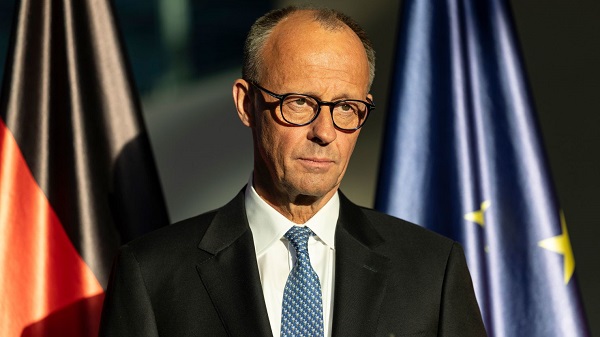
The firm stance reflects a broader caution in Europe as the conflict between Iran, the United States and Israel continues with no clear end in sight. German Chancellor Friedrich Merz has recently taken a more critical tone toward Washington’s strategy in the region, questioning the lack of clarity around U.S. plans to bring the war to a close.
Officials in Berlin have also pointed out that prior to the outbreak of hostilities, both Washington and Israel indicated that European military assistance would neither be requested nor required.
While Germany has ruled out involvement, Britain signaled that discussions are underway among Western partners about how to restore navigation through the strait.
British Prime Minister Keir Starmer said the United Kingdom is working with allies to develop a coordinated plan to reopen the critical maritime route, though he offered few details on what such an effort might involve.
“Ultimately, we must reopen the Strait of Hormuz to ensure market stability,” Starmer said during a press conference at Downing Street on Monday. “This is not a simple task. We are therefore working with our allies, including our European partners, to establish a viable collective plan that can restore freedom of navigation in the region as quickly as possible and reduce the economic damage.”
The strait, located between Iran and Oman, is one of the world’s most important energy corridors. Under normal circumstances roughly one-fifth of global oil supply passes through the narrow shipping lane, making any disruption highly consequential for global markets.
Energy prices have already experienced significant volatility since the conflict escalated and Iran effectively closed the waterway following strikes by the United States and Israel.
Western governments attempted to stabilize markets last week by releasing emergency oil reserves in what Starmer described as an “unprecedented” move. However, he warned that the measure alone would not be sufficient to calm energy markets if the maritime route remains blocked.
Reports from CNN have also raised concerns that Iran has begun laying naval mines in the Strait of Hormuz, a step that could further complicate any effort to reopen the passage and significantly increase the risks of military escalation in the region.
Although Starmer did not directly mention Trump in his remarks, the British leader’s comments followed the U.S. president’s warning that NATO allies must do more to address the crisis.
The widening war has already begun to ripple through global energy markets and international diplomacy, with European governments balancing pressure from Washington with concerns about deeper military involvement in a conflict that continues to expand across the Middle East.
